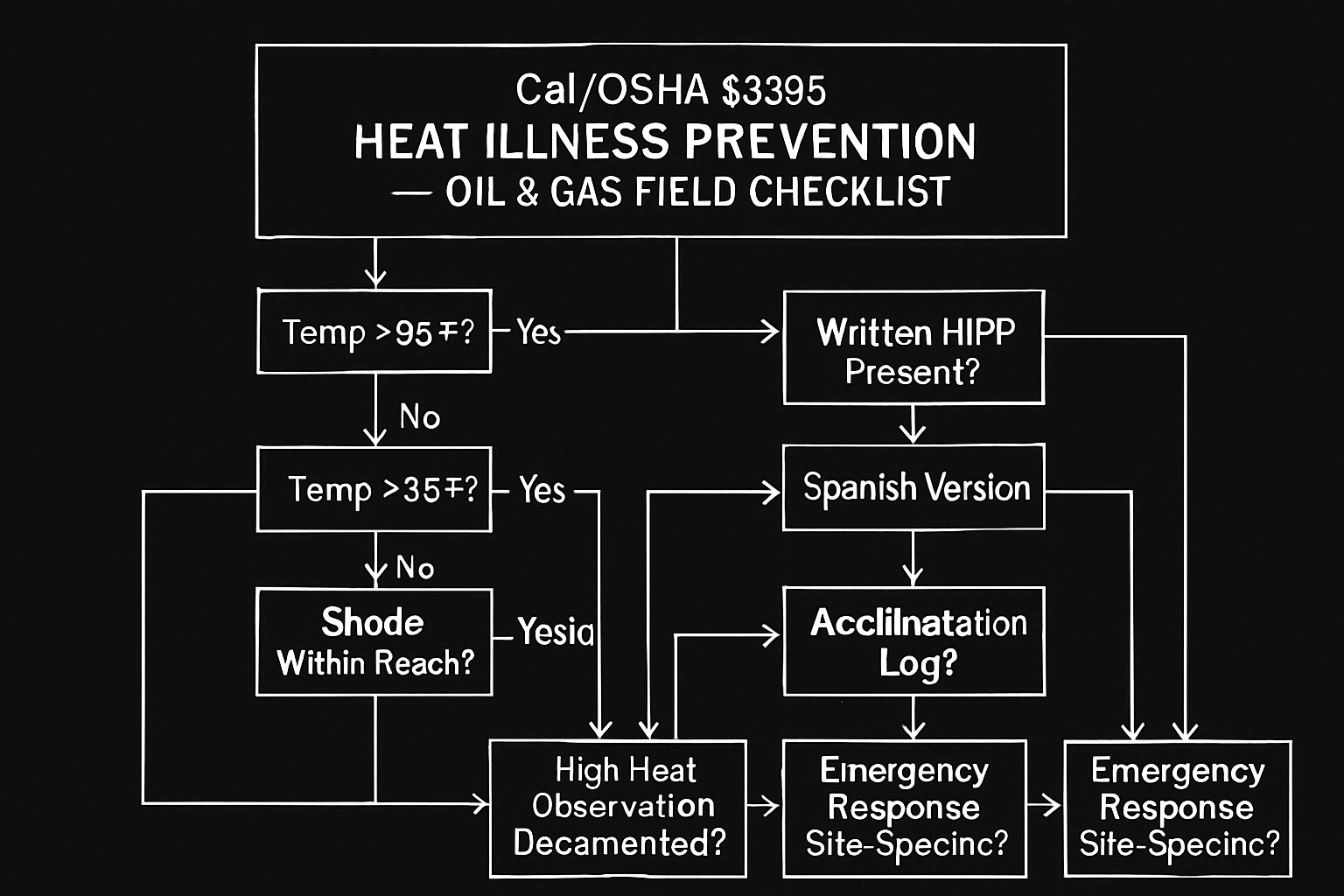
Cal/OSHA Heat Illness Prevention Under Title 8 Section 3395: Where Oil & Gas Contractors Think They're Compliant—and Where OSHA Disagrees
A drilling contractor operating in the San Joaquin Valley sets up a water cooler at the rig floor, posts a laminated heat illness poster in the doghouse, and hands every roughneck a copy of the company safety handbook. The toolpusher checks the box. The safety coordinator files the paperwork. And when a Cal/OSHA Compliance Safety and Health Officer (CSHO) shows up following a heat-related hospitalization on a workover rig in Kern County—every single one of those "compliance" steps becomes irrelevant within the first twenty minutes of the inspection.
This is the gap. Not the gap between knowing and not knowing the regulation. The gap between what contractors believe constitutes a heat illness prevention program and what California Title 8, Section 3395 actually requires—in writing, in practice, and verifiable on the ground the day a CSHO walks onto your location.
Why Federal OSHA Is Not Enough in California Oil & Gas Operations
Federal OSHA has no specific heat illness standard. Cal/OSHA does. That distinction alone creates an enormous compliance gap for upstream oil and gas contractors who operate in multiple states and apply a single corporate safety program across all locations.
Under federal OSHA, heat illness enforcement runs through the General Duty Clause, Section 5(a)(1) of the OSH Act—a broad, after-the-fact enforcement mechanism. Cal/OSHA's Title 8 §3395 is a standalone, specific standard with prescriptive requirements covering water, shade, acclimatization, emergency response, high-heat procedures, and a written prevention plan. These are not suggestions. Each element is independently citable.
For upstream operations—rotary drilling rigs, well servicing units, pipeline right-of-way crews, and production facility maintenance contractors working outdoors in the Central Valley, Inland Empire, or the Antelope Valley—temperatures routinely exceed 95°F from May through October. Under §3395(e)(1), once temperatures hit 80°F, the standard is active. At 95°F, high-heat procedures under §3395(f) kick in. Most multi-state contractors don't adjust their programs at either threshold.
The Written Prevention Plan: What Must Be in It and What's Almost Always Missing
Under Title 8 §3395(d), every California employer with outdoor workers must have a written Heat Illness Prevention Plan (HIPP). The plan must be in both English and the language understood by the majority of workers—on a drilling or workover crew in Kern County, that often means Spanish. A CSHO will ask for the Spanish version within minutes. If it doesn't exist, that's a citable violation.
Beyond translation, here is where contractor HIPPs consistently fall short in upstream operations:
- Site-specific procedures, not generic policies. §3395(d)(1) requires procedures specific to the employer's worksite. A plan referencing "the worksite" without naming the rig, unit, or pipeline segment—without mapping where shade structures will be located relative to the rig floor, the pipe rack, and the cellar—does not meet the site-specific requirement. A CSHO inspecting a well servicing operation will walk the location and compare the plan's shade and water locations against what's physically present.
- Acclimatization schedule for new and returning workers. §3395(i) requires that new employees and employees returning from an absence of more than ten days be closely observed during a heat wave and during the first fourteen days of employment in hot conditions. On a drilling rig, where company hands, contractors, and day-rate employees cycle constantly, this requirement is almost universally ignored. There is no formal acclimatization tracking, no supervisor assignment, and no documentation. A derrickhand who started on day shift three days ago during a heat advisory has the same daily schedule as the driller with fifteen years on the rig. That's a §3395(i) violation.
- High-heat procedures specific to job tasks. §3395(f) requires that when temperatures reach 95°F, employers implement specific high-heat procedures including mandatory ten-minute rest periods every two hours, pre-shift meetings to review procedures, and observation of employees for signs of heat illness. For a wireline crew or a swabbing crew working a pumping well, the HIPP must identify who conducts observation, at what intervals, and how communication is maintained when crew members are working at a distance from each other. "Employees will take breaks as needed" is not a high-heat procedure. A CSHO will cite the absence of documented pre-shift high-heat meetings as a failure under §3395(f)(1).
- Emergency response procedures that account for remote locations. §3395(g) requires a written emergency response plan. For pipeline maintenance crews working right-of-way in areas with no cell coverage—common in Kern, Kings, and San Luis Obispo Counties—the plan must address how emergency services will be contacted and how the injured worker will be transported to a medical facility. "Call 911" is not a compliant emergency response procedure when cell service doesn't exist at the location. Satellite communicators, designated emergency contact protocols, and pre-identified GPS coordinates for helicopter landing zones are the kinds of specifics that distinguish a real plan from a paper exercise.
Water and Shade: The Details Contractors Get Wrong at the Location Level
Under §3395(b)(1), water must be fresh, pure, suitably cool, and provided at no cost to employees—at least one quart per employee per hour. On a drilling rig in August in Bakersfield, that means a ten-person floor crew needs a minimum of ten quarts per hour available and accessible, not stored in a cooler inside the company man's trailer 300 feet from the rig floor.
Shade under §3395(c)(1) must be present when temperatures exceed 80°F and must accommodate the number of employees on rest at any given time. On a workover rig where five crew members might take a break simultaneously, a single beach umbrella near the doghouse does not provide "shade sufficient to accommodate" those employees. The shade must be available within close proximity to the work area. If the only shade is the inside of a company truck parked on the opposite side of the location from where the pipe tong operators are working, that's citable.
Contractors frequently confuse "shade is available on the location" with "shade is accessible during rest periods." These are different things. A CSHO will time the walk from the work area to the shade structure. If it takes four minutes to reach shade, that rest period is being consumed by travel time, not recovery.
The Counterintuitive Finding That Catches Experienced Safety Managers Off Guard
Most toolpushers and HSE supervisors assume that if no worker has complained about heat and no incident has occurred, their heat illness program is working. Cal/OSHA's CSHOs are trained to look for something entirely different: the absence of supervisor observation documentation during high-heat conditions.
§3395(f)(4) requires that during high-heat conditions, employers implement a procedure for observing employees for signs of heat illness. In practice, this means a designated supervisor—the driller on a rotary rig, the operator on a well service unit—must be actively monitoring crew members and that monitoring must be documentable. When a CSHO asks the driller "How do you observe your crew for heat illness signs?" and the driller answers "I watch them while they work," that answer confirms there is no structured observation procedure. No log. No checklist. No formal communication protocol between the floor crew and the rig medic or company man.
The violation isn't triggered by an illness. It's triggered by the absence of a system—and a penalty can be issued even when every employee went home healthy that day.
Penalty Exposure for Upstream Contractors Under Cal/OSHA
Cal/OSHA penalty structures mirror and in some categories exceed federal amounts. Under California Labor Code §6429, serious violations carry penalties up to $25,000 per violation—significantly higher than the federal serious violation cap of $16,131. Willful or repeat violations in California can reach $158,727 per violation. Failure to abate adds daily penalties on top of the original citation.
In a heat illness inspection triggered by a hospitalization on a well servicing unit, a CSHO may cite multiple §3395 subsections simultaneously: missing written plan elements, inadequate shade, no acclimatization documentation, no high-heat observation procedure, no emergency response specifics. Five separate citations at $25,000 each is $125,000—before any repeat or willful classification is applied. If the company had a prior citation for the same deficiency at another California location, that repeat designation escalates each violation to over $158,000.
What a CSHO Looks at First on a Drilling or Workover Location
Based on published Cal/OSHA inspection focus areas and enforcement patterns in the oil and gas sector, the first three things a CSHO typically requests during a heat illness inspection are:
- The written Heat Illness Prevention Plan—both English and Spanish versions
- Training records for all employees currently on site, including day-rate and contractor personnel
- The temperature log or documentation of how and when high-heat conditions are identified and communicated to supervisors
If a contractor cannot produce all three within the first thirty minutes of an inspection, the investigation has already taken a negative trajectory before a single interview is conducted.
Frequently Asked Questions from Oil & Gas Contractors About Cal/OSHA §3395
Our corporate HIPP was written by our corporate EHS team. Does it satisfy the site-specific requirement under §3395(d)?
Not automatically. A corporate HIPP becomes site-specific only when it includes documentation of the actual shade locations, water supply sources, emergency contact numbers, nearest medical facility, and communication methods for the specific rig or pipeline segment where work is occurring. A plan that says "shade will be provided" without specifying where and how—relative to the actual work tasks at that location—does not meet the standard. Contractors using multi-location corporate plans need a site-specific addendum for each California location.
We use a staffing agency for floor hands. Are they covered under our HIPP, or is that the agency's responsibility?
Both the host employer and the staffing agency share responsibility. Under California's multi-employer worksite doctrine and the obligations embedded in §3395 itself, the controlling employer—the drilling contractor managing the worksite—is responsible for ensuring that all workers at the location, regardless of employer of record, receive water, shade, acclimatization, training, and emergency response coverage. If the staffing agency's training is incomplete, the host contractor is still exposed to citation.
We document temperature using a weather app on a supervisor's phone. Is that sufficient for tracking high-heat conditions?
Cal/OSHA has not mandated a specific temperature measurement method, but the standard requires that employers identify when temperatures meet or exceed the 80°F and 95°F thresholds that trigger different levels of response. A weather app reflecting regional or city-wide temperature may not capture actual worksite conditions—particularly on a rig floor with radiant heat from equipment, or on a pipeline right-of-way in a confined cut through a hillside. A wet-bulb globe temperature (WBGT) measurement or a calibrated thermometer at the worksite provides a more defensible record than a smartphone weather widget.
Our company has never had a heat illness. Does that mean our program is working?
Not from a regulatory standpoint. Cal/OSHA can cite §3395 violations based on the absence of required program elements regardless of incident history. A CSHO does not need an injury to issue a citation. Programmatic deficiencies—missing Spanish plan, no acclimatization tracking, no documented high-heat observation procedure—are independently citable. The absence of reported illness may also reflect underreporting rather than absence of exposure, which is a separate concern.
Our pipeline maintenance crew moves locations daily. How do we make the HIPP site-specific when the site changes every day?
The written plan must include a protocol for how site-specific information is established and communicated at each new location before work begins. This typically takes the form of a daily pre-job tailgate or job hazard analysis that documents the day's temperature forecast, identifies the shade location, confirms water supply, establishes emergency contact numbers for that geographic area, and designates the observation-responsible supervisor. That completed JHA or tailgate form becomes the site-specific documentation for that day. It must be retained.
Does acclimatization apply to experienced oil field workers who have worked in the heat for years?
Yes. §3395(i) applies to any employee new to a work location or returning after more than ten days of absence, regardless of overall experience. A veteran production operator returning from a two-week vacation during a heat wave has the same acclimatization requirement as a first-day laborer. The physiology of heat acclimatization resets with absence. Experience does not override the body's cardiovascular and thermoregulatory adaptation timeline.
For contractors managing ISNetworld®, Avetta®, or Veriforce prequalification, EHS Inc provides fully managed OSHA compliance support. Book a free consultation at EHS Inc.