Cal/OSHA Injury and Illness Prevention Program (IIPP) Requirements for Metalworking and Fabrication Shops — The Failure Mode Nobody Sees Coming
Most metalworking shop owners assume their IIPP gets cited because it's missing a section or was never written down. That's not what kills them. The citation that blindsides experienced safety managers in grinding, welding, and press-brake operations is this: the IIPP exists on paper, but it cannot be demonstrated as a living system. Cal/OSHA compliance safety and health officers (CSHOs) are not librarians checking whether a binder exists on the shelf. They are investigators asking whether anyone in this facility has ever actually used what's in that binder — and in metal fabrication shops, the answer is almost always no.
This guide is written for the safety coordinator at a 45-person stamping and welding shop in the Inland Empire, the EHS manager overseeing three laser-cutting cells in Hayward, and the plant manager who just got a CSHO business card handed to him at the front desk. The California standard is 8 CCR § 3203 — Cal/OSHA's IIPP regulation — and it is not identical to any federal OSHA equivalent. Federal OSHA has no IIPP mandate at all. California stands alone.
What 8 CCR § 3203 Actually Requires — and Where the Language Gets Weaponized Against You
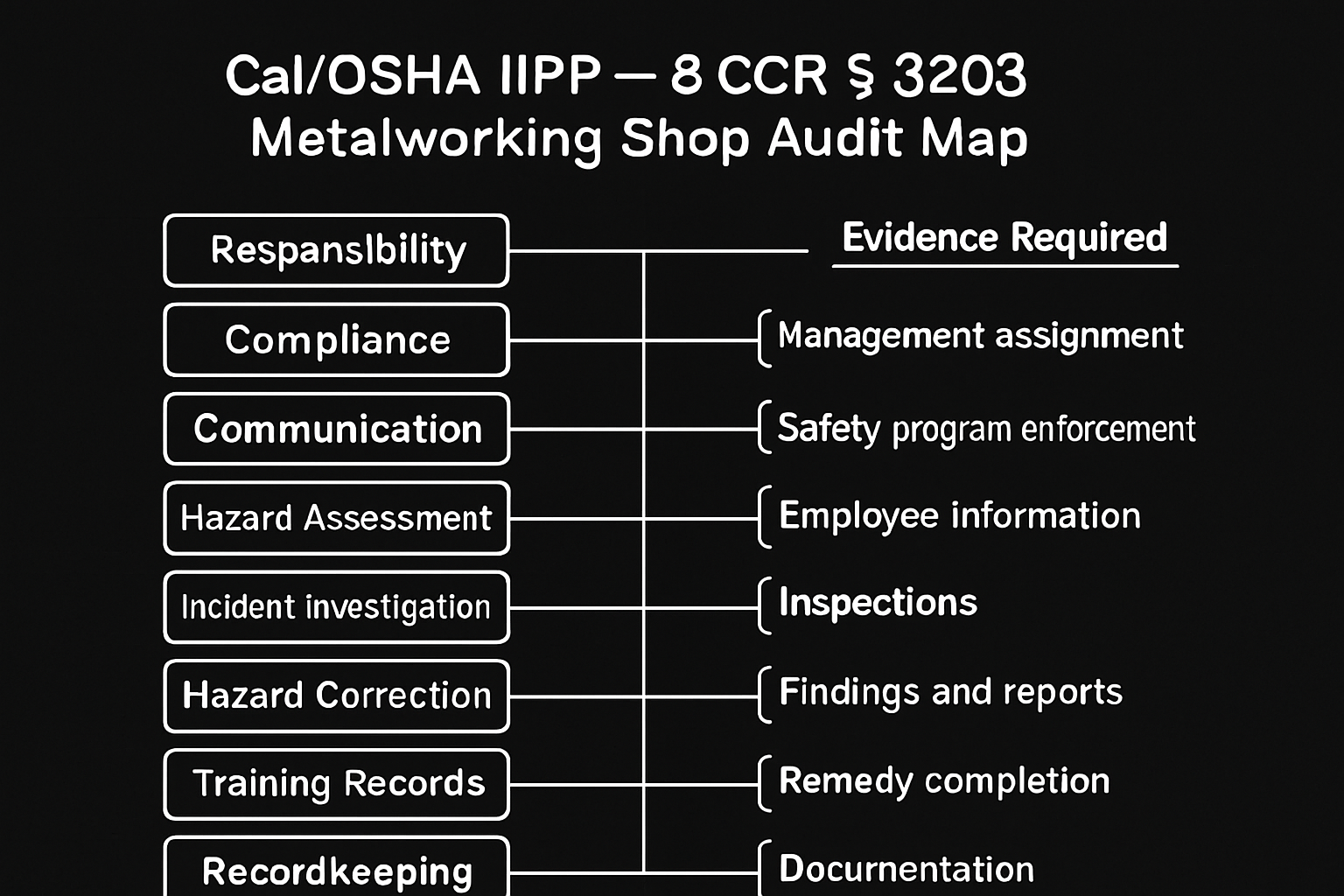
Under 8 CCR § 3203(a), every California employer must establish, implement, and maintain an effective IIPP. That word — effective — is the loaded weapon. The regulation specifies eight required elements:
- Responsibility (§ 3203(a)(1))
- Compliance (§ 3203(a)(2))
- Communication (§ 3203(a)(3))
- Hazard assessment (§ 3203(a)(4))
- Accident/exposure investigation (§ 3203(a)(5))
- Hazard correction (§ 3203(a)(6))
- Training and instruction (§ 3203(a)(7))
- Recordkeeping (§ 3203(a)(8))
Every one of these elements must be in writing for employers with ten or more employees. For employers with fewer than ten, the writing requirement is relaxed, but the implementation requirement is not. That distinction trips up small shops constantly — a six-person plasma-cutting operation still has to conduct hazard assessments; it just doesn't have to hand a written document to a CSHO. It still has to prove it happened.
The Failure Mode That Actually Gets Metal Fabrication Shops Cited
Here is the counterintuitive insight that surprises even experienced safety managers: Most EHS coordinators in metalworking assume OSHA scrutinizes the written IIPP document itself — but CSHOs in fabrication shop inspections are actually interrogating the hazard assessment records and training logs, not the IIPP binder.
The script plays out like this. A CSHO walks into a structural steel fabrication shop after a MIRC (minor injury requiring care) report triggers an inspection. She asks for the IIPP. The safety coordinator produces a clean 22-page document — professional formatting, every section present, signed by the owner. She reads it for four minutes, sets it down, and then asks for the last six months of workplace inspection records and the training documentation for the two ironworkers hired in the last 90 days.
That is where the citation lives. The IIPP says "monthly safety inspections shall be conducted of all work areas including welding stations, press-brake cells, and overhead crane paths." The records show three inspections from fourteen months ago and nothing since. The new ironworkers' onboarding paperwork has an HR checklist with a box checked that says "safety orientation completed" — but there is no record of what was covered, who delivered it, how long it took, or whether those workers demonstrated competency around the plasma table or angle grinders they operate daily.
Under 8 CCR § 3203(a)(7), training must be provided to employees when the IIPP is first established, to all new employees, to employees given new job assignments, and whenever new hazards are introduced. A press-brake operator cross-trained to run a tube laser has just received a new job assignment. The training record needs to reflect that transition — not just exist in the abstract as a promise buried in the IIPP narrative.
The penalty for a serious violation of 8 CCR § 3203 in California runs up to $16,131 per violation. A repeat violation — meaning the shop was cited for an IIPP deficiency in the prior three years — escalates to $161,323 per violation. When a CSHO finds that the written training commitment hasn't been honored for multiple new-hire ironworkers, MIG welders, or overhead crane operators, each instance can be characterized as a separate violation. Three un-documented new hires at a repeat citation level is nearly half a million dollars.
What a CSHO Notices in the First 10 Minutes at a Metalworking Shop
Before she's seen a single document, the CSHO is already building her citation narrative by observing the floor. In a welding and fabrication environment, the visible indicators she's cataloging include:
- Whether MIG and TIG welders are running hoods or whether respirators are present — and if present, whether a written respiratory protection program exists under 8 CCR § 5144 (Cal/OSHA's respiratory protection standard, which mirrors 29 CFR 1910.134 but is enforced independently)
- Whether grinding disc guards are in place on angle grinders — missing guards on Type 27 discs are a reflex citation under 8 CCR § 3578
- Whether the overhead crane operator has a visible pre-shift inspection tag or log — Cal/OSHA follows 8 CCR § 4999 for overhead hoist inspections
- Whether housekeeping around press-brake machines and shears suggests a shop where safety inspections are real or performative — metal chips packed into machine bases, oil accumulation on anti-fatigue mats, and scrap steel stacked against emergency egress paths are what a shop looks like when monthly inspections are fiction
Everything she observes before the document review becomes context for evaluating whether the IIPP's hazard assessment and correction provisions are implemented or theatrical. This is the ground-level meaning of "effective" under 8 CCR § 3203(a).
Building an IIPP That Survives a Fabrication Shop Inspection
Structural requirements aside, an IIPP that holds up in a metal fabrication environment needs to be operationally specific rather than generically compliant. That means:
Hazard Assessment (§ 3203(a)(4)) must name the equipment and processes. "Welding operations" is not sufficient. The IIPP should reference flux-core arc welding (FCAW) on galvanized steel specifically, because the hexavalent chromium and zinc oxide exposure profile is a distinct regulatory trigger under 8 CCR § 5155 (air contaminants) and 8 CCR § 5521 (control of harmful substances by ventilation). A shop where ironworkers weld coated or galvanized steel without a written acknowledgment that this generates hexavalent chromium fumes is sitting on a willful citation if anyone has ever been assigned to that task.
Accident/Exposure Investigation (§ 3203(a)(5)) must produce a written report within a defined timeframe. Cal/OSHA requires that serious injuries be reported to Cal/OSHA within 8 hours under 8 CCR § 342(a). But the IIPP's internal investigation requirement is separate — it applies to every injury, near-miss, and hazardous exposure, including the MIG welder who complains of fume headaches but doesn't go to the clinic. If that verbal complaint is never documented and investigated, and later that welder develops occupational asthma, the absence of an investigation record turns a health matter into a § 3203 citation.
Recordkeeping (§ 3203(a)(8)) must be retained for one year minimum, except for training records for hazardous substances, which must be retained for at least three years. A laser-cutting operator's training on the material safety data sheet — now called an SDS — for the cutting assist gases and fumes generated from stainless or coated alloys needs to stay in the file.
Communication (§ 3203(a)(3)) requires a system for employees to report hazards without fear of reprisal. In union shops, this is sometimes built into the collective bargaining agreement. In non-union fabrication shops with mixed-language workforces — where floor staff may include Spanish-speaking welders and Vietnamese-speaking CNC operators — the communication requirement carries a practical obligation to make the reporting mechanism accessible. An anonymous drop-box posted only in English in a shop where 60% of the floor speaks something else is not compliant in spirit and won't survive a sophisticated inspector.
Subcontractors and Temporary Staffing — The Hidden Exposure Layer
Metal fabrication shops that use staffing agencies to fill ironworker or machine operator positions face a layered liability that the IIPP must address. Under California law, both the staffing agency and the host employer share responsibility for ensuring temporary workers receive IIPP-compliant training and hazard communication. The host employer controls the physical environment, the equipment, and the hazards — which means a staffing agency's generic onboarding paperwork does not satisfy the host employer's obligation under 8 CCR § 3203(a)(7).
When a CSHO finds that a temp agency worker operating a hydraulic ironworker machine received no site-specific training from the host shop, the citation lands on both parties — and the host shop's exposure is based on the actual hazard conditions it controls, not the agency's boilerplate safety booklet.
Frequently Asked Questions — Cal/OSHA IIPP for Metal Fabrication Shops
Do we need a separate IIPP for each shift if our shop runs days and nights?
No — one IIPP covers the facility regardless of shift configuration. But the implementation has to be real on every shift. If your night-shift ironworkers haven't had a safety meeting in eight months and your hazard inspection records only ever show daytime walk-throughs, a CSHO will characterize that as a failure to implement the IIPP on the night shift, which is functionally a separate violation.
Our IIPP was written by a consultant five years ago. Is it still valid?
Only if it reflects current conditions. If you've added laser-cutting equipment, changed your welding wire from ER70S-6 to a flux-core product, or brought in a new CNC punch press since the IIPP was last revised, those changes introduced new hazards that must be reflected in the written program. An IIPP that doesn't mention equipment that's been running on your floor for three years tells a CSHO that hazard assessment under § 3203(a)(4) is not actually happening.
Can we keep training records digitally instead of in paper binders?
Yes. Cal/OSHA does not require paper records. Electronic records are acceptable as long as they are retrievable during an inspection and include the required information — employee name, date, topic covered, and trainer identity. A shared drive folder full of PDFs with no metadata or signed acknowledgments is not meaningfully different from having no records at all when a CSHO is standing at your front desk.
We had a near-miss last month where a press-brake operator's hand came close to the punch. Do we have to document that even though nobody was hurt?
Under 8 CCR § 3203(a)(5), the investigation obligation applies to "near-miss" incidents. The standard's language covers "incidents which could have resulted in serious injury or illness." A near-miss at a press-brake is exactly the scenario Cal/OSHA expects to find in an investigation file, because press brakes are a leading cause of amputations in California's manufacturing sector. Not having a written investigation for that incident — root cause, corrective action, and follow-up — is a citation waiting to be written.
How often do we have to conduct workplace safety inspections under the IIPP?
8 CCR § 3203 does not specify a frequency — it requires that inspections be conducted "periodically." Cal/OSHA guidance and enforcement history make clear that "periodically" in a high-hazard manufacturing environment means at minimum monthly. A grinding and welding shop that conducts quarterly inspections is exposed. The frequency should be written into the IIPP itself, and the records must show it was honored.
What happens if Cal/OSHA cites us and we correct the violation before the contest deadline? Does the penalty go away?
Correcting the violation is required to avoid failure-to-abate penalties, which run up to $16,131 per day under current 2024 figures. But correction does not eliminate the original citation or its penalty — it prevents additional daily penalties from accruing. Abatement documentation must be submitted to Cal/OSHA showing the violation was corrected by the deadline specified in the citation. For IIPP citations, that typically means producing updated records, revised written programs, or documented training completion.
For the full text of Cal/OSHA's IIPP standard and related regulations, see the OSHA regulations index at osha.gov and Cal/OSHA's Title 8 database at dir.ca.gov.
This guide is provided for informational purposes only and does not constitute legal advice. Regulatory citations are current as of 2024 and should be verified against the most recent versions of the applicable standards.
For contractors managing ISNetworld®, Avetta®, or Veriforce prequalification, EHS Inc provides fully managed OSHA compliance support. Book a free consultation at EHS Inc.