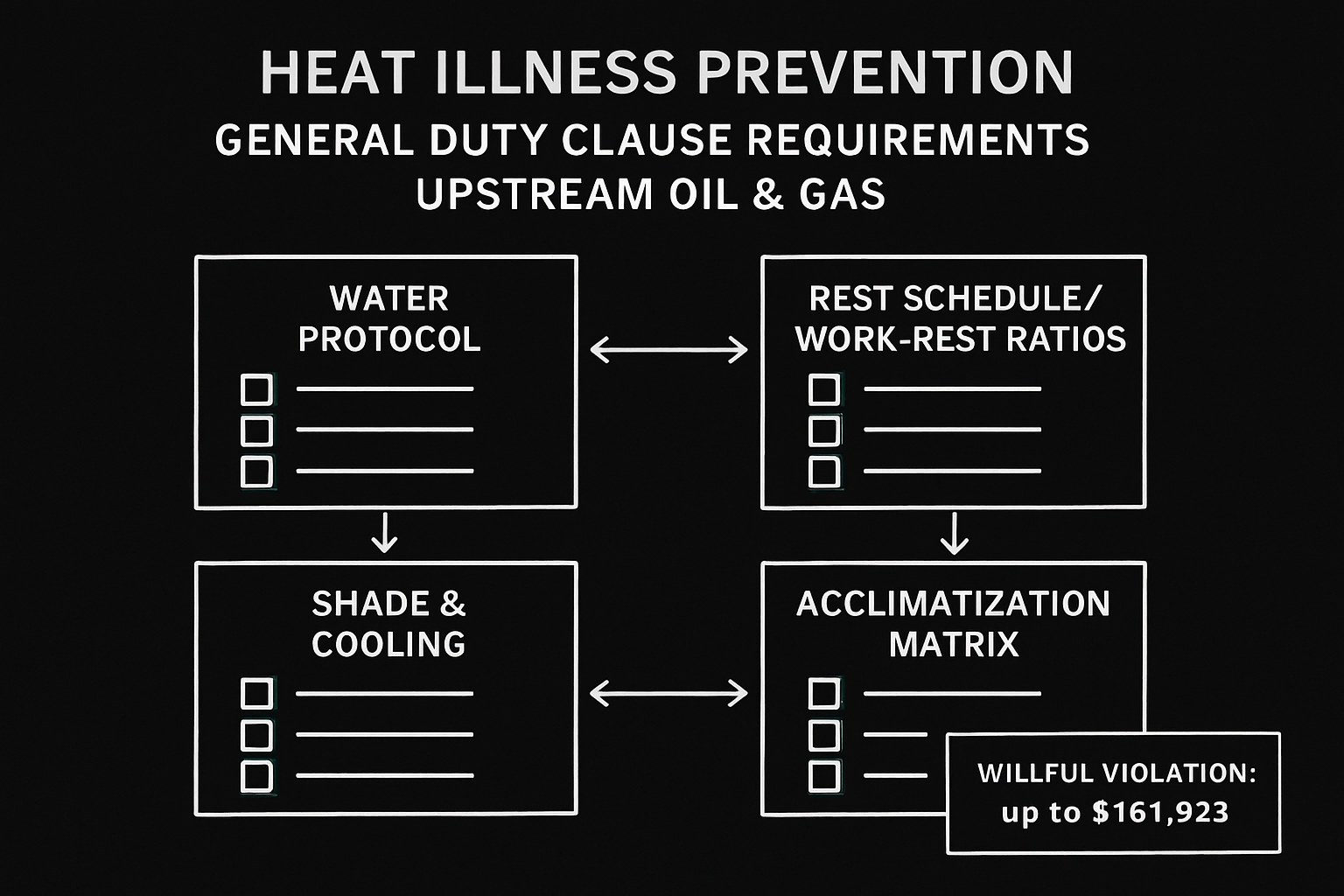
Heat Illness Prevention Under the OSHA General Duty Clause: What Oil & Gas Upstream Contractors Get Wrong
A driller on a West Texas location collapses during a trip out of the hole in July. The company has water on the rig floor, a written heat illness program, and a toolbox talk signed that morning. The OSHA compliance safety and health officer (CSHO) issues citations anyway — willful, $161,323 per item. The contractor's safety director is stunned. They did everything right. Except they didn't.
This guide is written for the EHS manager who has been through an OSHA inspection, not for someone reading about one for the first time. The gap between what upstream oil and gas contractors think constitutes a compliant heat illness program and what OSHA actually cites under the General Duty Clause (Section 5(a)(1) of the OSH Act) is wide — and expensive. Let's close it.
Why the General Duty Clause, Not a Specific Heat Standard
Federal OSHA has no standalone heat illness standard as of 2024 (a proposed rule was published in August 2024 under 29 CFR 1910/1926, but is not yet final). That means every heat-related citation in upstream oil and gas flows through Section 5(a)(1): the employer shall furnish a workplace free from recognized hazards causing or likely to cause death or serious physical harm.
OSHA establishes General Duty Clause violations by proving four elements: (1) the employer failed to keep the workplace free of a hazard; (2) the hazard was recognized — by the employer, the industry, or common knowledge; (3) the hazard caused or was likely to cause death or serious physical harm; and (4) a feasible and useful method existed to correct it. Every one of those elements is provable on a July drilling location in the Permian Basin, Eagle Ford, or Bakken.
State plans in California (8 CCR §3395), Washington (WAC 296-62-095), and Minnesota (MNOSHA 5205.0110) go further with mandatory heat standards. California's §3395 is the most aggressive — it mandates shade for two or more employees when the temperature exceeds 80°F, specific cool-down rest periods, and emergency response procedures, all with enforceable citations separate from the General Duty Clause. Upstream operators running California locations frequently underestimate this exposure.
What "Recognized Hazard" Means on a Drilling Location
OSHA doesn't need to prove your company knew about heat stress. They only need to prove the industry knew. The American Petroleum Institute's RP 74 on occupational health for upstream operations, IADC guidelines, and OSHA's own heat illness publications constitute industry knowledge. When a CSHO walks onto your location after an incident, the first document they request isn't your OSHA 300 log — it's your heat illness prevention plan. The second is your morning tailgate card. The third is the ambient temperature log for that day.
If the WBGT (wet bulb globe temperature) was above 85°F and your rotary helpers were making a connection in FR coveralls over base layers with no scheduled rest breaks — that's a recognized hazard. The fact that nobody complained doesn't matter. The fact that your toolbox talk covered heat awareness that morning doesn't matter. What matters is whether the hazard was controlled.
The Four Elements OSHA Inspects — And Where Upstream Contractors Fail Each One
Water
Contractors put a cooler of water on the rig floor and check the box. CSHOs look for something different: accessibility during the actual work cycle. A roughneck making a stand of drill pipe on the rig floor during a fast trip is not walking to the doghouse for water. OSHA's guidance (OSHA 3154 Heat Stress, and the OSHA-NIOSH Heat Safety Tool documentation) calls for cool potable water — not ice water, not sports drinks — available within 50 feet and consumed at a rate of approximately one cup every 15–20 minutes during heat stress conditions.
On pipeline maintenance crews, the water problem looks different. A valve maintenance crew working on a buried isolation valve in a 4-foot excavation in Oklahoma in August may have a cooler 200 feet away at the service truck. That distance matters. The CSHO measures it. The contractor assumed proximity to the vehicle was compliance. It isn't.
Rest
This is the most commonly misunderstood element in upstream. Operators put "take breaks as needed" in their heat plans. OSHA doesn't accept self-directed break scheduling as a control when workers are operating under production pressure. On a well servicing location where the customer — the operator — is paying day rates of $15,000–$40,000 and a pump truck is on standby, a floor hand is not going to announce that he needs to cool down. The crew pusher knows it. The company man knows it. OSHA will argue the employer knows it too.
A compliant rest protocol specifies frequency and duration by heat category — not "as needed." NIOSH recommends scheduled rest-to-work ratios adjusted to heat index, metabolic rate (heavy work like tripping pipe = 300–400 kcal/hr), and PPE burden. FR coveralls, H2S monitors, hard hats, and safety glasses worn in 105°F heat index add significant physiological load. That calculation has to appear somewhere in your heat plan or you will not survive scrutiny.
Shade
On a drilling location, shaded area is scarce by design. The argument that "there's no room" has been made and rejected. OSHA's position — backed by enforcement history — is that shade can be engineered: canopies over the shaker house, covered doghouse access, cooling trailers, misting fans in lay-down areas. The fact that a drilling contractor has never provided a shade structure on a location is evidence of a recognized hazard, not a defense against one.
Pipeline maintenance crews are worse off. A right-of-way crew installing cathodic protection test leads along a compressor station tie-in in south Texas in June has no natural shade, no permanent structure, and no relief from solar loading. A pop-up canopy is a $150 piece of equipment. Its absence in an inspection after a heat-related incident is the kind of detail that turns a serious citation ($16,131 per violation) into a willful one ($161,323).
Acclimatization
This is where the most expensive violations originate, and where contractors are most confidently wrong.
The standard industry practice — having a new hire or returning worker sign an acclimatization acknowledgment form — does not constitute an acclimatization program. OSHA's guidance and the NIOSH criteria document (NIOSH Publication 2016-106) describe acclimatization as a physiological process requiring 7–14 days of graduated heat exposure. New workers should not exceed 20% of full heat exposure on day one, increasing incrementally. Workers returning after more than a week away (including rotation breaks common in upstream) require re-acclimatization.
On a Permian Basin drilling rig running 12-hour hitch rotations — 14 days on, 7 days off — nearly every worker returning from a break is re-entering a heat exposure environment without acclimatization. The CSHO doesn't need to dig to find this. They ask the floor hand how long he's been back. If the answer is "two days" and the temperature is 107°F and there is no graduated work schedule, the violation is documented before they leave the doghouse.
The Counterintuitive Insight: Toolbox Talks Are Evidence Against You
Most safety directors assume toolbox talk documentation showing heat awareness training reduces OSHA exposure. OSHA actually treats it as proof of recognition — element two of the General Duty Clause violation. When a CSHO reviews your signed tailgate card from the morning of the incident and it lists heat stroke symptoms, hydration requirements, and the right to refuse work in dangerous heat — and then a roughneck goes down with heat exhaustion four hours later — that card is Exhibit A in the citation package. You've documented that you knew the hazard existed and told workers to manage it themselves. That's not a control. That's hazard recognition without abatement.
The toolbox talk matters. But it is evidence of training, not evidence of engineering or administrative controls. The citation rate doesn't drop because your workers can recite heat illness symptoms. It drops when your work-rest schedule is enforced by supervision, your heat index threshold triggers visible operational changes (moving heavy work to early morning, rotating crew tasks), and your acclimatization program has supervisor sign-off with documented gradual exposure schedules.
What a Compliant Heat Illness Prevention Plan Actually Contains
A plan that survives a post-incident OSHA inspection in upstream oil and gas contains these components — not as policy statements, but as operational procedures with named responsibilities:
- Heat Index Monitoring Protocol: Who takes the reading, with what instrument (sling psychrometer, WBGT meter, or validated weather station), at what frequency, and what operational triggers result from each heat index tier. "Consult the weather app" is not a monitoring protocol.
- Work-Rest Schedule by Heat Category: Mapped to ACGIH TLV tables or NIOSH recommendations, adjusted for PPE burden and metabolic rate of the specific tasks on that location — not generic office worker assumptions.
- Acclimatization Matrix: New hires receive one exposure schedule. Returning workers (defined as absent 7+ days) receive a separate re-acclimatization schedule. Both require supervisor daily sign-off, not just a one-time acknowledgment.
- Emergency Response Procedure: Not a general heat emergency procedure — a site-specific one. Who calls 911? What is the nearest hospital with an emergency department, and how long does transport take? On a remote location 60 miles from Midland, that transport time is a medical variable, not an administrative footnote.
- Buddy System and Supervisor Observation Requirement: Named supervisory roles — toolpusher, driller, company man as applicable — with documented authority and obligation to remove a worker from heat exposure based on observed symptoms, regardless of production status.
- Documentation of Daily Conditions: A heat log that becomes part of the daily safety record. If an incident occurs and you cannot produce temperature readings from that day, OSHA will establish conditions through weather service data — and you will have no counter-record.
Penalty Exposure in Upstream: The Math Is Ugly
A post-incident inspection on a drilling location typically generates multiple General Duty Clause citations, not one. Failure to implement an acclimatization program is one citation item. Failure to provide accessible water is a second. Failure to enforce scheduled rest is a third. Failure to provide shade is a fourth. In a willful classification — which OSHA pursues when documentation shows the employer was aware of the hazard and did not act — each item runs up to $161,323. Four items: $645,292. If the worker is hospitalized, OSHA has 6 months to inspect and the employer must report the hospitalization within 24 hours per 29 CFR 1904.39(a)(2).
Failure to abate a cited violation adds up to $16,131 per day per item. A contractor who receives citations, contests them without correcting the hazard, and then has a second incident will face that accumulating daily penalty on top of new citations for the second event.
Frequently Asked Questions From Upstream Contractors
We're a well servicing contractor working on an operator's location. Who is responsible for the heat illness program — us or the operator?
Both. OSHA's multi-employer citation policy (OSHA Directive CPL 02-00-124) allows citation of the controlling employer (operator), the exposing employer (your crew), and the correcting employer. On a well servicing location, your company is the exposing employer — your workers are exposed — which means your heat illness program governs your crew regardless of what the operator has or hasn't done. "The operator didn't tell us" is not a defense to a General Duty Clause citation against your company.
Our heat illness plan references the OSHA heat index chart. Isn't that enough to show we followed OSHA guidance?
No. Referencing a chart is not implementation. OSHA looks for evidence that the chart drove actual operational decisions on the day of the incident. If the heat index was in the "Danger" range (103–124°F) and no operational changes occurred — no adjusted work-rest ratio, no task rotation, no restricted heavy exertion — the plan failed at the implementation layer, not the documentation layer.
Our workers are all experienced hands who know to drink water and take breaks. Does OSHA account for worker experience?
No. Worker experience does not transfer liability from employer to employee. Under 29 CFR 1926 and the General Duty Clause framework, the employer's obligation to provide a hazard-free workplace is non-delegable. Additionally, heat acclimatization is a physiological process, not a knowledge-based one — experienced hands who work 14/7 rotation schedules require re-acclimatization after every break just as new hires do.
We operate in Texas. Is there a state heat standard we need to follow?
Texas operates under federal OSHA jurisdiction, so there is no separate Texas state heat standard as of 2024. However, Texas SB 14 (enacted 2023) restricts local municipalities from passing heat ordinances, which does not affect federal OSHA enforcement. Federal General Duty Clause citations apply in full. If your company has operations in California, 8 CCR §3395 is mandatory and more prescriptive than federal guidance.
If a worker doesn't report feeling sick, can OSHA still cite us for a heat hazard?
Yes. Failure to report symptoms is common — crew culture in upstream oil and gas strongly disincentivizes workers from appearing unable to handle the job. OSHA does not require a worker complaint or illness report to initiate a programmatic citation. A CSHO conducting a planned inspection or referral inspection can cite the absence of an acclimatization program, inadequate water access, or no rest schedule as standalone violations, regardless of whether anyone became ill.
We have a heat illness section in our IIPP. Does that satisfy the General Duty Clause?
An Injury and Illness Prevention Program entry is the minimum floor, not the ceiling. The General Duty Clause requires abatement of the hazard — meaning operational controls, not written statements of intent. OSHA Field Operations Manual guidance on General Duty Clause citations makes clear that a written program without evidence of implementation does not constitute abatement. The question the CSHO asks is not "do you have a plan?" — it's "what happened at 10:30 AM on the day of the incident that was different from a normal workday because the heat index was 109°F?"
For the full text of OSHA's heat illness prevention guidance and General Duty Clause enforcement policy, see the OSHA Heat Illness Prevention page on osha.gov.
For contractors managing ISNetworld®, Avetta®, or Veriforce prequalification, EHS Inc provides fully managed OSHA compliance support. Book a free consultation at EHS Inc.