OSHA Programmed vs. Unprogrammed Inspections in Food Processing and Meatpacking Plants: Triggers, Timelines, and the Gap Between Your Written Program and the Floor
When a Compliance Safety and Health Officer (CSHO) walks into your slaughter floor or further-processing line, they are not there to read your lockout/tagout binder. They are watching what happens in the first 90 seconds — who moves, what gets adjusted, and what gets quietly set down before anyone makes eye contact. That gap between what your written program says and what deboners, sanitation crew leads, and evisceration-line workers actually do every shift is precisely what OSHA's inspection methodology is designed to surface. Understanding how inspections are triggered, and what happens after a citation lands, is the operational core of staying compliant in this industry.
The Two Inspection Categories — and Why the Distinction Matters for Food Processing
OSHA inspections fall into two broad buckets under its Field Operations Manual (FOM): programmed and unprogrammed. Food processing and meatpacking facilities live disproportionately in both — and for different reasons that trace directly to the physical hazards of this industry.
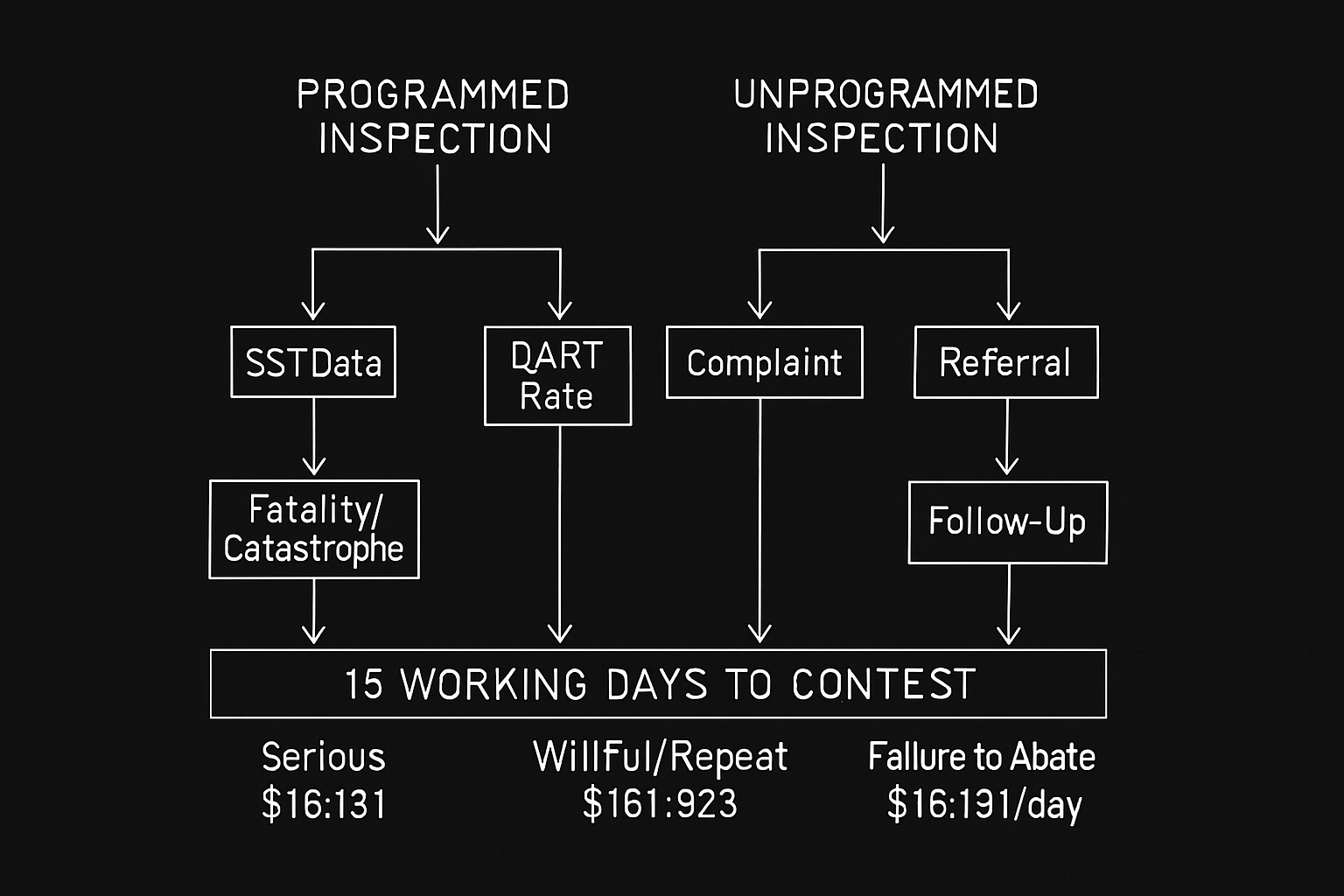
Programmed inspections are scheduled in advance based on data-driven targeting. OSHA uses its Site-Specific Targeting (SST) program, which draws from OSHA 300A Summary data submitted through the Injury Tracking Application (ITA). Facilities with Days Away, Restricted, or Transferred (DART) rates and Total Recordable Incident Rates (TRIR) above the industry average for NAICS codes 3116 (Animal Slaughtering and Processing) and 3111–3119 (broader food manufacturing) get flagged. If your 300A shows a DART rate of 6.4 when the industry benchmark for your NAICS is 4.1, you are on a list. It is not a matter of if — it is a matter of when the scheduling letter arrives.
Unprogrammed inspections are reactive. They are triggered by a specific event or complaint and are given priority over programmed visits. In food processing, the four primary triggers are:
- Fatality or Catastrophe (FatalCat): Any workplace death or hospitalization of three or more employees triggers mandatory reporting under 29 CFR 1904.39 within 8 hours (fatality) or 24 hours (in-patient hospitalization, amputation, or eye loss). Amputations at band saws, spiral slicers, and grinders are the most common triggers in this vertical. Reporting alone does not stop the inspection — it starts it.
- Employee Complaint: A sanitation worker who loses a fingertip and then files a complaint with OSHA — or calls the 1-800 number anonymously — generates an unprogrammed inspection. OSHA does not need to tell you the complainant's identity. You will receive a Complaint Inspection with the allegation summarized but the source redacted.
- Referral: Another agency — USDA/FSIS inspectors stationed in your facility, state labor departments, or local fire marshals — can refer your facility. FSIS personnel see your floor every day. If they witness an unguarded conveyor nip point or a sanitation lockout being bypassed, a referral to OSHA is a single phone call.
- Follow-Up / Monitoring: After a citation is issued, OSHA may return to verify abatement. This is not optional, and it is not always announced.
How OSHA's SST Targeting Actually Works in Meatpacking — The Data Trail You're Building Every Year
Most EHS managers assume OSHA only targets facilities after a serious injury. OSHA actually runs SST selections annually, and your 300A data is the primary input. When your injury tracking application submission shows elevated rates, your facility enters the inspection pool. The SST algorithm does not know whether your injuries were investigated thoroughly, whether root cause was fixed, or whether you have a safety committee that meets weekly. It reads numbers.
For NAICS 3116 specifically, this matters because slaughter and processing operations carry inherently elevated injury exposure — knife work, repetitive motion, wet floors, ammonia refrigeration, confined spaces in evisceration pits, and high-speed conveyor systems. The industry average DART rate runs well above general manufacturing. A facility that genuinely improves its recordkeeping practices and starts documenting first-aid cases correctly may actually see its recorded rates increase year-over-year — and move up the SST targeting list despite having improved safety outcomes. That is not an argument for underrecording. It is a reason to understand what the data signals and to have documentation ready to contextualize it.
What the CSHO Looks for First — The Gap Between Paper and Practice
The opening conference is short. The CSHO will ask for your OSHA 300 logs, 301 incident reports, the written lockout/tagout program under 29 CFR 1910.147, your powered industrial truck (PIT) training records, your confined space entry permits, and your hazard communication program under 29 CFR 1910.1200. Then they go to the floor.
Here is what they are actually doing on that floor walk: they are comparing what the binder says against what they observe in real time. In a meatpacking facility, the gaps that surface most consistently are:
- Lockout/Tagout Program vs. Actual Practice (29 CFR 1910.147(c)(4)): The written program lists machine-specific procedures for every piece of equipment. But when the CSHO walks to the skinning machine or the belly-opening saw and asks a maintenance mechanic to walk through the lockout sequence without the laminated card in hand, hesitation is the tell. If the mechanic reaches for the card or says "I normally just de-energize the main breaker," OSHA has evidence that the procedure exists on paper but hasn't been trained to the point of competency. That is a serious violation under 29 CFR 1910.147(c)(7)(i) — failure to certify that affected employees have been trained.
- Guarding on Conveyor Systems (29 CFR 1910.212(a)(1)): Guards are frequently removed for line speed adjustments or sanitation access and not replaced. The CSHO will photograph every open nip point. One missing guard after a recent sanitation shift is explainable. Three missing guards on a line that runs product 16 hours a day is a pattern — and patterns suggest willful or repeat classification.
- Sanitation Crew Hazcom Training (29 CFR 1910.1200(h)): Sanitation workers — especially third-party sanitation contractors — are frequently trained in their home language on Day 1 and then handed chemicals they've never seen before by the end of Week 1. If the CSHO asks a sanitation crew member about the hazards of a quaternary ammonium sanitizer or peracetic acid solution and the employee cannot articulate any response, the employer of record is exposed regardless of whether the sanitation crew is an independent contractor.
Counterintuitive Insight: What Most EHS Managers Assume vs. What OSHA Actually Looks For
Most EHS managers assume OSHA's first focus during a meatpacking inspection is the slaughter floor — the high-drama, high-severity zone. OSHA actually prioritizes the sanitation shift. Third-shift sanitation operations in food processing plants represent some of the highest-density hazard concentrations in any industry: workers entering machinery to clean it, often with inadequate lockout, working in wet environments with electrical equipment, using corrosive and oxidizing chemicals, and doing all of it in a facility operating under time pressure to be production-ready by 5 a.m. CSHOs increasingly request to observe or review documentation from the sanitation shift specifically, because that is where the program-to-practice gap is widest. If your third-party sanitation contractor's crew lead cannot produce lockout training records for their team, and your facility allows them on the floor, you may be cited as the controlling employer under OSHA's multi-employer citation policy.
Citation Response Timelines — What Happens After the Closing Conference
After the inspection, OSHA has no fixed deadline to issue citations, though the agency typically acts within six months of the opening inspection. When the citation arrives, your response window is strictly governed by 29 CFR 1903.17:
- 15 working days from receipt of the citation to file a Notice of Contest with the OSHA Area Director. Miss this window and the citation becomes a final order — no appeal, no negotiation, no reduction. This deadline is not flexible.
- If you do not contest, the penalty and abatement dates in the citation stand. Abatement deadlines for serious violations in food processing are typically 30–90 days depending on the complexity of the fix.
- Failure to Abate: If OSHA returns for a follow-up inspection and the cited condition has not been corrected, failure-to-abate penalties accrue at up to $16,131 per day (2024 figures) from the original abatement deadline. For a facility that received a citation in February with a 60-day abatement date and has not fixed a guarding violation by April — and the CSHO returns in June — that is 60+ days of per-day exposure.
Penalty levels for 2024:
- Serious violations: up to $16,131 per violation
- Willful or Repeat violations: up to $161,323 per violation
- Failure to Abate: up to $16,131 per day beyond the abatement deadline
- Other-than-Serious: up to $16,131 per violation (typically lower in practice)
Repeat violations require OSHA to find a substantially similar violation within the past five years. In large multi-site food processing companies — Tyson, Smithfield, Cargill-scale operations — a citation at one plant can set the baseline for repeat classification at a sister facility. One citation at your Nebraska pork operation can make the next guard violation at your Iowa facility a repeat at $161,323 per instance.
State Plan States — Stricter Standards That Apply to Food Processing Operations
If your facility operates in California, Washington, or Michigan, federal OSHA minimums are a floor, not a ceiling.
- California (Cal/OSHA): Injury and Illness Prevention Program requirements under 8 CCR 3203 are substantially more prescriptive than the federal General Duty Clause approach. Cal/OSHA also enforces heat illness prevention under 8 CCR 3395 — directly applicable to food processing environments where workers move between refrigerated kill floors and ambient-temperature staging areas. Cal/OSHA conducts its own programmed inspections using separate targeting criteria.
- Washington (L&I/WISHA): Washington's ergonomics rule under WAC 296-62-051 applies directly to food processing and meatpacking repetitive motion hazards — cumulative trauma disorders from knife work on deboning lines are specifically addressed. Federal OSHA withdrew its ergonomics standard in 2001; WISHA did not.
- Michigan (MIOSHA): Michigan has its own inspection scheduling and citation timeline processes under the Michigan Occupational Safety and Health Act. MIOSHA's general industry standards largely mirror federal OSHA but enforcement posture and penalty gravity can differ at the Area Office level.
FAQ: OSHA Inspections in Food Processing and Meatpacking
Can OSHA show up without notice at our processing facility?
Yes. The Occupational Safety and Health Act explicitly authorizes warrantless inspections of workplaces during regular working hours under 29 CFR 1903.7. OSHA does not need to call ahead for unprogrammed inspections triggered by a complaint, referral, or fatality. For programmed SST inspections, you may receive a scheduling letter, but the inspection itself is unannounced. Denying entry forces OSHA to obtain an inspection warrant — which they will get — and refusing entry is itself a legally adversarial posture that complicates any subsequent negotiation on citations.
Our LOTO binder is current and signed. Why were we still cited for a lockout violation?
A signed binder proves you have a written program. It does not prove employees can execute the procedure correctly or that machine-specific procedures exist for every piece of equipment on your floor. Under 29 CFR 1910.147(c)(4)(ii), machine-specific procedures must be developed for equipment with multiple energy sources, complex de-energization sequences, or stored energy that cannot be visually verified as released. If your brand-new spiral freezer or your continuous washer doesn't have a documented, equipment-specific procedure, the binder is incomplete regardless of how many signatures it has.
If a USDA FSIS inspector reports a safety hazard, does that automatically trigger an OSHA inspection?
Not automatically, but FSIS personnel stationed inside your facility have a direct referral pathway to OSHA under interagency cooperation agreements. A referral from FSIS is treated as an unprogrammed referral inspection — meaning it goes to the front of the queue ahead of scheduled programmed visits. Because FSIS inspectors work your floor daily, their observations carry significant weight and specificity in the referral documentation.
We use a third-party sanitation contractor. Are we responsible for their employees' OSHA compliance?
Under OSHA's multi-employer citation policy, a facility can be cited as the controlling employer if it knew or should have known of a hazardous condition created by or affecting a subcontractor's employees on its premises. If your sanitation contractor's employees are performing lockout on your equipment using your energy isolation points, and those procedures are inadequate, you bear exposure. The contractual arrangement between you and the sanitation company does not transfer OSHA liability.
What is the practical difference between a serious and a willful citation in our context?
A serious citation under 29 CFR 1903.15(a) requires OSHA to show the employer knew or should have known of the hazard, and that the hazard could cause death or serious physical harm. A willful citation requires evidence of intentional disregard or plain indifference — not malice, but documented awareness without correction. In food processing, willful citations most often arise when a prior citation or warning exists on a condition that was not abated, when a supervisor is observed directing workers to bypass a guard or skip lockout, or when training records are fabricated. The penalty difference is roughly 10x: $16,131 vs. $161,323 per instance.
How long does OSHA have to issue a citation after the inspection?
Under Section 9(c) of the OSH Act, OSHA must issue a citation within six months of the occurrence of the violation — not six months from the inspection opening date, but from when the violation occurred or was last in continuous existence. For most conditions found during an inspection, the clock runs from the inspection date. However, for ongoing conditions like missing machine guards or absent training records, the "occurrence" may be treated as continuous, which gives OSHA flexibility. Practically, most citations in food processing follow within 60–120 days of the closing conference.
For contractors managing ISNetworld®, Avetta®, or Veriforce prequalification, EHS Inc provides fully managed OSHA compliance support. Book a free consultation at EHS Inc.