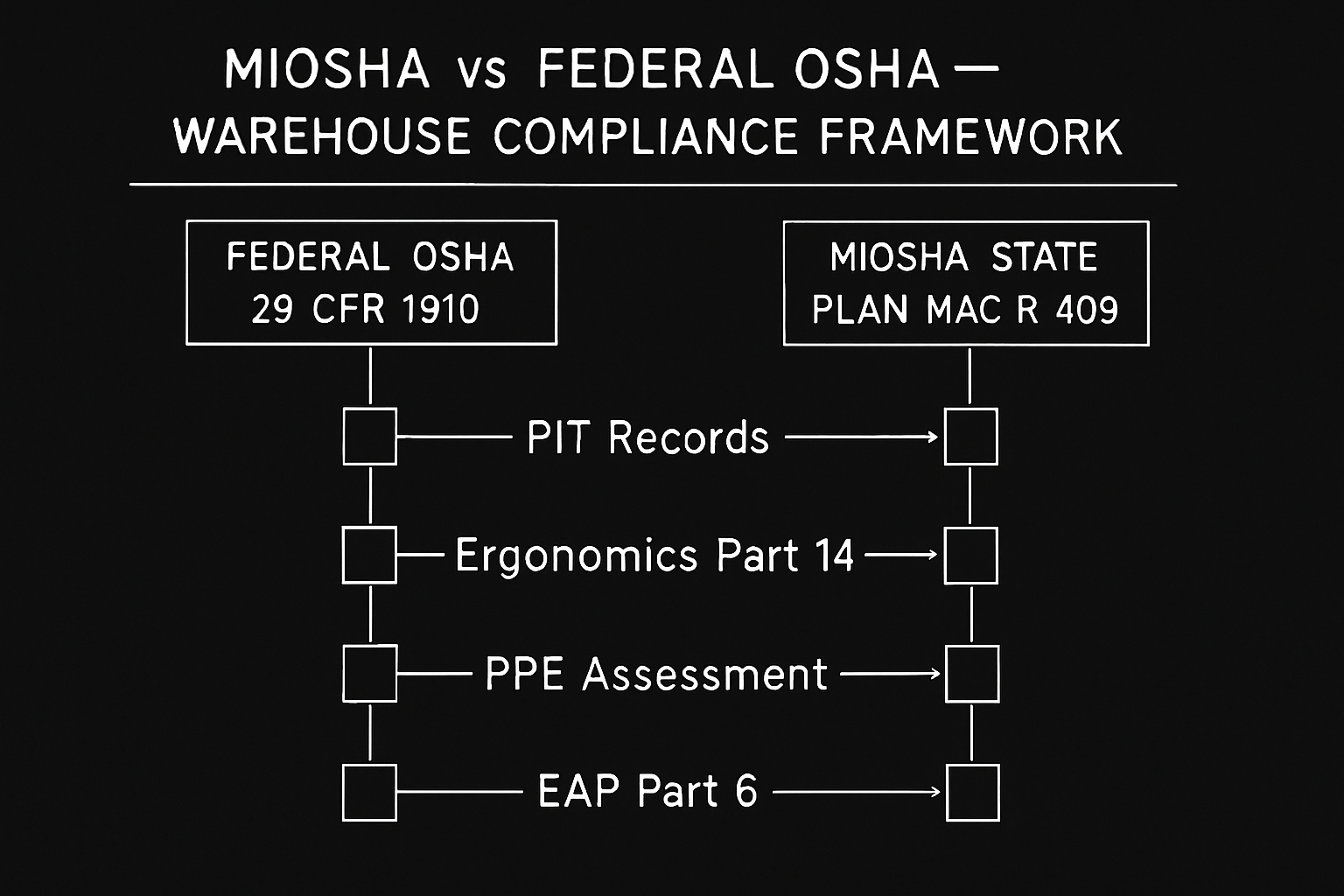
Michigan MIOSHA vs Federal OSHA in Warehousing and Distribution: What a CSHO Checks First at Your 3PL or Fulfillment Center
When a MIOSHA Compliance Safety and Health Officer walks through the dock doors of a Michigan fulfillment center or 3PL operation, the first five minutes are not spent reviewing your written programs. They are spent watching. The CSHO is cataloging what pickers and order selectors are doing without supervision, whether powered industrial truck operators are slowing at intersections, whether the dock leveler pit covers are in place, and whether anyone notices a stranger walking the floor. What they see in those first minutes shapes everything that follows.
Michigan operates a State Plan approved under Section 18 of the OSH Act, administered by the Michigan Occupational Safety and Health Administration (MIOSHA) under the Department of Labor and Economic Opportunity. Michigan's plan must be "at least as effective" as federal OSHA — and in several areas directly relevant to warehousing, it is demonstrably stricter. Managing compliance in a Michigan warehouse means maintaining two mental frameworks simultaneously: the federal floor and the Michigan ceiling.
How Michigan's State Plan Authority Works — and What It Means on the Dock Floor
Michigan's State Plan covers both private-sector and state/local government workers, unlike federal OSHA, which has no jurisdiction over public employees in non-State Plan states. For 3PL operators managing both private and public sector contracts — think fulfillment operations serving municipal procurement agencies — this distinction matters for training documentation, PPE programs, and hazard communication compliance.
MIOSHA enforces its own set of General Industry Safety and Health Standards (Parts 1–99 of Michigan Administrative Code Rule 408 et seq.) alongside Michigan-specific Construction Safety Standards. Michigan has adopted many federal standards by reference, but has promulgated independent rules where it has chosen to go further. Understanding which rules are adopted-by-reference versus independently promulgated is the core of dual-framework compliance management.
The authoritative source for federal standards remains 29 CFR 1910 — OSHA General Industry Standards.
What the CSHO Looks at First: The Walking Entry Assessment
Before asking for any paperwork, a MIOSHA CSHO performing an inspection at a warehouse or fulfillment center will conduct an opening walkaround — sometimes called the "entry observation." In warehousing, this typically surfaces the following within minutes:
- Powered industrial truck (PIT) traffic patterns and operator behavior — specifically whether forklift operators are traveling with elevated loads, whether pedestrian/vehicle separation is marked and enforced, and whether operators are performing pre-shift inspections. This is documented under 29 CFR 1910.178 and MIOSHA Part 21.
- Dock conditions — dock leveler guards, trailer restraint systems (whether wheel chocks or ICC bar restraints are in use and being used), and dock plate load ratings posted per 29 CFR 1910.178(e)(1).
- Emergency exit paths — whether pallets, shrink-wrapped freight, or return merchandise are staged within exit corridors. MIOSHA Part 6 (Emergency Action Plans) and 29 CFR 1910.37(a)(3) require exit routes to be unobstructed at all times. In fulfillment centers during peak season, this is the single most common citation pathway.
- Hazard communication labeling — specifically whether battery charging stations have secondary containment and whether electrolyte (sulfuric acid) containers are labeled per 29 CFR 1910.1200(f) and MIOSHA Part 92.
Where MIOSHA Is Stricter Than Federal OSHA — Warehousing-Specific Divergences
1. Powered Industrial Trucks — MIOSHA Part 21 vs. 29 CFR 1910.178
Michigan's MIOSHA Part 21 (General Industry Safety Standard for Powered Industrial Trucks) adopts federal 29 CFR 1910.178 by reference but adds specific Michigan-only requirements on aisle width minimums and operator certification documentation retention. Under MIOSHA Part 21, Rule 408.12161, written records of PIT operator evaluations must be maintained for the duration of the operator's employment plus three years — a longer retention period than what federal OSHA specifies under 1910.178(l)(6), which requires only that training be documented without specifying a post-employment retention window.
In a high-turnover environment like a 3PL fulfillment center — where seasonal order selectors and reach truck operators may cycle through in 90-day stints — this creates a records management problem that MIOSHA CSHOs know to probe. When the CSHO requests PIT training records for operators who are no longer employed, the typical failure is that records were purged at separation. That is a citable condition under MIOSHA Part 21.
2. Ergonomics — Michigan Has a General Duty Obligation OSHA Cannot Match
Here is where experienced EHS managers get surprised. Michigan's General Industry Safety Standard Part 14 (Ergonomics) — MAC R 408.11401 through R 408.11418 — establishes formal requirements for identifying and abating ergonomic hazards in workplaces with documented musculoskeletal disorder (MSD) injury patterns. Federal OSHA has no specific ergonomics standard (the 2001 federal ergonomics rule was vacated by Congress); Michigan never revoked Part 14.
Most safety managers at fulfillment centers assume ergonomics is only a general duty clause issue — a soft target. In Michigan, a CSHO reviewing OSHA 300 logs showing recurring MSD entries among pick-and-pack associates or inbound freight handlers can open a formal ergonomics inspection under Part 14. If your injury log shows three or more MSD cases in a 12-month period in a specific job classification, and you have no documented ergonomic assessment, that is a standalone violation under MIOSHA — not just a general duty characterization.
3. Personal Protective Equipment — MIOSHA Part 33 Adds Hazard Assessment Documentation Requirements
Federal 29 CFR 1910.132(d)(2) requires a written certification that a PPE hazard assessment has been performed, identifying the workplace evaluated, the person certifying it, and the date. MIOSHA Part 33 (PPE) mirrors this, but Michigan CSHOs apply it with particular attention to whether the certification covers every distinct work area in a facility — not just the facility as a whole.
In a large fulfillment center, the battery charging room, the returns processing area, the dock, the inbound receiving bay, and the pick modules are distinct areas with different hazard profiles. A single blanket PPE certification that reads "Warehouse — steel-toed boots required" fails Part 33 scrutiny. The CSHO will ask: where is the eye protection assessment for the battery room? Where is the cut-resistant glove assessment for associates processing returned goods with box cutters?
4. Emergency Action Plans and Fire Prevention — MIOSHA Part 6
MIOSHA Part 6 (Emergency Action Plans and Fire Prevention Plans) is enforced with notably higher specificity in Michigan than federal 1910.38 inspections typically produce at the federal level. Michigan CSHOs in warehousing environments look specifically for whether the EAP names specific individuals by job title — not just "a designated employee" — responsible for accounting for all personnel after an evacuation, including temporary staffing agency workers and contract carriers on-site.
In a 3PL environment operating with a staffing agency providing 60–70% of the picking workforce, the failure mode is almost always the same: the EAP was written for the permanent headcount, and nobody owns accountability for the agency workers during an evacuation drill. That gap, documented in inspection notes, becomes a serious citation under MIOSHA Part 6, Rule 408.10634.
Penalty Structure: Federal vs. MIOSHA
MIOSHA applies penalty structures consistent with the federal framework as required by State Plan agreements. For 2024:
- Serious violations: up to $16,131 per violation
- Willful or repeat violations: up to $161,323 per violation
- Failure to abate: up to $16,131 per day beyond the abatement deadline
In warehousing, repeat violations most commonly arise from PIT pre-shift inspection failures and exit route obstruction — both high-frequency, high-visibility conditions that generate initial citations, get corrected on paper, and then recur when operational pressure returns. A fulfillment center that received a PIT citation during Q4 peak season and then gets re-inspected the following Q4 peak is looking at a repeat classification and the $161,323 ceiling — for a condition that costs almost nothing to correct permanently.
The Counterintuitive Reality: Training Records Are Not Your First Problem
Most safety managers at 3PL operations assume the CSHO's primary tool is the document request — they spend inspection prep time organizing training records, SDS binders, and written programs. OSHA actually looks for behavioral evidence first. A CSHO who watches a reach truck operator travel 40 feet with a load elevated 8 feet off the ground does not need your training records to write a citation. The behavior is the violation. The training records only determine whether it becomes a serious citation or a willful one.
The practical implication: your pre-inspection readiness program should spend more time on observed floor behavior — random PIT audits, pedestrian interaction points, dock safety checks — than on document organization. Documents defend you after a citation. Behavior prevents one.
Managing Dual-Framework Compliance Across a Multi-State 3PL Network
For 3PL operators running facilities in Michigan alongside operations in Ohio (federal OSHA jurisdiction) or Illinois (federal OSHA), the compliance management challenge is real. A standardized corporate safety program written to the federal floor will be non-compliant in Michigan on at least three dimensions: PIT record retention, ergonomics program requirements, and PPE hazard assessment granularity.
The practical approach used by experienced EHS directors in this space is to build the Michigan standard as the enterprise baseline — since Michigan is consistently at or above the federal floor — and then document Michigan-specific citations separately in the corporate compliance tracker. When MIOSHA-specific rules apply, they should be flagged in the job hazard analysis and SOP headers so supervisors and safety coordinators know which standard governs at that location.
FAQ: MIOSHA vs Federal OSHA in Warehousing and Fulfillment
Does MIOSHA inspect warehouses differently than federal OSHA does?
MIOSHA CSHOs follow a similar inspection protocol — opening conference, walkaround, records review, closing conference — but Michigan inspectors are specifically trained on Part 21 (PIT), Part 14 (Ergonomics), and Part 6 (EAP) as priority standards in industrial environments. You are more likely to receive a formal ergonomics review at a Michigan warehouse than at a comparable facility under federal OSHA jurisdiction.
If we follow 29 CFR 1910.178 for forklifts, are we compliant with MIOSHA Part 21?
Mostly, but not entirely. The post-employment record retention requirement under MIOSHA Part 21 goes beyond federal 1910.178(l)(6). If your records policy purges PIT training documentation at employee termination, you have a gap under Michigan rules. Retain PIT evaluation records for the duration of employment plus three years.
We use a staffing agency for 70% of our picking workforce. Who is responsible for their OSHA training under MIOSHA?
Both the host employer (your 3PL operation) and the staffing agency share compliance responsibility under MIOSHA's multi-employer worksite policy, consistent with federal OSHA's multi-employer citation policy. The host employer is responsible for site-specific hazard training and the staffing agency for general safety training. Document the division of responsibility in your staffing contract — it directly affects how citations are allocated if MIOSHA finds a training gap.
Our facility has recurring back strain injuries among pick associates. Do we need a formal ergonomics program under MIOSHA?
If your OSHA 300 log reflects a pattern of MSD cases in a specific job classification over a 12-month period, MIOSHA Part 14 creates a documented obligation to conduct and record an ergonomic assessment. This is not optional in Michigan the way it effectively is under federal OSHA. Engage a qualified ergonomist, document the assessment, implement feasible controls, and retain the records. A CSHO reviewing your 300 log will cross-reference it against your ergonomics program documentation.
Can a MIOSHA CSHO show up without advance notice at our fulfillment center?
Yes. Programmed inspections (targeting high-hazard industries) and unprogrammed inspections (responding to complaints, referrals, or fatalities) both occur without advance notice under Michigan's State Plan. Warehousing and distribution is a priority industry for MIOSHA programmed inspections. Operate as if a CSHO could arrive at any shift change.
We received a federal OSHA citation at our Ohio facility last year for exit route obstruction. If MIOSHA inspects our Michigan facility and finds the same condition, is that a repeat violation?
Potentially. MIOSHA follows guidance consistent with federal OSHA's repeat violation policy, which can look across an employer's facilities — not just the cited location — when classifying a repeat. If the condition is substantially similar and the violation occurred within five years, MIOSHA may classify the Michigan citation as a repeat, triggering the $161,323 per-violation ceiling. This is one of the most financially consequential dynamics for multi-state 3PL operators.
For contractors managing ISNetworld®, Avetta®, or Veriforce prequalification, EHS Inc provides fully managed OSHA compliance support. Book a free consultation at EHS Inc.