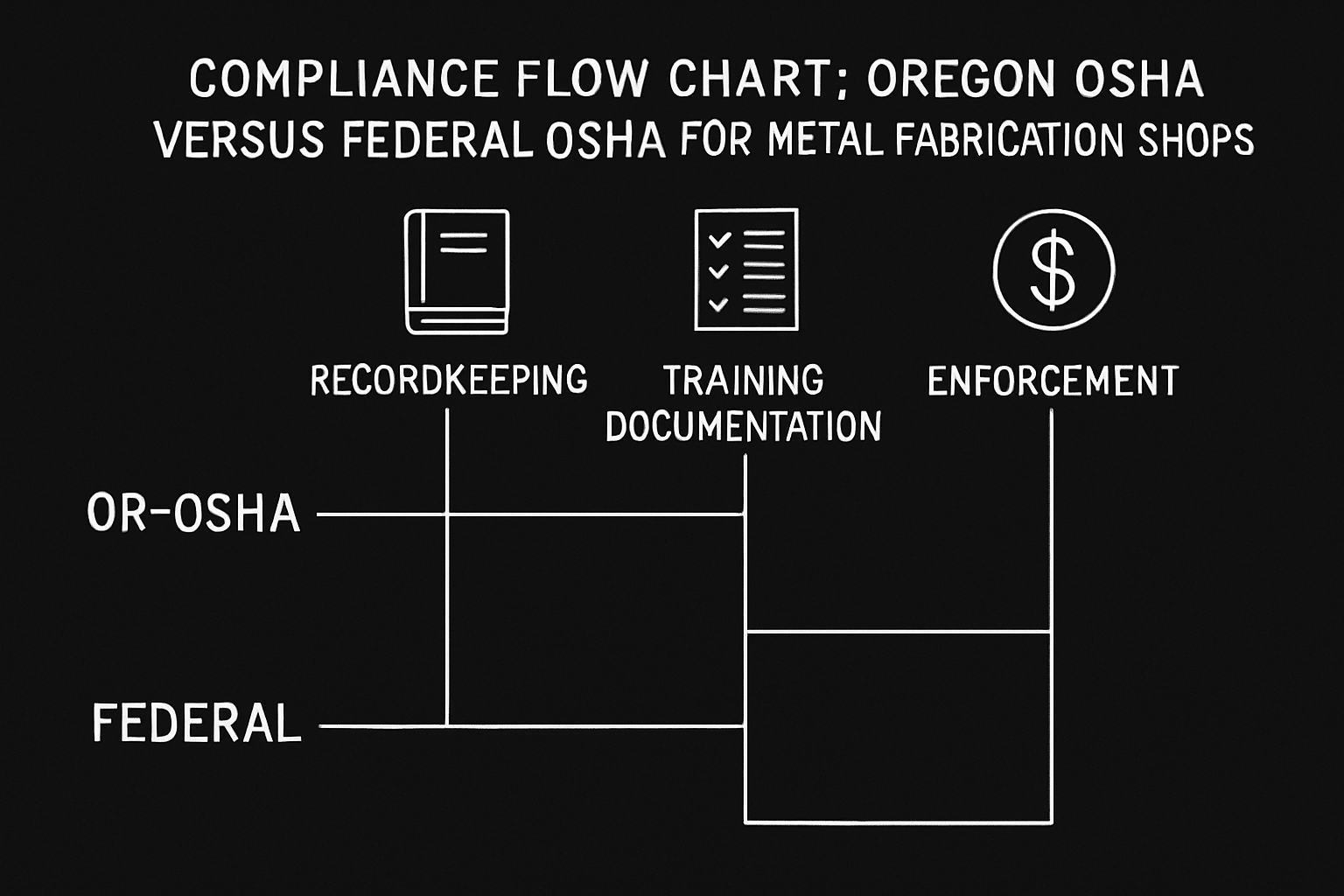
Oregon OSHA vs Federal OSHA: The Key Differences in Recordkeeping, Training, and Enforcement That Oregon Metal Fabrication and Metalworking Shops Must Know
Walk into most metalworking and fabrication shops in Oregon and you'll find a safety manager who has done the hard work — lockout/tagout procedures posted on every press brake, PPE stations stocked, SDS binders organized. What you usually won't find is a 300 Log that accurately reflects what happened in the last calendar year, or training records that meet Oregon's specific documentation threshold rather than federal minimums. That gap — not the obvious hazards a CSHO can see from the door — is what drives the bulk of OR-OSHA recordkeeping and training citations in this sector.
Oregon operates as a State Plan state under Section 18 of the OSH Act, meaning OR-OSHA must maintain standards that are "at least as effective" as federal OSHA. In practice, that means Oregon routinely goes further — in recordkeeping thresholds, in training documentation requirements, and in how enforcement actions are structured. If your compliance program was built around 29 CFR 1904 and federal training standards without layering in Oregon Administrative Rule (OAR) Chapter 437, you have gaps that cost money when a CSHO walks in.
The Failure Mode That Surprises Oregon Metal Fabrication Shops
Most safety managers in fabrication shops assume the citation risk lives in the shop floor — a grinder guard missing from an angle grinder, inadequate machine guarding on a turret punch press, or a lockout procedure that hasn't been updated since the last PLC retrofit. Those hazards are real and inspectors do cite them. But the failure mode that generates clustered, multi-violation citations in Oregon metal fab shops is something more administrative: the misclassification of restricted work activity cases as first-aid cases on the OSHA 300 Log, combined with the absence of the OR-OSHA-required supervisor training documentation that would have caught the misclassification during the annual review.
Here's how it plays out on the ground. A press brake operator develops hand or wrist pain consistent with repetitive motion strain — common in shops doing high-volume sheet metal bending. The shift supervisor, who has not received OR-OSHA's mandated training under OAR 437-001-0760 on recordkeeping responsibilities, makes a judgment call: the employee came back the next day and ran the machine, so it goes down as first aid. What the supervisor missed is that the employee was rotated off the press brake to a sweeping and cleanup role for three days — a textbook restricted work case under 29 CFR 1904.7(b)(4). That case should have been logged as a Days Away, Restricted, or Transfer (DART) case. It wasn't. Now multiply that by a small shop running two shifts with five supervisors, none of whom have documented training on recordkeeping criteria, and you have a pattern of systematic misclassification that a CSHO will identify within 20 minutes of reviewing your 300 Log and cross-referencing it against workers' comp claims and first-aid logs.
Oregon's Recordkeeping Rules: Where They Diverge from 29 CFR 1904
Federal OSHA's recordkeeping rule at 29 CFR 1904.1 exempts establishments with 10 or fewer employees from routine recordkeeping. Oregon does not mirror this exemption cleanly. Under OAR 437-001-0700, Oregon applies recordkeeping requirements to employers based on NAICS code and workforce size, but the partial-exemption threshold for low-hazard industries does not apply to NAICS codes covering fabricated metal product manufacturing (NAICS 332) or other primary metal industries. A shop with eight welding fabricators in Portland is not exempt from 300 Log requirements — a point that surprises owners who have been told they're "too small to need the log."
Oregon also requires that the OSHA 300A Summary be certified by a company executive — identical to 29 CFR 1904.32(b)(3) — but OR-OSHA inspectors specifically look for whether the certifying official has any documented basis for believing the summary is accurate. In a fabrication shop context, that means the plant manager or owner signing the 300A should be able to point to a recordkeeping review process. If your internal audit trail shows no one reviewed the log before certification, that's a recordkeeping system failure, not just a paperwork error.
The electronic submission requirement also differs in timing enforcement. Federal OSHA requires establishments with 100 or more employees in high-hazard industries to submit 300A data via the Injury Tracking Application (ITA) by March 2. OR-OSHA tracks compliance with this separately and coordinates with federal OSHA on submission data — meaning inspectors may arrive already knowing your reported injury rate before they knock on your door. If your submitted rate looks inconsistent with what's on your physical 300 Log, that discrepancy becomes the first interview topic.
OR-OSHA Training Requirements: The Documentation Standard Federal OSHA Doesn't Match
Federal OSHA standards require training — but the documentation requirements embedded in those standards vary significantly by topic. Oregon adds a layer through OAR 437-001-0760, which requires that employers document the content, date, trainer qualifications, and employee comprehension for training delivered under any OR-OSHA standard. This is not just a retention requirement — it's a content requirement. A sign-in sheet with names and a date does not satisfy OAR 437-001-0760 for a fabrication shop conducting hazard communication training under OAR 437-002-0360 (Oregon's analog to 29 CFR 1910.1200).
In a metalworking shop context, the standards where this documentation gap most commonly triggers citations are:
- Lockout/Tagout (OAR 437-002-0220 / 29 CFR 1910.147): Oregon inspectors routinely ask for retraining records for employees who were involved in any LOTO-related near-miss. If a CNC machinist was present during an unintended energization event and the employer conducted retraining, the retraining record must document what specific procedural deficiency was covered — not just that "LOTO training" was repeated.
- Abrasive Wheel Operations (OAR 437-002-0294 / 29 CFR 1910.215): Angle grinder operators and die grinder operators in fabrication shops are often cross-trained by peer demonstration rather than formal instruction. Oregon requires documented training for anyone operating abrasive equipment, including portable grinders — and "he learned from watching the other guys" is not a training record.
- Powered Industrial Trucks (OAR 437-002-0228 / 29 CFR 1910.178(l)): The federal standard requires forklift operator evaluation every three years or upon observed unsafe operation. Oregon applies additional scrutiny when a lift truck operator is also performing rigging tasks in the same work area — a common scenario in fabrication shops where a forklift operator doubles as a material handler moving structural steel or heavy weldments. Inspectors look for whether the operator's training records cover both forklift operation and the incidental rigging activity.
Most safety managers assume that if training happened, the record obligation is met by a sign-in sheet and a training topic description. OR-OSHA actually looks for evidence that the employee demonstrated comprehension — a quiz score, a practical evaluation checklist, a supervisor sign-off on task demonstration. In a fabrication shop inspection, the absence of comprehension documentation is treated as evidence that the training did not occur at a standard sufficient to protect the employee.
OR-OSHA Enforcement Structure: How It Differs From Federal in Practice
Federal OSHA penalty amounts apply in Oregon as a ceiling, but OR-OSHA has its own penalty calculation matrix that frequently produces different outcomes at the violation level. Oregon uses a gravity-based penalty system that accounts for severity, probability, and employer size — similar to federal methodology — but Oregon's size reduction factors are applied differently. A fabrication shop with 25 employees may receive a smaller size reduction in Oregon than the same shop would under federal OSHA's penalty tables, because OR-OSHA evaluates the employer's overall safety program sophistication, not just headcount.
Penalty exposure for the most common citation clusters in metal fabrication:
- Serious violations (e.g., 300 Log misclassification, inadequate lockout procedures): up to $16,131 per violation under 2024 federal penalty levels, which Oregon mirrors.
- Willful or repeat violations (e.g., a second citation for the same recordkeeping failure within three years): up to $161,323 per violation. Oregon inspectors who find systematic misclassification — particularly where workers' comp records contradict the 300 Log — will consider whether the pattern constitutes willful conduct rather than negligence.
- Failure to abate: up to $16,131 per day beyond the abatement deadline. For a training documentation deficiency where the employer was cited and issued a correction deadline, every day the records remain incomplete after that date accumulates separate exposure.
Oregon also conducts follow-up inspections more systematically than federal OSHA areas offices in many regions. If a fabrication shop received a citation in the last three years and the same CSHO is assigned to a complaint investigation at the same facility, expect them to pull the prior citation file before arriving. Repeat violation classification in Oregon looks back five years — not the three years commonly referenced in federal guidance.
What a CSHO Notices First When Walking Into a Metal Fab Shop
Before reviewing any paperwork, a CSHO conducting an inspection at a metalworking or fabrication shop will do a physical walk-through. In this sector, the first visual checkpoints are typically: grinder guards and wheel RPM rating markings, machine guarding on press brakes and shears, housekeeping around welding stations, and whether overhead crane operators are wearing the correct PPE and whether lift charts are posted at the crane controls.
What triggers the deeper document review is when the walk-through reveals evidence of recent injury that wasn't accompanied by a near-miss or incident report. A bandage on a CNC operator's hand. A modified workstation that wasn't documented. A "light duty" sign on a task board. Each of these is a CSHO's signal to ask for the 300 Log and the corresponding supervisor's incident report. If the log doesn't reflect what the physical evidence suggests, the entire recordkeeping system comes under scrutiny — and that's when OR-OSHA's documentation requirements for training become the next audit target.
Frequently Asked Questions
We have fewer than 10 employees in our Oregon metal fab shop. Do we still need to keep an OSHA 300 Log?
Yes. The partial-exemption that applies to low-hazard industries under federal 29 CFR 1904.1 does not apply to NAICS codes covering fabricated metal manufacturing (NAICS 332x) under Oregon's recordkeeping rules. Even a shop with six employees doing structural steel fabrication is required to maintain a 300 Log under OAR 437-001-0700. This is one of the most commonly misunderstood exemptions in this sector.
Our press brake operators have worked here for years. Can we grandfather their training records?
No. OAR 437-001-0760 requires that training documentation exist — not just that training occurred at some point in the past. If records were never created, the training is treated as undocumented for compliance purposes. Shops in this situation need to conduct documented retraining and create contemporaneous records, including comprehension verification. Verbal attestations from supervisors that "everyone has always known how to do this" do not satisfy OR-OSHA's documentation standard.
If an employee goes to urgent care and is prescribed anti-inflammatories for a wrist strain, is that recordable?
Prescription medication for a work-related injury is recordable under 29 CFR 1904.7(a), and Oregon follows this threshold. The common error in fabrication shops is treating prescription ibuprofen or similar NSAIDs as equivalent to over-the-counter medication. They are not — prescription status triggers recordability regardless of the drug's OTC availability in lower doses. This is the specific scenario that creates 300 Log misclassification in high-repetition metalworking operations.
We do our LOTO training every year and have sign-in sheets. Is that enough for OR-OSHA?
Not in Oregon. A sign-in sheet satisfies attendance documentation but not OR-OSHA's content and comprehension requirements under OAR 437-001-0760. For lockout/tagout specifically, training records should document which machine-specific procedures were covered, who delivered the training (and their qualification), and how employee comprehension was verified — a written test, a practical demonstration, or a supervisor evaluation checklist. Annual training without comprehension verification is a citation waiting to happen when an inspector reviews LOTO records after a machinery-related incident.
OR-OSHA issued us a citation two years ago for machine guarding. If we get cited again for a different machine, is that still a repeat violation?
Potentially, yes. Oregon's repeat violation look-back period is five years, and the repeat classification applies when the new violation involves the same standard — not necessarily the same machine. A citation for missing guarding on a shear in 2022 and a new citation for missing guarding on a punch press in 2024 can both be cited under OAR 437-002-0134 (Oregon's machine guarding standard). If the standard is the same, the repeat multiplier applies, and that moves the penalty ceiling to $161,323 per violation.
Does OR-OSHA accept electronic training records, or do we need paper documentation?
OR-OSHA accepts electronic recordkeeping systems for training documentation, provided the records are accessible for inspection, tamper-evident, and retrievable within a reasonable timeframe during an inspection. What inspectors flag is when electronic records lack metadata — date of training, trainer identity, and employee acknowledgment — or when the system can't produce records promptly during an on-site visit. Cloud-based LMS records where the shop can't log in during an inspection because they don't know the credentials is a real-world failure mode that has extended inspection timelines and triggered document subpoenas.
For additional detail on the federal recordkeeping standard that Oregon builds upon, see OSHA's official recordkeeping requirements page at osha.gov.
For contractors managing ISNetworld®, Avetta®, or Veriforce prequalification, EHS Inc provides fully managed OSHA compliance support. Book a free consultation at EHS Inc.