OSHA 300 Log for Electrical Transmission & Distribution Crews: Recording Rules, the 7-Day Deadline, and When Post-Incident Drug Testing Becomes Retaliation
When a Compliance Safety and Health Officer (CSHO) walks into a utility transmission and distribution (T&D) crew's field office — whether that's a trailer at a substation rebuild project or the dispatch yard of a line crew — the first thing they ask for is the OSHA 300 log. Not the OSHA 301 incident report. Not the safety program binder. The 300 log. And in the T&D space, what they find there — or more precisely, what they don't find there — is usually the first indicator of how the rest of the inspection is going to go.
This guide breaks down the specific paperwork obligations under 29 CFR Part 1904 as they apply to transmission linemen, substation electricians, apprentice wiremen, cable splicers, and the foremen supervising them. It also covers the single most misunderstood enforcement trend in utility safety right now: post-incident drug testing as an anti-retaliation violation.
What the OSHA 300 Log Actually Is — and What CSHOs Look For First
The OSHA 300 log (Form 300) is a running record of every work-related injury and illness that meets the recording criteria under 29 CFR 1904.7. The companion documents are the OSHA 301 Incident Report (29 CFR 1904.29) and the OSHA 300A Annual Summary (29 CFR 1904.32). Together, these three documents form the paperwork trail OSHA demands during an inspection.
When a CSHO opens that log for a T&D crew, they're not just scanning for entries — they're cross-referencing. They'll pull workers' compensation first reports of injury, compare dates against the 300 log entries, and look for the gap. A transmission lineman fractures his wrist after a come-along slips during a conductor stringing operation on a 345 kV line. Workers' comp has a report dated May 14. The 300 log entry is dated May 28. That's a recording violation — and it's the paperwork equivalent of a flashing red light.
They also look at what's classified as "first aid only" — the entries that aren't on the log. Line clearance tree trimmers and groundmen are particularly exposed here. A laceration from contact with energized tooling gets dressed at the tailgate, labeled "first aid," and never reaches the log. If that treatment included anything beyond the first aid list defined in 29 CFR 1904.7(a) — say, prescription-strength wound irrigation or a physician's wound closure order — that case should have been recorded. CSHOs know to ask crew foremen directly about injuries that got treated "in the field."
The 7-Day Recording Deadline: Where T&D Crews Consistently Fail
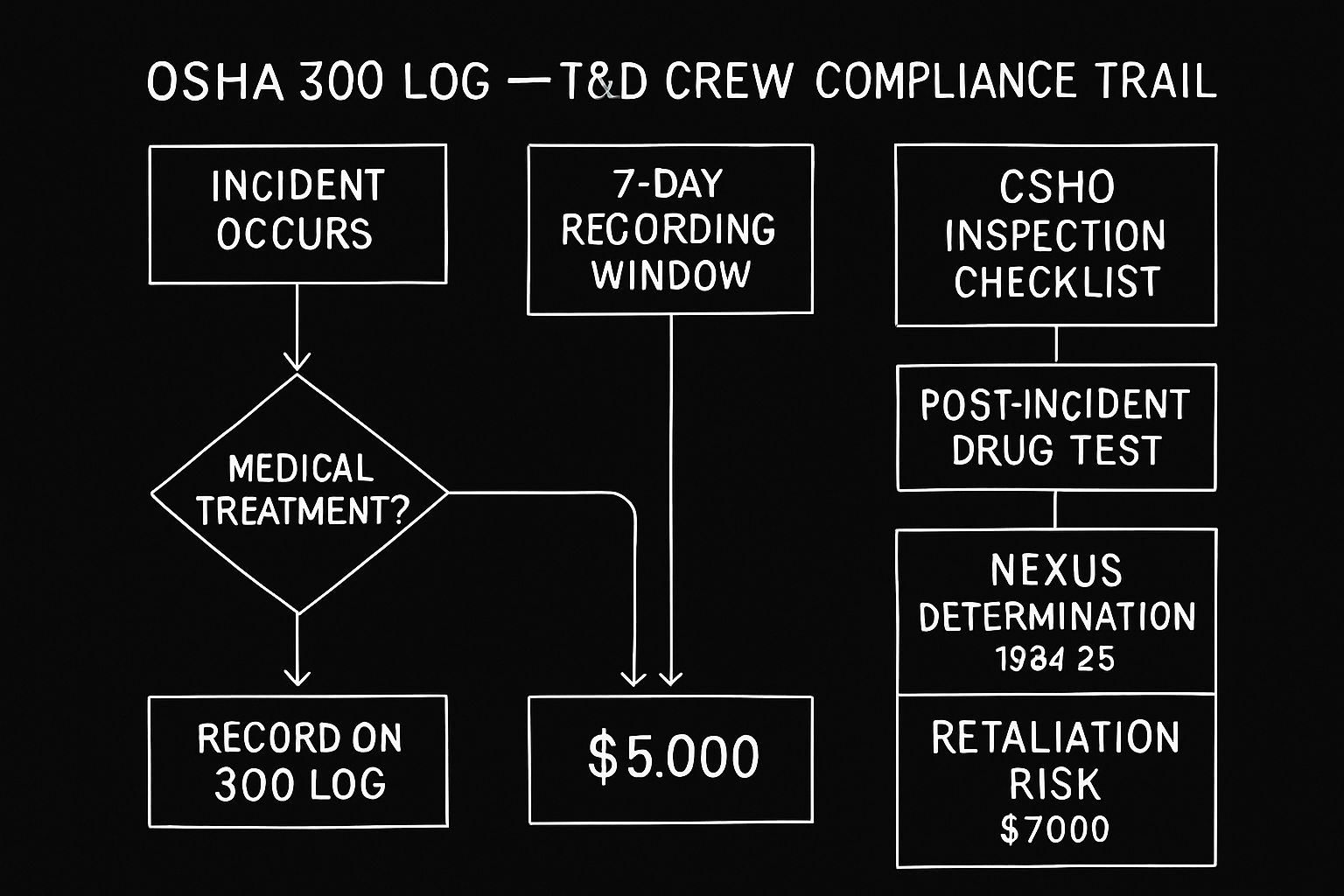
Under 29 CFR 1904.29(b)(3), an employer has seven calendar days to record a work-related injury or illness on the 300 log after learning that the injury or illness occurred. This is not seven business days. It is not seven days after the employee returns to work. It is seven calendar days from the date the employer — meaning any management representative — becomes aware of the incident.
In T&D field operations, the breakdown happens in the handoff. A journeyman lineman on a line reconductoring project in a rural corridor gets a back strain at the end of a 10-hour shift on a Friday. He tells his crew foreman. The foreman logs it in his paper field incident book, intends to send it up on Monday, and then the crew rotates to a different job site. The area supervisor doesn't see it until day nine. That employer just earned a recordkeeping violation under 29 CFR 1904.29(b)(3).
Penalty exposure for a serious recordkeeping violation: up to $16,131 per violation (2024 OSHA penalty structure). Each missed or late entry is a separate violation. A crew with four unreported injuries from a single transmission line rebuild project is looking at $64,524 in recordkeeping penalties alone — before any citations for the underlying hazards are issued.
The operational reality for T&D contractors is that their crews are mobile and dispersed across multi-county project footprints. The 7-day clock doesn't care about geography. The reporting chain needs to be defined in writing, and foremen need to understand that "told my supervisor" is not the same as "the employer has knowledge." OSHA's knowledge attribution rules under general industry enforcement principles treat any supervisory employee's knowledge as the employer's knowledge.
What Must Actually Be Recorded: The T&D-Specific Criteria That Get Missed
Under 29 CFR 1904.7(a), a work-related injury or illness must be recorded if it results in any of the following: death, days away from work, restricted work or job transfer, medical treatment beyond first aid, loss of consciousness, or a diagnosis of a significant injury or illness by a healthcare professional.
For transmission and distribution crews, four categories consistently generate missed recordings:
- Arc flash incidents with secondary injury: A substation electrician working switching operations on a 15 kV distribution bus experiences an arc flash event. He's not hospitalized, but the occupational health clinic documents corneal flash burns and prescribes ophthalmic medication. That is medical treatment beyond first aid. It goes on the 300 log. The fact that he returned to work the same day is irrelevant.
- Musculoskeletal strain with restricted duty: A transmission lineman pulls a rotator cuff loading transformer components from a flatbed. He's put on "light duty" for three days — meaning no overhead work. That is recordable restricted work activity under 29 CFR 1904.7(b)(4). "Light duty" is not a recording exemption. It is a recording trigger.
- Heat illness with loss of consciousness: A groundman on a summer line crew loses consciousness briefly during a heat exhaustion event. Loss of consciousness is recordable regardless of duration or whether medical treatment was sought. This one gets missed because the crew handles it internally and the foreman files it as "first aid — hydration."
- Hearing loss from equipment exposure: Under 29 CFR 1904.10, standard threshold shifts in audiometric testing are recordable. T&D crews working near high-voltage line noise, diesel generator banks, and hydraulic equipment are chronically exposed. Audiometric programs that don't pipe results back to the safety department create invisible recordkeeping gaps.
The Counterintuitive Truth About Post-Incident Drug Testing and OSHA 300 Log Pressure
Most safety managers at utility contractors assume that post-incident drug testing is a protected employer practice — something that lives entirely in HR policy and DOT compliance. OSHA actually looks for whether your drug testing policy is being used to discourage injury reporting, and they will cite you for it under 29 CFR 1904.35(b)(1)(iv).
This is the single most underestimated enforcement mechanism in T&D safety right now.
Under OSHA's anti-retaliation provisions (29 CFR 1904.35(b)(1)(i)–(iv)), employers are prohibited from taking adverse action against employees for reporting work-related injuries. OSHA's enforcement guidance — published in the wake of the 2016 rule amendments — makes clear that a blanket post-incident drug testing policy can constitute a form of adverse action if it is applied automatically to all reported injuries regardless of whether drug use could have plausibly contributed to the incident.
Here is what this looks like in a T&D inspection: A transmission lineman reports a contact injury — his hand was caught between a block and a snatch block during a pulling operation. There is no behavioral indicator, no equipment malfunction trace, no witness account suggesting impairment. Under a blanket policy, he is sent for a urine drug screen. The CSHO reviewing the 300 log notices this case. They pull the 301 incident report. They ask whether drug testing was conducted. They ask whether the testing was mandatory under policy. They examine the policy language.
If the policy reads "all injuries resulting in medical treatment will be subject to post-incident drug testing" — that policy is vulnerable. OSHA's position is that mandatory testing in situations where drug use could not have reasonably contributed to the incident discourages reporting. Employers who terminate or discipline employees based on results from these non-nexus tests are exposed to retaliation citations.
Willful retaliation violations under 29 CFR 1904.35: up to $161,323 per violation. This is not a records-management fine. This is a major citation category.
The correct policy structure requires a reasonable nexus determination before testing is mandated. Testing should be triggered by situations where impairment could plausibly have contributed — not by the mere fact of injury. T&D contractors operating under DOT authority have separate mandatory testing obligations under 49 CFR Part 382 for CDL drivers operating commercial motor vehicles — those obligations are not affected by this analysis and must be maintained independently.
What a CSHO Sees When the Paperwork Trail Breaks Down
An experienced CSHO inspecting a T&D contractor after a serious incident — say, a lineman taken to the hospital following a 12 kV contact event — will reconstruct the paperwork timeline within the first hour. They will request:
- The OSHA 300 log for the current year and the previous three years (29 CFR 1904.44)
- The OSHA 301 incident report for the specific event and any related events from the same crew
- The 300A annual summaries, including the certifying official's signature (29 CFR 1904.32(b)(3))
- Workers' compensation first reports of injury for the same period
- Any post-incident drug testing records and the written policy that triggered them
- The incident notification log to confirm timelines
The gap between workers' comp records and 300 log entries is the most commonly cited discrepancy. When those dates don't align — when WC shows seven injuries in Q3 and the 300 log shows four — the CSHO has probable cause to expand the inspection scope. At that point, the conversation shifts from recordkeeping to underlying hazards, and every line item on that T&D crew's safety program is now in play.
State plan states have additional exposure. In California, Cal/OSHA Title 8 CCR Section 14300 series mirrors federal Part 1904 but includes stricter employer posting and access obligations. In Washington State, WAC 296-27 governs recordkeeping with state-specific definitions that can broaden the recording criteria beyond federal minimums. T&D contractors operating across state lines need to know which standard applies at each project location — federal OSHA or the applicable state plan — and apply the more protective standard where required.
Frequently Asked Questions: OSHA 300 Log for T&D Utility Contractors
If a lineman doesn't report an injury until two weeks after it happened, does the 7-day clock start when he finally reports it?
Yes — with an important qualifier. Under 29 CFR 1904.29(b)(3), the seven calendar days begin when the employer learns of the injury. If the lineman genuinely concealed the injury and no supervisory employee had any knowledge of it until his delayed report, the recording deadline starts from that report date. However, if any foreman or crew lead had knowledge earlier — even informal knowledge like "heard he hurt his shoulder" — that knowledge is attributed to the employer and the clock started then. CSHOs will interview crew members to establish the actual knowledge timeline.
A substation electrician was hurt offsite, driving a company truck to pick up materials. Is that recordable?
Potentially yes. Under 29 CFR 1904.5(b)(6), injuries in company vehicles during work-related travel are generally work-related and recordable. The exception for commuting does not apply if the employee was actively performing a work task — picking up materials for a job site qualifies. The determining factor is whether the employee was in the course and scope of employment at the time. If that vehicle is also a CDL-required commercial motor vehicle, DOT post-accident drug and alcohol testing obligations under 49 CFR 382.303 are also triggered independently.
Our drug testing policy was reviewed by HR legal and approved. Does that protect us from a 1904.35 retaliation citation?
No. Legal review for HR compliance purposes does not insulate a policy from OSHA's anti-retaliation analysis under 29 CFR 1904.35(b)(1)(iv). OSHA evaluates the practical effect of the policy — specifically whether it functions to deter injury reporting. A blanket automatic-testing policy, regardless of how it's drafted or who approved it, remains vulnerable if it applies to incidents where drug use could not have plausibly contributed. This is an area where OSHA's position and standard employment law guidance have diverged, and T&D safety managers need to reconcile both independently.
We're a smaller T&D contractor with fewer than 10 employees. Are we exempt from 300 log requirements?
Partially. Employers with 10 or fewer employees at all times during the previous calendar year are exempt from the routine 300 log maintenance requirement under 29 CFR 1904.1(a)(1). However, this exemption does not apply to fatality and catastrophic incident reporting, which remains mandatory for all employers under 29 CFR 1904.39. A T&D contractor with eight employees who has a lineman fatality on a distribution line rebuild must still report that fatality to OSHA within eight hours. The recordkeeping exemption does not reduce incident reporting obligations.
Can we use our incident management software to satisfy the OSHA 300 log requirement, or does it need to be the official OSHA form?
Equivalent forms are acceptable under 29 CFR 1904.29(b)(4), provided they contain all the data elements required by the official Form 300 and are as readable and understandable. The critical issue for T&D contractors using software platforms is print accessibility — if a CSHO requests the log during an inspection, you must be able to produce a legible printed or displayed version immediately. Software that requires remote server access or is only accessible through a vendor portal creates a compliance gap during field inspections. Keep a current printed copy at each establishment or accessible at the worksite.
What counts as the "establishment" for a mobile T&D crew working across multiple counties on a long-distance transmission project?
This is one of the most practically significant questions in utility recordkeeping. Under 29 CFR 1904.46, an establishment is a single physical location where business is conducted or where services or industrial operations are performed. For mobile field crews, OSHA has historically treated the employer's fixed reporting location — typically the main office or regional dispatch facility — as the establishment. However, if crews are based out of a project-specific staging yard for an extended period, that yard may constitute a separate establishment. The practical guidance: injuries should be recorded at the employer's primary recordkeeping location, and that location must be able to produce the log during an inspection within four business hours as required under 29 CFR 1904.40(a).
For contractors managing ISNetworld®, Avetta®, or Veriforce prequalification, EHS Inc provides fully managed OSHA compliance support. Book a free consultation at EHS Inc.