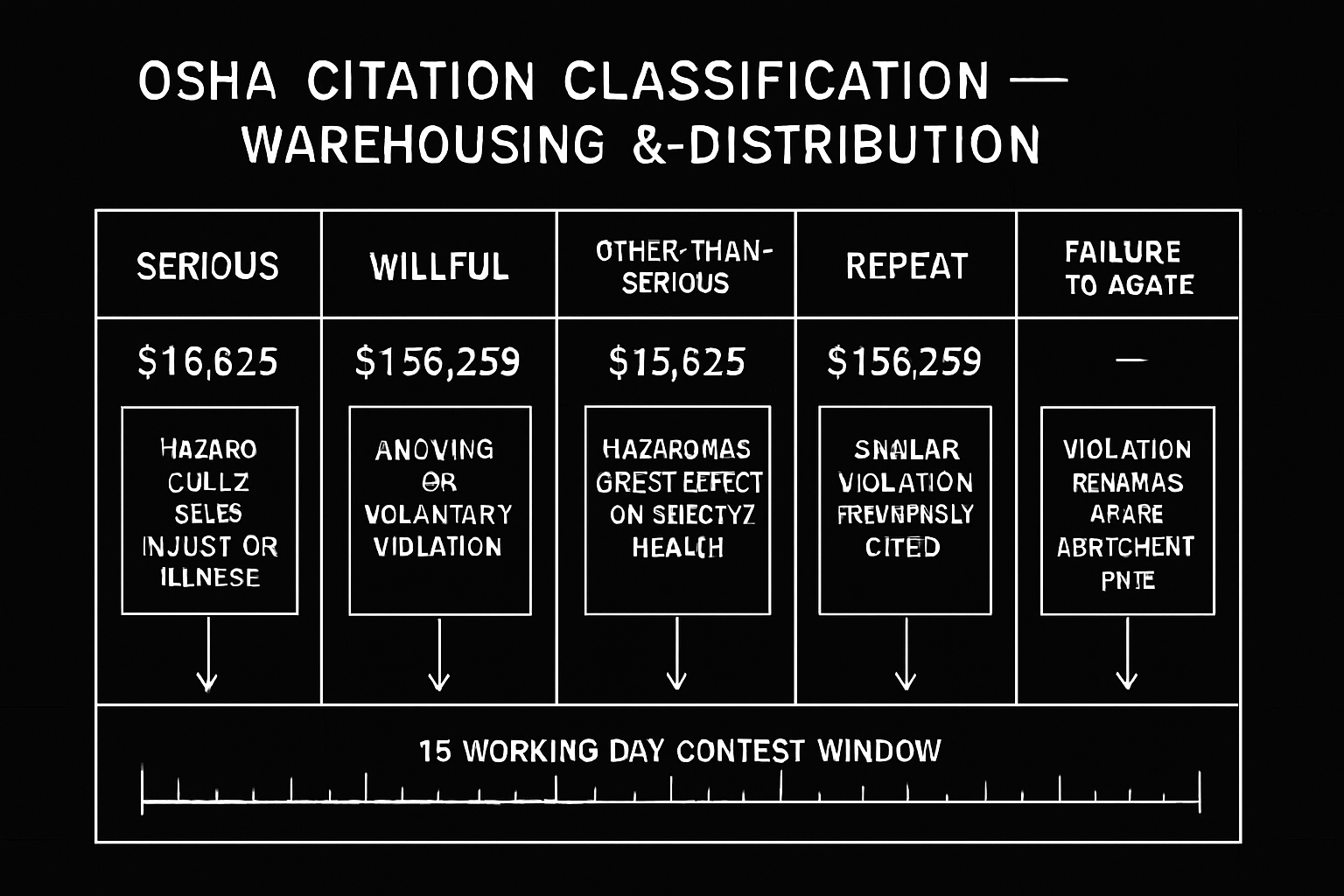
OSHA Citation Types Explained for Warehousing & Distribution: Willful, Serious, Repeat, Failure to Abate, and How to Contest Each
When a Compliance Safety and Health Officer (CSHO) walks through the receiving dock of a fulfillment center or 3PL, they are not reading the poster on the break room wall. They are watching the reach truck operator make a turn. They are looking at whether powered industrial truck (PIT) pre-shift inspection logs exist on paper or exist in reality. They are clocking how long it takes a order-selector to walk a full pick aisle before anyone notices a stranger is on the floor. What the CSHO sees in the first seven minutes shapes every citation classification decision that follows. This guide explains exactly what those classifications mean, what triggers each one in a warehouse environment, and what your response options look like before the 15-working-day contest clock runs out.
What the CSHO Checks First in a Warehouse Inspection
Federal OSHA and most State Plan agencies open warehouse inspections the same way: a walkaround of the receiving and shipping docks, a review of the OSHA 300 log, and an immediate scan of battery charging stations and egress routes. In a 400,000-square-foot fulfillment center running two shifts, a CSHO can identify enough probable-cause observations for a formal inspection in under ten minutes without ever asking a question.
The specific items a CSHO examines first in warehousing and distribution are not random. OSHA's National Emphasis Program (NEP) on Warehousing and Distribution specifically targets powered industrial trucks (29 CFR 1910.178), walking-working surfaces and floor loading (29 CFR 1910.22 and 1910.23), emergency egress under 29 CFR 1910.37, and the lockout/tagout standard at 29 CFR 1910.147. If your 3PL has a conveyor system feeding a sortation line, expect 29 CFR 1910.212 machine guarding to enter the picture within the first thirty minutes.
Serious Citations: The Most Common Outcome in Fulfillment Centers
A serious citation under Section 17(k) of the OSH Act is issued when a CSHO determines that a hazard exists that could cause death or serious physical harm, and that the employer knew or should have known about it. In warehousing, "should have known" does a lot of heavy lifting. A fleet manager at a 3PL with 80 stand-up counterbalanced reach trucks who cannot produce PIT pre-shift inspection records under 29 CFR 1910.178(q)(7) is not going to convince a CSHO that management lacked constructive knowledge of a defective mast or worn forks.
Serious penalty amounts in 2024 reach up to $16,131 per violation. OSHA applies a gravity-based penalty matrix that considers the severity of potential injury (high, medium, low), probability of occurrence (greater or lesser), and four reduction factors: good faith, history, size, and quick fix. A fulfillment center with 500+ employees and a prior inspection record gets minimal credit for size. Good faith reductions require documented safety programs, not binders that were last updated three years ago.
The failure mode that generates serious citations most reliably in warehousing is the gap between written program and field execution. An order-selector at a sort center may receive PIT certification every three years per company policy, but if the training records show 40% of current operators are overdue and a reach truck struck a pallet rack column last quarter, OSHA will cite the training requirement under 29 CFR 1910.178(l) as serious — and the documentation deficiency compounds the gravity score.
Willful Citations: When a Warehouse Manager Knew and Did Nothing
Willful citations are issued when OSHA concludes an employer either intentionally disregarded a known requirement or demonstrated plain indifference to employee safety. The 2024 penalty ceiling is $161,323 per willful violation. In warehousing and distribution, willful citations are not hypothetical. OSHA has issued them to fulfillment center operators for unguarded conveyor nip points after prior citations, for allowing order-selectors to ride on the forks of reach trucks when prior written warnings to supervisors existed, and for ignoring blocked egress routes documented in a prior inspection.
The most reliable path to a willful classification in a 3PL is a paper trail that shows knowledge without action. A safety manager's email saying "we need to fix the conveyor guard on line 3" followed by no repair order, followed by a finger laceration, followed by an OSHA inspection, is a willful citation waiting to be written. The internal documentation you create to track hazards becomes OSHA's evidence if you do not close those items out.
Most EHS managers assume willful citations require proof of malicious intent — OSHA actually looks for documented awareness of the hazard at the supervisory level, not intent to harm. A general manager at a cross-dock facility who received a safety audit finding for inadequate dock plate securing procedures under 29 CFR 1910.22(c) and archived it without corrective action has satisfied OSHA's "knew" element regardless of what they intended.
Other-Than-Serious Citations: Do Not Dismiss Them
Other-than-serious (OTS) citations cover violations that have a direct relationship to job safety and health but would not cause death or serious physical harm. Penalty amounts are discretionary and often reduced significantly, but the 2024 maximum remains $16,131 per violation. In practice, warehouses accumulate OTS citations for recordkeeping failures under 29 CFR 1904 — missing entries on the OSHA 300, late posting of the 300A summary (required February 1 through April 30 under 29 CFR 1904.32), or failure to provide injury and illness records within four hours of a request under 29 CFR 1904.40.
The risk OTS citations create is not the penalty — it is what they become on a second inspection. An OTS recordkeeping citation at a 3PL in 2022 that is cited again in 2024 is now a repeat. The repeat classification multiplies the exposure tenfold.
Repeat Citations: How a $500 Fine Becomes $161,323
A repeat citation is issued when OSHA finds a substantially similar violation to one cited in the prior five years, at any establishment owned by the same employer — not just the same facility. For national 3PL operators and large fulfillment center networks, this matters enormously. A powered industrial truck citation at a distribution center in Memphis creates repeat exposure for PIT violations at the same company's facility in Phoenix.
The 2024 maximum penalty for a repeat violation is $161,323 per violation. OSHA does not need to cite the identical CFR subsection — only a substantially similar hazard. A pallet rack inspection deficiency cited under 29 CFR 1910.22(a) at one site followed by an aisle obstruction citation at a sister facility can qualify as repeat if both relate to walking-working surfaces conditions.
Inbound receiving supervisors and warehouse operations managers are the job titles most often deposed during repeat citation contests because they are the supervisors closest to the daily floor conditions OSHA is comparing across inspection cycles.
Failure to Abate: The Citation That Keeps Charging Daily
A failure to abate notice is not a new citation — it is issued when an employer has not corrected a previously cited violation by the abatement deadline. The penalty accrues at up to $16,131 per day beyond the abatement date. In warehousing, this surfaces most often when a 3PL contests a citation, the contest period extends the abatement deadline, the citation is ultimately affirmed, and the employer then discovers the violation still exists.
The practical failure mode: a fulfillment center receives a citation for inadequate guarding on a takeaway conveyor under 29 CFR 1910.212(a)(1) with a 30-day abatement date. The facility submits an abatement certification letter. OSHA returns six months later and finds the guard was installed but has been removed because a maintenance technician needed access to the motor and never reinstated it. That is failure to abate. The daily penalty clock runs from the original abatement deadline, not the date of the second inspection.
The 15-Working-Day Contest Window: What Happens If You Miss It
After receiving a citation, an employer has exactly 15 working days from receipt to file a Notice of Contest with the OSHA Area Director. Missing this deadline makes the citation a final order of the Occupational Safety and Health Review Commission (OSHRC), enforceable as a federal court judgment. There is no automatic extension. There is no "we didn't understand the form" exception that reliably works after the fact.
Filing a Notice of Contest preserves your rights and sends the case to OSHRC, where an Administrative Law Judge (ALJ) will eventually hear it. Settlement through informal conference with the Area Director is available before or after the Notice of Contest is filed and is how the majority of warehouse citation disputes resolve. Penalty reductions of 30–60% are common in informal settlement when an employer demonstrates prompt abatement, no prior history, and genuine corrective action — not paper correction.
State Plan Considerations for Warehouse Operators
Twenty-two states and two territories operate OSHA-approved State Plans. For warehousing and distribution operators in California (Cal/OSHA), Washington (L&I), and Michigan (MIOSHA), the citation structure differs in important ways. Cal/OSHA under Title 8 CCR 3668 imposes forklift operator training requirements that are more specific than federal 29 CFR 1910.178(l) and allows repeat citation lookback beyond five years in some circumstances. Washington L&I under WAC 296-863 has additional powered industrial truck operator evaluation requirements that federal OSHA does not explicitly mandate in the same format. Michigan's MIOSHA citations under Part 21 (Powered Industrial Trucks) have their own penalty calculation methodology distinct from federal gravity-based scoring. Multi-state 3PL operators need a citation management protocol that accounts for which standard applies at each DC location — the federal standard is the floor, not the ceiling, in State Plan jurisdictions.
FAQ: OSHA Citations in Warehousing and Distribution
Can OSHA cite us for a violation that did not cause an injury?
Yes. OSHA citations are based on the existence of a hazard and employer knowledge, not on whether an injury occurred. A reach truck operating with a cracked overhead guard can be cited under 29 CFR 1910.178(e)(1) regardless of whether anyone was hurt. The absence of injury affects the probability component of penalty calculation, not citation issuance.
If we fix the violation immediately during the inspection, does that eliminate the citation?
No. Immediate correction may qualify for a "quick fix" penalty reduction of up to 15% under OSHA's penalty reduction guidelines, but the citation is still issued. Correcting the hazard while the CSHO is on-site is worth doing for safety reasons and for the reduction credit — but do not let a field supervisor promise a CSHO that correction means no citation. That misunderstanding has caused 3PL safety managers real problems when they later try to contest.
We have multiple warehouse locations. Does a citation at one site affect the others?
For repeat citation purposes, yes. OSHA looks at all establishments owned by the same employer when determining whether a violation is repeat. A safety director managing a 12-DC 3PL network needs a centralized citation tracking system specifically because a citation at the Memphis facility creates repeat exposure for substantially similar conditions at every other location in the network.
What is the difference between an informal conference and filing a Notice of Contest?
An informal conference is a meeting with the OSHA Area Director held within the 15-working-day contest window. It is the fastest path to penalty reduction and citation modification without formal litigation. Filing a Notice of Contest sends the case to OSHRC for adjudication before an ALJ. You can pursue an informal conference and still file a Notice of Contest to preserve your rights — in practice, most warehouse employers do both simultaneously when the penalty exposure is significant.
Can a temporary staffing agency and the host employer both be cited for the same hazard?
Yes. Under OSHA's multi-employer citation policy, both the staffing agency (creating employer) and the host fulfillment center (controlling employer) can receive citations for the same violation affecting temporary order-selectors or pickers. The host employer's responsibility under 29 CFR 1910.178 and the controlling employer doctrine does not disappear because the worker's W-2 comes from a temp agency. This is one of the most consistently misunderstood exposures in the 3PL model.
How long does OSHA have to issue a citation after an inspection?
OSHA must issue citations within six months of the alleged violation — specifically within six months of when the CSHO observed or could have discovered the condition. For inspections triggered by a fatality or catastrophe at a fulfillment center, this timeline does not expand, but the inspection itself is typically more thorough and may uncover violations that extend the scope significantly.
For contractors managing ISNetworld®, Avetta®, or Veriforce prequalification, EHS Inc provides fully managed OSHA compliance support. Book a free consultation at EHS Inc.