OSHA 29 CFR 1926.1400 Crane Compliance for Roofing & Specialty Trade Contractors: What the A/D Director, Operator Certification, and Pre-Shift Inspection Actually Require
A roofing crew is setting up a personnel/material hoist or swinging a knuckle-boom crane into position to lift bundles of TPO membrane to a six-story commercial roof deck. Someone gets caught in a pinch point during assembly. OSHA shows up within 24 hours. The compliance safety and health officer (CSHO) doesn't start with the injury itself — they start with three questions: Who directed the assembly? Can your operator prove certification? Where is yesterday's pre-shift inspection record? If you can't answer all three cleanly, you are about to get cited under 29 CFR 1926.1400 — and the crane standard's penalty exposure is not forgiving.
This guide breaks down exactly what those three requirements demand, why roofing and specialty trade contractors fail them, and what a CSHO's inspection log looks like after a near-miss investigation on your jobsite.
Why Roofing Contractors Are a High-Priority Target Under 1926.1400
Crane and derrick incidents in roofing and specialty trades share a pattern that OSHA's Area Offices recognize immediately: the equipment is rented or subcontracted, the assembly is treated as a "set-up task" rather than a regulated lift, and the person overseeing the assembly is often the foreman who also runs the roofing crew — not a trained assembly/disassembly (A/D) director. Roofing contractors regularly use articulating/knuckle-boom cranes, telescoping boom trucks, and self-erecting tower cranes on commercial reroofing projects. Each of these triggers full coverage under 29 CFR 1926.1400(a) — there is no "small crane" or "short-duration" exemption that saves you.
When the CSHO opens an investigation after a pinch-point injury or a dropped load, the paperwork trail they request in the first hour typically includes: the operator's certification documents, the most recent pre-shift inspection record, and any written A/D procedures. In roofing, those three items are almost never in the same place — and sometimes none of them exist.
The Assembly/Disassembly Director: Who Actually Has to Be There
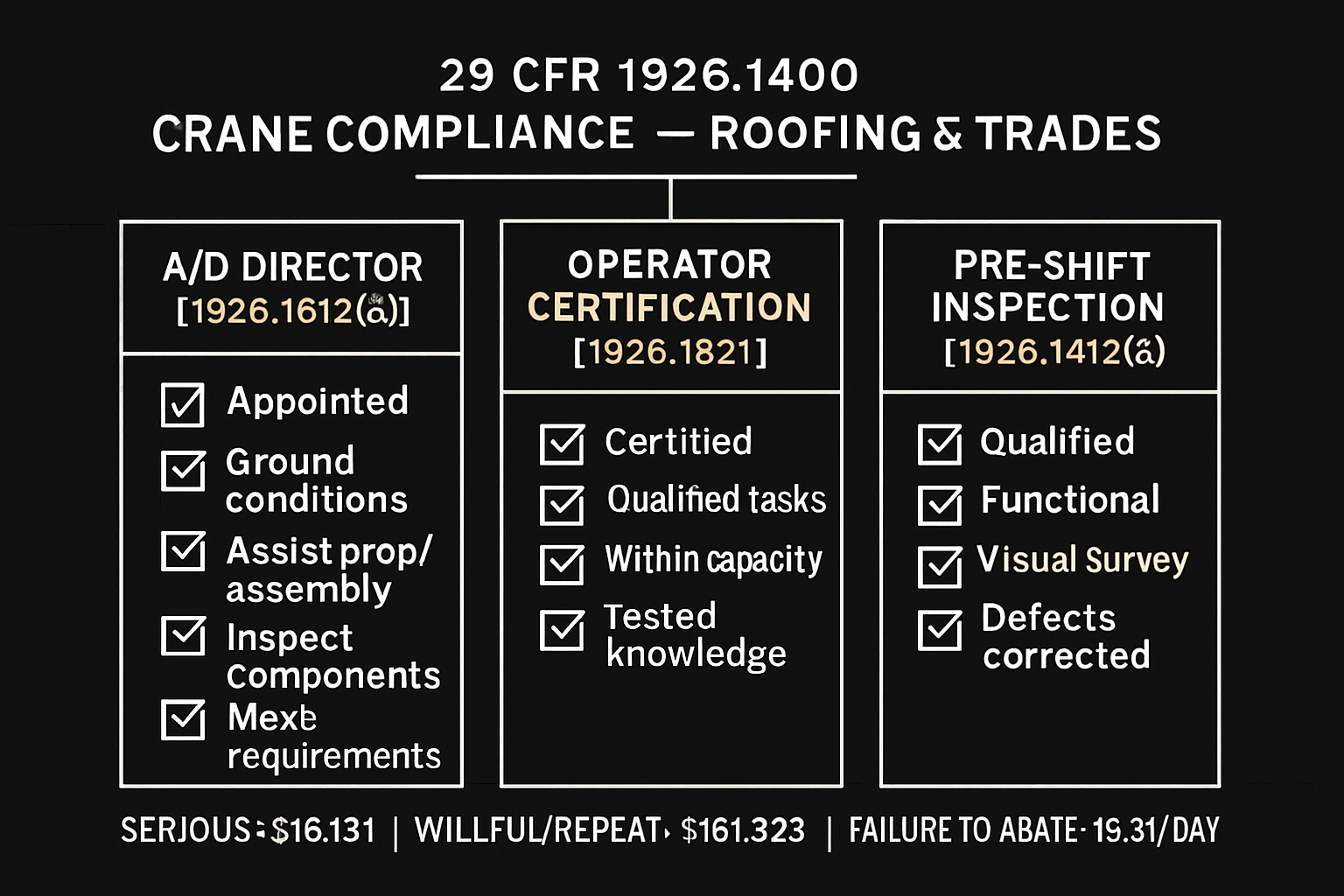
Under 29 CFR 1926.1412(a)(1), a qualified person must be designated as the A/D director and must be present on-site during the entire assembly and disassembly process. "Present" means physically there — not available by phone, not on the adjacent roof section, not in the crew truck filling out paperwork.
In roofing, the failure mode looks like this: a crane rental company delivers and begins erecting a self-erecting tower crane on Monday morning. The roofing company's project superintendent is treating this as the rental company's problem. The rental company's driver/operator assumes the roofing foreman is the A/D director because it's his site. Nobody has been formally designated in writing. When the CSHO arrives after an incident, both parties point at each other — and OSHA cites both under 29 CFR 1926.1412(a)(1) as a serious violation at up to $16,131 per violation.
What the standard actually requires the A/D director to do goes well beyond standing nearby. Per 29 CFR 1926.1412(a)(2), the director must understand the applicable procedures — either the equipment manufacturer's instructions or a qualified engineer's written procedures — and must ensure those procedures are followed step by step. If the self-erecting tower crane manufacturer's erection sequence specifies that outriggers must be fully extended and locked before the mast is raised, the A/D director must verify that sequence, not assume it happened. On a roofing site where the crane is being erected on a membrane-covered parking garage deck, that outrigger verification also intersects with the ground conditions assessment required under 29 CFR 1926.1402 — another common citation trigger in this trade.
Counterintuitive insight: Most roofing project managers assume that if they're renting the crane and the rental company is doing the assembly, the rental company owns the A/D director obligation. OSHA actually looks at who controls the worksite. If you are the controlling employer under the multi-employer citation policy, you can be cited for the A/D director violation even if you never touched the crane. The CSHO will pull your contract with the crane rental company and your site control documentation on the first day of the inspection.
Operator Certification: What the Card Must Say and What It Can't Cover
Under 29 CFR 1926.1427(a), crane operators must be certified or qualified through one of four pathways: accredited crane operator testing organization (e.g., NCCCO, NCCER), an audited employer program, the U.S. military, or a state/local licensing program where applicable. For roofing and specialty trade contractors, NCCCO certification is the most common pathway — but certification alone doesn't close every compliance gap.
NCCCO issues certifications by crane type. A roofing contractor using a mobile telescoping boom crane on one project and a knuckle-boom articulating crane on the next needs to verify that the operator's NCCCO certificate specifically covers the equipment being used. An operator certified for Telescopic Boom Cranes is not automatically qualified to operate an articulating/knuckle-boom crane under 29 CFR 1926.1427(a)(1)(ii). This is a citation that OSHA issues in this trade repeatedly — the certification card exists but covers the wrong equipment type.
When the CSHO arrives after a near-miss involving a knuckle-boom crane on a roofing project, the first document they request is the operator's certification. The second is the crane's load chart. If the operator can produce an NCCCO card that covers a different crane type, that card does not satisfy the standard. The violation is cited as serious at up to $16,131 — and if the employer knew the operator wasn't certified for that specific crane type, it becomes willful at up to $161,323.
California roofing contractors have an additional layer: Cal/OSHA's 8 CCR 5006.1 requires crane operators to hold a valid license issued by the Division of Occupational Safety and Health. Federal NCCCO certification alone does not satisfy California's requirement. Washington State similarly enforces WAC 296-155-53300, which requires a crane operator certificate of competency issued by the Department of Labor & Industries. Roofing contractors crossing state lines with their crane operators need to audit certification compliance per-state before the equipment arrives on site.
Pre-Shift Inspection: The Paper Trail That Saves or Sinks You
Under 29 CFR 1926.1412(e), a competent person must conduct a visual inspection of the crane before each shift. The inspection must cover all the items listed in 29 CFR 1926.1412(e)(1)(i) through (xiv) — including the operational and emergency controls, wire rope, hooks and latches, outriggers, hydraulic systems, and load lines. None of this is optional and none of it can be delegated to someone who hasn't been established as a competent person under the standard's definition.
On a roofing project, the pre-shift inspection consistently fails in one of three ways. First, the crane operator completes a verbal walk-around but nothing is written down. The standard doesn't explicitly mandate a written record for the pre-shift inspection — but when OSHA investigates an incident, the absence of documentation is treated as evidence the inspection didn't happen. Second, the inspection form used is the one the crane rental company left in the cab, which covers a different crane model and doesn't address all the items in 1926.1412(e)(1). Third, the inspection is completed by the roofing laborer who moves the crane between positions during the day — not by a person who has been trained and designated as competent.
If the CSHO finds a crane that has been operating on a roofing project for three days and there are zero pre-shift inspection records, that is three separate violations at up to $16,131 each. If the employer received a prior citation for the same issue and didn't fix it, the repeat classification brings each violation to up to $161,323. If OSHA issues an abatement order and the employer continues operating without completing inspections, the failure-to-abate penalty runs at up to $16,131 per day.
The competent person conducting the pre-shift inspection must also know what to do when they find a deficiency. Under 29 CFR 1926.1412(e)(2), if a condition that creates a safety hazard is identified, the equipment must be taken out of service until the deficiency is corrected. On a roofing project with tight schedules and a crane rental cost running by the day, the pressure to "run it anyway and fix it tonight" is real — and it is exactly the kind of decision that turns a serious citation into a willful one when OSHA investigates.
What the CSHO's Inspection Log Actually Looks Like
After a near-miss or injury involving a crane on a roofing project, the CSHO's opening conference typically runs through this sequence: they request the operator's certification, the pre-shift inspection records for the current shift and the two prior shifts, the written A/D procedure and the name and qualifications of the A/D director, the crane's annual inspection records under 29 CFR 1926.1412(f), and the ground conditions assessment. They photograph the crane's serial number and pull the equipment's operational history. They interview the operator, the foreman, and any other workers who were present during assembly.
In roofing investigations, the CSHO almost always finds that the operator's certification is on file somewhere but wasn't verified for the specific crane type. The pre-shift records are either missing or incomplete. The A/D director was never formally designated. These three conditions together — not just one in isolation — are what drives the citation grouping that roofing contractors see after incidents. A grouping of three serious citations under 1926.1400 starts at $48,393 in serious penalties before any repeat or willful classifications are applied.
FAQ: What Roofing Contractors Actually Ask
We rented the crane — doesn't the rental company own the crane compliance obligations?
No. Under OSHA's multi-employer worksite policy, the controlling employer — typically the roofing contractor managing the site — can be cited for crane violations even when a subcontractor or rental company is operating the equipment. The A/D director obligation under 29 CFR 1926.1412(a)(1) falls on whoever controls the worksite. Clarify this in your crane rental contracts before equipment arrives, and designate the A/D director in writing before assembly begins.
Our operator has an NCCCO card — isn't that enough?
Only if the card covers the specific crane type being operated on your project. NCCCO certifies by equipment category. An operator certified for Telescopic Boom Cranes cannot legally operate an articulating/knuckle-boom crane under 29 CFR 1926.1427 without the corresponding certification. Verify the certification type matches the equipment before the operator takes the controls — not after a near-miss.
The pre-shift inspection form from the crane rental company — can we use that?
Only if it covers all the items required by 29 CFR 1926.1412(e)(1)(i) through (xiv). Many manufacturer and rental company forms do not cover every item the OSHA standard requires. Cross-reference the form against the standard's checklist before using it. If it's missing items, add them. Keep completed forms on the jobsite and accessible — not at your main office.
We're in California. Do federal crane rules apply to us?
California operates a state OSHA plan under Cal/OSHA, which enforces standards at least as strict as federal OSHA. California's 8 CCR 5006.1 requires a state-issued crane operator license in addition to any federal certification requirements. Cal/OSHA enforcement of crane operator licensing is aggressive — verify your operators hold a valid California crane operator license before any lift on a California project.
How long do we have to keep pre-shift inspection records?
The standard under 29 CFR 1926.1412 doesn't specify a retention period for pre-shift inspection records, but OSHA's general recordkeeping expectations and the practical reality of incident investigations mean you should retain them for a minimum of three years. During an investigation triggered by an incident, OSHA will request records going back to the start of the project. If those records don't exist, absence of documentation is treated as evidence of non-compliance.
What's the difference between a "competent person" and a "qualified person" under the crane standard — and does it matter for pre-shift inspections?
Yes, it matters significantly. Under 29 CFR 1926.1401, a competent person is someone who can identify existing and predictable hazards and has authority to take corrective action — typically established through training and employer designation. A qualified person has a recognized degree or extensive knowledge in the field. Pre-shift inspections under 29 CFR 1926.1412(e) require a competent person — a lower threshold than qualified. But "competent" still means documented training and formal designation. Your roofing laborer who happens to move the crane is not a competent person until you train and designate them as one.
For contractors managing ISNetworld®, Avetta®, or Veriforce prequalification, EHS Inc provides fully managed OSHA compliance support. Book a free consultation at EHS Inc.