OSHA Emergency Action Plan Requirements Under 29 CFR 1910.38 for Commercial Construction GCs and Subcontractors
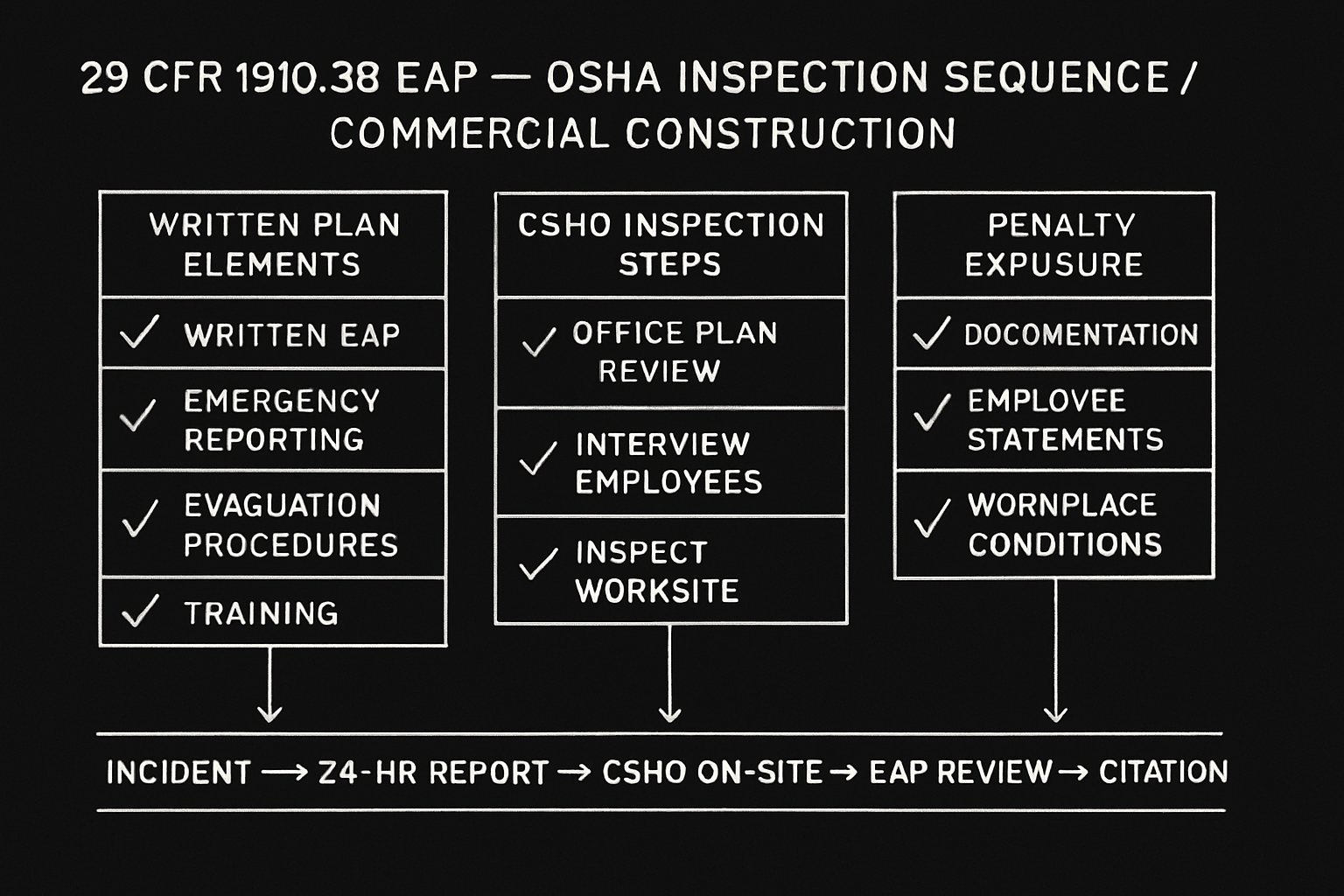
A laborer on your concrete pour crew gets struck by a reversing dump truck. EMS responds. The foreman calls it in. Within 24 hours — sometimes less — a Compliance Safety and Health Officer (CSHO) is on-site under OSHA's severe injury reporting protocol triggered by the hospitalization. The first thing that CSHO asks for after your OSHA 300 log? Your Emergency Action Plan.
This is how 29 CFR 1910.38 violations get found in commercial construction. Not during proactive inspections — though those happen too — but in the aftermath of a near-miss, a struck-by, a fall, or a collapse. The EAP is a paper trail that either proves you had a functional emergency response system or exposes the fact that you had a template downloaded from the internet five years ago that nobody has looked at since.
This guide is written for GCs and subcontractors in commercial construction with 25 to 200 employees. Everything here is specific to your work environment: multi-employer job sites, rotating subcontractor crews, high-hazard trades, and the operational reality that your "office" might be a job trailer that moves every six months.
Why 29 CFR 1910.38 Applies to Construction — and Why Contractors Get Confused
Most contractors assume the emergency action plan standard lives in 29 CFR 1926 — the construction standards. It does not. Federal OSHA enforces 29 CFR 1910.38 across general industry and construction under the General Duty Clause and through specific cross-references in 1926 subparts. Cal/OSHA enforces its equivalent under 8 CCR 3220, which mirrors the federal structure but adds specific notification requirements for high-hazard operations common in construction, including excavation and concrete work.
In Washington State, WAC 296-800-300 governs emergency action plans and is enforced by L&I with additional specificity around mustering accountability — something federal OSHA's standard leaves vague. If you operate in these states, the federal standard is your floor, not your ceiling.
What the Written Plan Must Actually Contain — 29 CFR 1910.38(c)
Under 29 CFR 1910.38(c), a written Emergency Action Plan must include six specific elements. In commercial construction, each one has a failure mode that shows up repeatedly during post-incident inspections.
1. Emergency escape procedures and routes — 29 CFR 1910.38(c)(1). On a vertical construction project — say, a 12-story cast-in-place concrete structure — "escape routes" are not abstract. They are specific stairwells, temporary stairs, or manlifts. Your EAP must name them. A plan that says "use nearest exit" fails immediately when a CSHO asks your ironworkers which stairwell to use if the east core is on fire. If they don't know, you don't have a functional plan.
2. Procedures for employees who remain to operate critical operations — 29 CFR 1910.38(c)(2). On active construction sites, this applies to crane operators who cannot simply abandon a suspended load, concrete pump operators mid-pour, and utility workers managing temporary power systems. Your EAP must specifically address what these employees do during evacuation. A crane operator who stays on the machine during a fire evacuation is following protocol — but only if the protocol is written down and trained to.
3. Procedures to account for all employees after evacuation — 29 CFR 1910.38(c)(3). This is where multi-employer job sites fall apart. When three subcontractors are working the same floor simultaneously — say, your drywall crew, an MEP sub, and a flooring installer — who is accounting for whom at the muster point? The GC's superintendent? Each sub's foreman? This accountability gap is exactly what a CSHO documents after a building fire or collapse event where the headcount was chaotic.
4. Procedures to rescue and provide medical assistance to employees — 29 CFR 1910.38(c)(4). Not "call 911." Actual procedures: who is the designated first responder on site, where is the first aid kit relative to the muster point, and does your EAP address elevated work areas where rescue may require the aerial lift operator to retrieve a worker from an upper floor before evacuation can complete?
5. Preferred means of reporting fires and other emergencies — 29 CFR 1910.38(c)(5). In commercial construction, cellular dead zones are common in below-grade work — parking garages, tunnels, underground utility work. Your EAP must address communication failures. Radios, runners, hardwired phones in the job trailer — whatever your site uses, it needs to be in the plan and demonstrated to work.
6. Names or job titles of persons who can be contacted — 29 CFR 1910.38(c)(6). This is where most construction EAPs become immediately obsolete. A plan listing the project superintendent by name fails when that super rolls off the job and the name isn't updated. OSHA wants a system, not a specific person. List the role — "Site Safety Manager," "Project Superintendent" — and maintain a separate contact roster that gets updated with personnel changes.
The Drill Requirement — What 29 CFR 1910.38 Actually Says vs. What Contractors Think It Says
Here is the counterintuitive insight that surprises experienced safety managers: Most safety managers assume OSHA requires documented evacuation drills at a set frequency under 29 CFR 1910.38 — but the standard itself contains no explicit drill frequency mandate for most construction applications. What OSHA actually looks for is evidence that employees have been trained on the EAP under 29 CFR 1910.38(e), that they can demonstrate knowledge of their responsibilities, and that the plan has been reviewed with each employee when they are first assigned to a job where an EAP is in effect.
That said, drilling is the mechanism OSHA uses to assess whether training was effective. During a post-incident investigation, if a CSHO interviews three carpenters and none of them can identify the muster point, name the on-site emergency contact, or describe the alarm signal — that training record you produced means nothing. The absence of demonstrated knowledge is treated as a failure to train, which feeds directly into a 29 CFR 1910.38(e) citation.
Cal/OSHA under 8 CCR 3220 goes further and includes specific language around emergency response drills for sites with more than ten employees, making documentation of drill frequency a practical necessity in California even when the federal standard does not mandate it explicitly.
How OSHA Penalty Exposure Builds After a Construction Incident
When a CSHO arrives at your site following a hospitalization — triggered by the mandatory 24-hour reporting requirement under 29 CFR 1904.39(a)(2) — the investigation typically generates a citation package, not a single citation. A missing or inadequate EAP under 29 CFR 1910.38 is almost always a serious violation, carrying penalties up to $16,131 per violation (2024 figures).
The exposure compounds when OSHA discovers the same employer had a prior EAP citation at another project. That converts a serious violation into a repeat violation, with penalties up to $161,323. In commercial construction where GCs operate multiple projects simultaneously, a citation on Project A creates repeat exposure on Projects B, C, and D if the same deficiency exists.
Failure to abate — meaning you received a citation, agreed to a correction date, and OSHA finds the problem still exists — carries penalties up to $16,131 per day beyond the abatement deadline. For a GC managing a two-year build-out, an unresolved EAP citation at month three can generate six-figure exposure by month six without anyone on the project team realizing the clock is running.
What the CSHO Actually Looks at When They Walk In
Based on how post-incident construction inspections unfold, here is the sequence a CSHO typically follows when evaluating EAP compliance:
Step 1 — Document request. The CSHO asks for the written EAP immediately. If you hand them a generic template with the project name filled in on line one and no site-specific information anywhere in the body, that is a red flag. CSHOs recognize boilerplate plans. They know what a real site-specific plan looks like versus one generated from a safety software auto-populate function.
Step 2 — Employee interviews. The CSHO will walk the site and interview workers — specifically the trades most likely to have been involved in the incident. Roofers, ironworkers, operating engineers — they will be asked: "Where do you go if there's a fire?" "How do you report an emergency?" "Who is the emergency contact on this site?" If the answers are inconsistent or blank, the EAP is functionally non-existent regardless of what's in the document.
Step 3 — Training records review. Under 29 CFR 1910.38(e), training must occur when the plan is first developed, when new employees are assigned to the job, and when the plan changes. The CSHO will look for sign-in sheets or training records that correspond to employee hire dates and any major site changes — like when a new subcontractor came on board and brought 40 additional workers onto a site with an existing EAP.
Step 4 — Physical site walk. The CSHO will verify that muster points exist and are marked, that alarm systems function (if applicable), and that escape routes are physically accessible — not blocked by stored materials, which is common during active commercial construction phases when every square foot of floor space is contested.
The Multi-Employer Site Problem That Nobody Talks About
On a commercial construction project, a GC with a 150-person site may have its own EAP — and five subcontractors, each with their own EAPs that conflict with the GC's. Different muster points. Different alarm signals. Different emergency contacts. When the CSHO interviews an electrician from the MEP sub, that electrician describes the sub's EAP. When the CSHO interviews a concrete finisher from the GC's direct workforce, they describe a different procedure.
This is a real failure mode. The GC, as the controlling employer under OSHA's multi-employer citation policy, carries liability for ensuring that all workers on the site — including subcontractor employees — are covered under a unified or coordinated emergency action plan. The sub's plan does not insulate the GC from citation if the GC's plan does not address sub crew accountability.
Frequently Asked Questions From Commercial Construction Contractors
Do we need a written EAP if we have fewer than 10 employees on the job site?
Under 29 CFR 1910.38(b), employers with 10 or fewer employees may communicate the EAP orally rather than maintaining a written document. However, in commercial construction, this threshold applies to your entire workforce — not just the crew on one phase. If you have 12 carpenters, a superintendent, and a project manager on site, you are at 14 and a written plan is required. Multi-employer sites complicate this further. When in doubt, produce a written plan. The cost of drafting one is trivially small compared to citation exposure.
Who is responsible for the EAP when a GC uses 100% subcontracted labor?
The GC retains responsibility as the controlling employer on site. Under OSHA's multi-employer citation policy, a controlling employer can be cited for hazardous conditions created by a subcontractor if the controlling employer knew or should have known about the condition and failed to exercise reasonable care. An EAP gap created by a sub that the GC never coordinated with is a GC problem during an OSHA investigation.
Our project superintendent changes every six months. Do we have to update the EAP every time?
The plan must be kept current. 29 CFR 1910.38(f) requires the plan to be reviewed with each employee when it changes. If your designated emergency contact is now a name that hasn't been on the project for four months, that plan is out of compliance. The practical fix is to use job titles rather than names in the plan body and maintain a separate, separately updated contact roster.
We had an EAP on our last project. Can we reuse it for the new one?
A prior project's EAP is a starting template, not a transferable compliance document. Muster points, egress routes, alarm systems, and emergency contacts are all site-specific. Using an old plan without revision — especially if the site layout, hazard profile, or subcontractor mix has changed — will be immediately apparent to a CSHO who compares the plan to the physical site.
Does OSHA require us to conduct fire drills on a construction site?
Federal 29 CFR 1910.38 does not specify a drill frequency for most construction applications. However, employee training under 29 CFR 1910.38(e) must be demonstrably effective. If your workers cannot articulate emergency procedures during an OSHA interview, you have a training failure regardless of whether formal drills were conducted. Cal/OSHA under 8 CCR 3220 is more prescriptive — California contractors should treat documented drills as effectively mandatory.
What happens if OSHA cites us for an EAP violation and we're in the middle of a project?
The abatement period for an EAP citation is typically short — often 30 days or fewer for a serious violation. You correct the deficiency, submit documentation to OSHA's Area Office, and close the citation. The danger is the repeat exposure: if OSHA returns to any of your other projects and finds the same deficiency, or if a subsequent incident triggers another inspection within three years of the original citation, the serious violation converts to a repeat at up to $161,323 per instance.
For the full text of 29 CFR 1910.38, visit the OSHA standard page on osha.gov.
This guide is provided for educational purposes only and does not constitute legal advice. Consult a qualified EHS professional or legal counsel for guidance specific to your operations and jurisdiction.
For contractors managing ISNetworld®, Avetta®, or Veriforce prequalification, EHS Inc provides fully managed OSHA compliance support. Book a free consultation at EHS Inc.