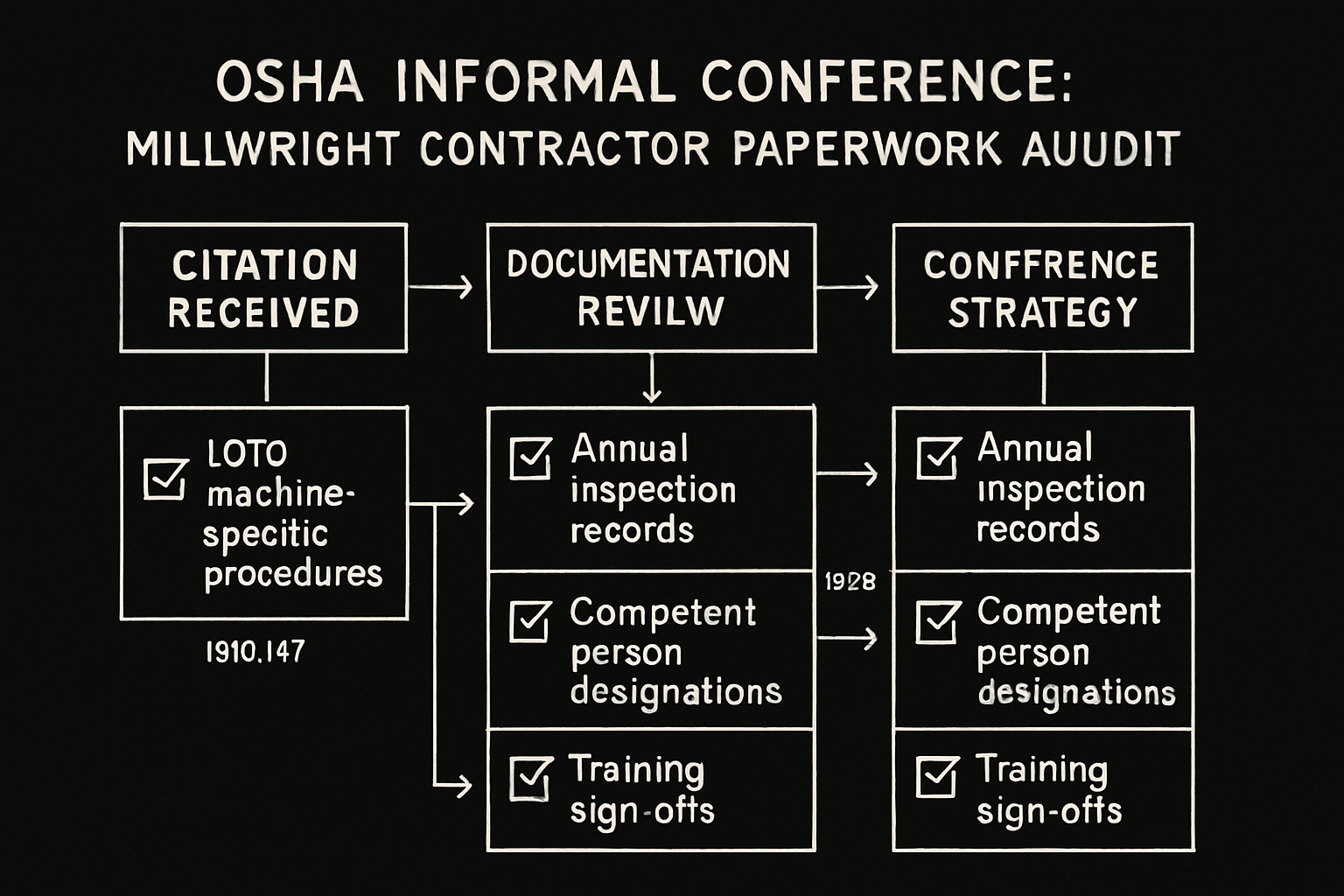
OSHA Informal Conference for Industrial Maintenance & Millwright Contractors: How to Negotiate Citations and Protect Your Paperwork Trail
You've just walked an OSHA Compliance Safety and Health Officer (CSHO) through your millwright crew's active work area. They've photographed your coupling alignment station, reviewed your lockout/tagout (LOTO) energy control procedures, and asked your lead millwright three questions you weren't prepared for. Now the citations are in your hand. The question isn't whether to fight them — the question is whether you have the documentation to survive a negotiation, or whether the paperwork trail you're about to lay down will make things worse.
This guide is written for industrial maintenance and millwright contractors managing multi-employer worksites, ISNetworld® or Avetta® prequalification requirements, and the specific documentation gaps that trigger citation upgrades. The informal conference is your one structured opportunity to reduce penalties before a formal contest — but only if you walk in with the right evidence, the right framing, and a clear understanding of what the CSHO already documented before you said a word.
What the OSHA Informal Conference Actually Is — and What It Isn't
Under 29 CFR 1903.20, an employer has 15 working days from receipt of a citation to request an informal conference with the OSHA Area Director. This isn't an appeal. It's a negotiation. The Area Director has authority to modify citations — reclassify them, consolidate them, reduce penalty amounts, extend abatement deadlines — without any formal hearing.
For millwright contractors, this distinction matters. A willful citation under 29 CFR 1910.147 (LOTO) carries a penalty ceiling of $161,323 per violation as of 2024 federal figures. A serious citation carries up to $16,131 per violation. Failure to abate runs $16,131 per day. The reclassification of even one willful citation to serious — or the consolidation of five serious citations into one instance-by-instance grouping — can represent a six-figure swing. That swing happens at the informal conference, not in front of an ALJ.
What the informal conference is not: it is not a place to tell your side of the story emotionally, to argue that OSHA misunderstood the industry, or to bring your millwright supervisor in to explain what "really happened." The CSHO documented what they observed. Your job is to present evidence that changes the legal characterization of that observation.
The Paperwork Trail OSHA Demands — and Where Millwright Contractors Fail It
When a CSHO walks into an industrial maintenance contractor's field office or a plant maintenance bay, the first thing they look for isn't a violation. They look for the gap between what your written program says and what the physical evidence shows. That gap is the violation.
Here's what that looks like in this industry specifically:
LOTO energy control procedures (29 CFR 1910.147(c)(4)(i)): The standard requires machine-specific written procedures. Most millwright contractors have a generic LOTO program. What they don't have is a procedure written for the specific piece of equipment being serviced — say, a 4,000-ton hydraulic press at an automotive stamping facility, or a 600-HP gearbox in a pulp mill. The CSHO will ask your millwright to produce the energy control procedure for the machine they're currently locked out on. If your millwright hands them a generic form with "various" written in the equipment ID field, that's a serious citation under 1910.147(c)(4)(ii) — and depending on prior history, potentially willful.
Training records (29 CFR 1910.147(c)(7)(iv)): The standard requires retraining when there is reason to believe authorized employees don't understand the procedure. The documentation failure here isn't that training didn't happen — it's that the records don't connect the employee to the specific procedure for the specific machine. You may have a sign-in sheet for a LOTO class from 18 months ago. The CSHO will note that the sign-in sheet doesn't reference a procedure number, doesn't identify the equipment covered, and doesn't document that the employee demonstrated proficiency. That's a documentation failure, not a training failure — and it's a distinction that matters enormously in your informal conference.
Annual LOTO inspections (29 CFR 1910.147(c)(6)(i)): The standard requires a periodic inspection at least annually. The documentation must identify the machine, the date, the employees involved, and the authorized employee who performed the review. In multi-employer environments — a millwright contractor working inside a chemical plant, for example — these inspections often fall through the gaps between the host employer's program and the contractor's program. Nobody owns it. The CSHO finds no records.
Competent person designations (multiple CFR subsections): Under 29 CFR 1926.32(f), a competent person must have the authority to take corrective action. Millwright contractors routinely designate their lead millwright as competent person for rigging operations, confined space entry, and fall protection — but cannot produce documentation showing that individual has been trained and authorized with that designation. A verbal assignment isn't a designation. If your rigging competent person is supervising a pick using chain falls and the CSHO asks for their competent person documentation under 29 CFR 1926.251(a)(1) and you hand them a blank look, that's a paperwork failure with real penalty exposure.
What's Missing vs. What's Wrong: The Critical Distinction for Your Informal Conference
This is where experienced EHS managers earn their pay. There is a meaningful legal difference between a document that doesn't exist and a document that exists but contains an error or gap. At your informal conference, you want to reframe as many citations as possible from the first category into the second — or into evidence that the document existed but wasn't accessible during the inspection.
If your LOTO annual inspection records exist in your corporate safety management system but your field supervisor didn't have access to them on-site, bring those records to the informal conference. The CSHO cited the absence. You're presenting the existence. That's not a retraction of the citation — it's evidence for penalty reduction and potentially for reclassification from willful or repeat to serious, or from serious to other-than-serious.
If the document genuinely doesn't exist, the informal conference is not the time to fabricate it or backdate it. That converts a documentation violation into a much larger problem. What you can bring instead is evidence of good faith: corrective action already completed, a new program implemented since the inspection, training records that demonstrate the underlying behavior was compliant even if the paperwork wasn't.
Counterintuitive Insight: What OSHA Is Actually Looking For
Most safety managers at millwright and industrial maintenance contractors assume OSHA's primary concern during an informal conference is the severity of the hazard — how dangerous was the exposure, how likely was an injury. OSHA's Area Directors are actually most focused on good faith and history of prior violations.
The penalty calculation under 29 CFR 1903.15 includes reductions for employer size, good faith, and history. Good faith isn't a feeling — it's documented. A contractor who walks in with a written corrective action plan, evidence of immediate abatement, and documentation of management engagement gets a good faith credit. A contractor who walks in and argues that the violation wasn't serious does not. The Area Director has seen every argument. What they haven't seen enough of is contractors who did the work before walking through the door.
For millwright contractors, good faith looks like: a revised machine-specific LOTO procedure written after the citation, proof it was distributed to authorized employees, and a sign-off sheet showing those employees reviewed it. That documentation — produced between the citation date and the informal conference — is worth more in penalty reduction than any legal argument about the standard's applicability.
What to Never Say to a CSHO — Before, During, or After the Inspection
These are not hypothetical. These are statements that have appeared in OSHA case files for industrial maintenance contractors and contributed to willful classifications or penalty increases:
- "We've been doing it this way for 20 years and never had an accident." This is direct evidence of employer knowledge of a hazard combined with a conscious decision not to correct it. That's the definition of willful under OSHA case law.
- "The host employer handles that — we're just the contractor." Multi-employer worksite doctrine under 29 CFR 1910.12 and the multi-employer citation policy means creating employers, controlling employers, and correcting employers each carry independent citation exposure. Deflecting to the host employer is not a defense — it's a flag to look harder at your own program.
- "My guys all know what they're doing." Competency is documented, not assumed. This statement tells a CSHO that no formal training verification exists.
- "That machine has a safety interlock so LOTO doesn't apply." Under 29 CFR 1910.147(a)(2)(ii), minor tool changes during normal operations may qualify for an exception — but only under specific, documented conditions. Claiming the exception without the documentation is an admission that you know the standard applies and chose an undocumented workaround.
- Anything about an ongoing injury claim, workers' compensation, or litigation. These are separate proceedings. Raising them creates confusion and can look like an attempt to leverage a legal outcome against OSHA's enforcement process.
How to Request the Informal Conference and What to Bring
Submit the written request to the OSHA Area Office within 15 working days of citation receipt. The request should be brief — identify your company, the citation number, and your intent to discuss the matter. Don't argue your case in the request letter. Save that for the conference.
Bring to the conference:
- A citation-by-citation written response that addresses each CFR subsection cited, not just the general standard
- Corrective action documentation with completion dates and responsible parties named by title and name
- Any training records, inspection logs, or written procedures that were not available during the inspection but do exist
- Evidence of abatement already completed — photographs, revised procedures, updated LOTO tags or energy isolation diagrams
- Your OSHA 300 log for the past three years, if your history supports a clean record
- Any third-party audit reports, ISNetworld® or Avetta® compliance scores, or insurance carrier safety assessments that speak to program maturity
For state plan states, note that California (Cal/OSHA under Title 8 CCR 3314), Washington (WAC 296-803), and Michigan (MIOSHA Part 85) each have lockout/tagout requirements that are more specific than federal 1910.147 — in some cases requiring additional documentation steps for complex energy sources. If you operate in these states, your informal conference must address the state-specific citation language, not just the federal standard.
Frequently Asked Questions from Millwright and Industrial Maintenance Contractors
Can I bring my attorney to the informal conference?
Yes. You can bring legal counsel, a safety consultant, or a union representative. For contractors with willful citations or repeat citations at the $161,323 penalty level, having an attorney present is standard practice. For smaller penalty cases, an experienced EHS consultant who knows the specific CFR subsections cited is often more effective than general counsel.
If we fix the violation before the conference, does OSHA drop the citation?
No. Abatement eliminates the failure-to-abate penalty accrual, but the original citation stands. What abatement does — when documented thoroughly — is support a good faith penalty reduction and, in some cases, a reclassification from willful to serious. Abatement is evidence of intent to comply, not evidence that no violation occurred.
Our millwright crew was working under the host employer's LOTO program. Are we still responsible?
Yes. Under OSHA's multi-employer worksite policy, a controlling employer who directs the work of a millwright crew has exposure if they knew or should have known of a hazard. A creating employer — whoever set up the energy isolation procedure — has exposure regardless of who performed the work. Your own written program must address how your employees interact with host employer procedures under 29 CFR 1910.147(f)(1) for coordinated LOTO programs.
What's the difference between a serious and other-than-serious citation in practical terms?
A serious citation under Section 17(k) of the OSH Act requires that there is substantial probability of death or serious physical harm. An other-than-serious citation means the violation directly relates to job safety but would not likely cause death or serious injury. For millwright contractors, a missing LOTO annual inspection record is typically cited as serious because the underlying hazard — unexpected energization of machinery — is lethal. The paperwork failure is cited as the vehicle for the hazard exposure.
Can OSHA upgrade a citation after the informal conference?
OSHA can withdraw citations, reduce them, or modify them at the informal conference. Upgrading a citation after the conference would be procedurally unusual, but if you disclose information at the conference that reveals additional violations or evidence of willfulness, the Area Director can act on that information. This is why what you say — and what you don't say — matters.
How long does the informal conference process take?
The informal conference itself typically lasts one to two hours. Settlement negotiations after the conference can take two to six weeks depending on the complexity of the citations and the volume of cases at the Area Office. The 15-working-day contest deadline is separate — if you've requested an informal conference, the contest period is typically tolled during negotiations, but confirm this in writing with the Area Office at the time of your request.
For contractors managing ISNetworld®, Avetta®, or Veriforce prequalification, EHS Inc provides fully managed OSHA compliance support. Book a free consultation at EHS Inc.