OSHA PPE Requirements 29 CFR 1910.132 for Oil & Gas Upstream: Hazard Assessments, Employer-Paid PPE, and the Training Contractors Routinely Skip
Walk onto any active drilling location in the Permian Basin or a well servicing operation in the DJ Basin and you'll see hard hats, safety glasses, and FR coveralls everywhere. Boxes checked. Program binder on the toolbox. Yet when a CSHO (Compliance Safety and Health Officer) shows up under 29 CFR 1910.132, citations follow at a rate that surprises contractors who genuinely believed they were in good shape. The problem isn't that oil and gas operators ignore PPE — it's that they've built programs around the appearance of compliance rather than the substance OSHA actually audits.
This guide breaks down exactly where 29 CFR 1910.132 creates exposure for upstream oil and gas contractors — drilling crews, well service operators, pipeline maintenance contractors, and the subcontractors who work alongside them — and what compliance actually looks like when OSHA disagrees with your current approach.
What 29 CFR 1910.132 Actually Requires — and What Contractors Miss
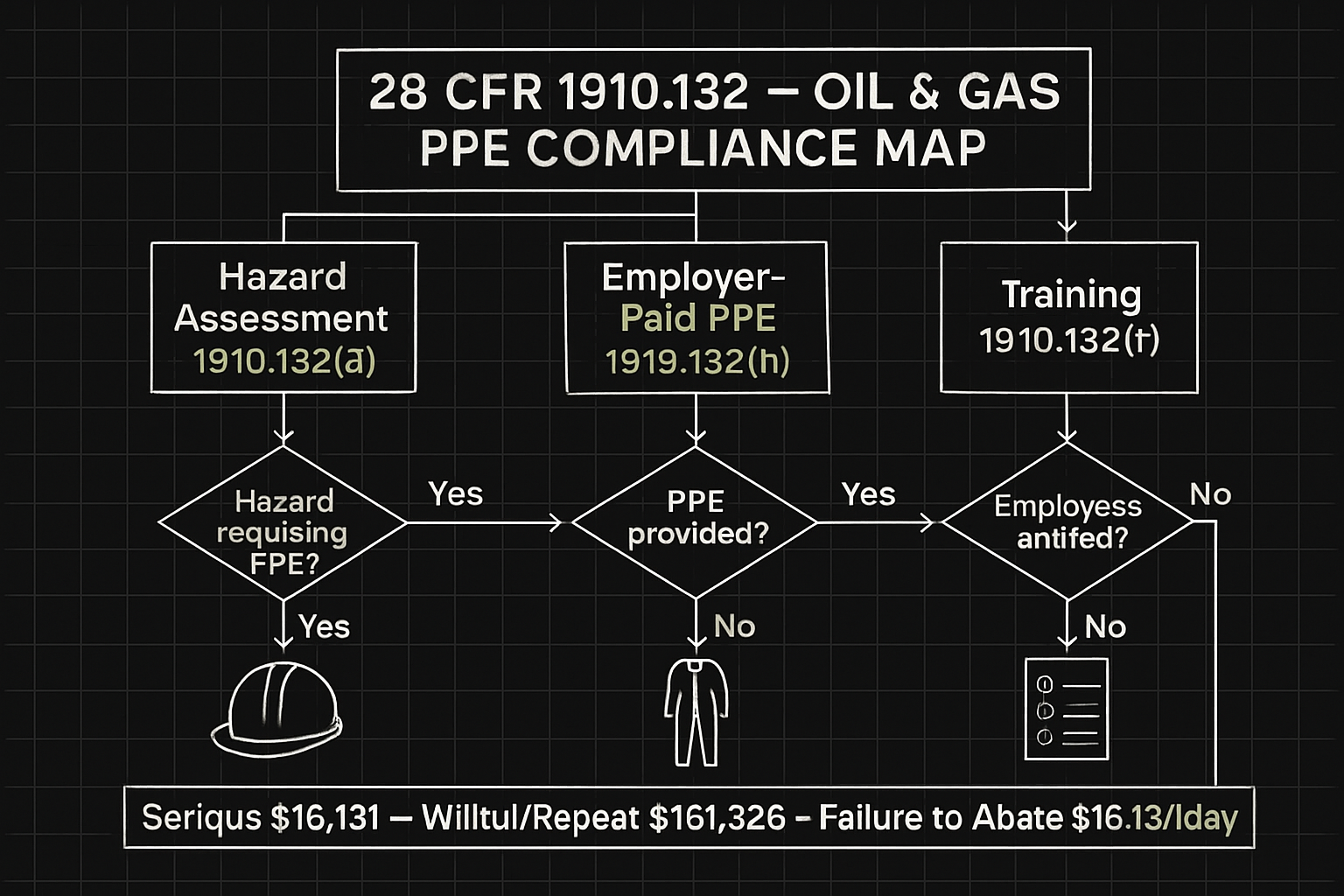
The standard at 29 CFR 1910.132 covers general requirements for PPE in general industry. For oil and gas upstream operations classified under general industry (not construction), this is your governing standard. Three subsections generate the overwhelming majority of citations in this vertical:
- 29 CFR 1910.132(d) — Hazard assessment and equipment selection
- 29 CFR 1910.132(h) — Payment for PPE (the employer-paid PPE rule)
- 29 CFR 1910.132(f) — Training
Notice what's not on that list: the hard hat itself, the gloves, or the FR rating. OSHA rarely cites an oil and gas contractor for wearing the wrong glove. They cite them for failing to document why that glove was selected, who paid for it, and whether the crew member was ever formally trained on its limitations.
The Hazard Assessment Failure OSHA Finds First
Under 29 CFR 1910.132(d)(1), every employer must assess the workplace to determine if hazards are present that necessitate the use of PPE. Under 29 CFR 1910.132(d)(2), that assessment must be certified in writing — a written document that identifies the workplace evaluated, the person certifying the evaluation, and the date.
Here's what the CSHO finds on the first document request at a drilling or well servicing operation: a copy-pasted generic hazard assessment that lists "eye hazards," "head hazards," and "foot hazards" with no reference to the specific location, equipment, or job tasks on that pad. Or worse — a hazard assessment that was completed for a single wellsite two years ago and has been reused across 47 subsequent locations without update.
On an active drilling rig, the hazard profile changes by phase. The hazards during spud are different from those during casing running, which are different from those during completion and stimulation operations. A derrickman working in the derrick at 90 feet faces fall arrest requirements and dropped object risks that don't appear in a static desk-written assessment. A cementer running through high-pressure flowback faces chemical splash exposures from cement additives and acid wash solutions that a generic assessment will never capture. A wireline operator working around explosive perforating guns faces hazards that most standard templates don't address at all.
The written certification requirement under 29 CFR 1910.132(d)(2) is non-negotiable. "We do it, we just don't have it documented" is not a defense — it's a serious violation at up to $16,131 per instance. If OSHA finds that the same deficient assessment was knowingly reused across multiple locations after a prior citation, that becomes a repeat or willful violation at up to $161,323 per instance.
The Employer-Paid PPE Rule That Oil & Gas Contractors Consistently Misread
The 2008 amendment to 29 CFR 1910.132(h) created an employer-paid PPE requirement that the upstream oil and gas industry has never fully digested. The rule is straightforward: with limited exceptions, the employer pays for required PPE. The exceptions that don't apply here are what contractors get wrong.
The most common misread in oilfield contracting: a well service contractor issues FR coveralls to floor hands at hire and deducts the cost from the first paycheck, or requires employees to purchase their own boots meeting ASTM F2413 to keep the job. Both are violations of 29 CFR 1910.132(h)(1). The exception under 29 CFR 1910.132(h)(2) for employee-owned PPE requires that the employee voluntarily provides their own equipment and that the employer does not make wearing that specific equipment a condition of employment.
In upstream oil and gas, where many floor hands, lease operators, and pipeline laborers are hired through staffing agencies or are short-term contract employees, the power dynamic makes "voluntary" a fiction that OSHA sees through immediately. When a CSHO reviews your onboarding paperwork and finds a clause stating employees are responsible for purchasing safety boots, FR clothing, or hard hats meeting specific standards — that's a citation waiting to be issued.
The exception that does apply — and that contractors under-use — is the exception for everyday clothing that an employee wears to and from work. But FR coveralls worn exclusively on a drilling floor do not qualify. Neither do specialty gloves required for H2S environments or metatarsal-guard boots required for working around tubulars and handling tongs.
The Counterintuitive Insight: FR Clothing and the PPE Payment Trap
Most safety managers at well service companies assume that because FR clothing is mandated by API RP 2218 or operator site requirements — rather than explicitly by an OSHA standard — it falls outside the employer-paid PPE rule. OSHA actually looks at whether the hazard that necessitates the FR clothing exists in the workplace, not whether a specific OSHA standard names that clothing.
If your hazard assessment (which you've completed and certified per 29 CFR 1910.132(d)) identifies flash fire and arc flash exposure for service rig floor crews, then FR coveralls are required PPE under 1910.132 — and the employer pays. It doesn't matter that OSHA didn't write an upstream-specific FR clothing standard. The general duty clause and 29 CFR 1910.132(h) close that gap. Operators who have been charging employees for FR gear on this theory are exposed.
The Training Requirement Nobody Takes Seriously
29 CFR 1910.132(f)(1) requires employers to train each employee who is required to use PPE to know: when PPE is necessary; what PPE is necessary; how to properly don, doff, adjust, and wear it; its limitations; and proper care, maintenance, useful life, and disposal.
On a drilling location with a 12-on/12-off rotation, with floor hands who may have been on location for 48 hours before any formal onboarding paperwork catches up with them, PPE training defaults to: "Here's your gear, watch your hands around the tongs, don't drop anything from the derrick." That is not training under 29 CFR 1910.132(f).
The specific failures OSHA documents in oil and gas PPE training citations:
- No documented training on H2S escape respirator donning for floor hands working in sour gas areas — a direct violation of 29 CFR 1910.132(f)(1)(ii) and 29 CFR 1910.134 cross-reference obligations
- FR coverall training that covers only "don't modify the garment" but never addresses the garment's arc thermal performance value (ATPV) rating or the specific ignition hazards it protects against
- No documentation of training completion per 29 CFR 1910.132(f)(4) — verbal briefings that no one can prove happened
- Failure to retrain when employees are transferred to a new hazard environment — a derrickman moved from a sweet gas well to an H2S-bearing formation is a different hazard profile requiring new PPE assessment and retraining
Per 29 CFR 1910.132(f)(3), if an employee demonstrates inadequate understanding of required training, retraining is required. On a drilling operation, if a CSHO interviews a floor hand and asks what the ATPV rating of their FR coverall protects against and the employee cannot answer — that is documentation of an inadequate training program, not just an uninformed employee.
State Plan Considerations for Oil & Gas Operations
In California (Cal/OSHA), upstream oil and gas operations fall under 8 CCR 3380 (Personal Protective Devices), which mirrors 29 CFR 1910.132 but adds specific provisions around heat illness prevention PPE integration that federal OSHA does not require at the same threshold. Cal/OSHA's enforcement posture on written hazard assessments has historically been more aggressive than federal enforcement. Operations in the San Joaquin Valley should treat their hazard assessments as litigation documents, not administrative checkboxes.
In Washington State, WAC 296-800-160 governs PPE requirements under the Washington Industrial Safety and Health Act (WISHA). Washington operators should note that L&I (Labor & Industries) inspectors apply the same written certification requirement and have cited pipeline maintenance contractors operating in the state for failure to update hazard assessments when crew compositions or task scopes changed.
What a CSHO Actually Looks At on Day One
A CSHO arriving at a drilling location under a programmed inspection or in response to an incident will pull three documents before they walk the location: the written hazard assessment certification, the PPE training records, and payroll or onboarding documents that show who paid for what PPE. Those three documents will tell them in 20 minutes whether your 29 CFR 1910.132 program is real or cosmetic.
If the hazard assessment is undated, covers a different location, or was authored by someone who has never been on a drilling floor, the CSHO notes it. If training records show completion dates but no trainer signature and no employee acknowledgment, the CSHO notes it. If onboarding paperwork has a line where the employee acknowledges they are responsible for providing ANSI Z87.1-compliant eye protection, the CSHO photographs it.
None of these are hard violations to avoid. They are administrative failures that compound under OSHA's instance-by-instance citation policy — meaning each employee without a compliant hazard assessment, each employee without documented training, is a separate violation at up to $16,131 each. On a 20-person drilling crew, a documentation failure becomes a $322,620 exposure before OSHA writes a single word about the physical conditions on the floor.
Frequently Asked Questions
We use a prequalification system like ISNetworld — doesn't that mean our PPE program has already been reviewed and approved?
No. ISNetworld, Avetta, and Veriforce review whether you have a written PPE program — they verify document existence, not OSHA compliance. A program that satisfies grading criteria in a contractor management system can still generate multiple OSHA citations. OSHA does not recognize third-party prequalification as evidence of compliance. The CSHO will request the underlying documents and evaluate them against the regulatory standard directly.
Our operator requires FR clothing on location. Does that mean we can say it's an operator requirement, not an OSHA requirement, and the employer-paid rule doesn't apply?
No. If a hazard exists at your worksite that requires FR clothing — flash fire exposure from hydrocarbon vapors, for example — then FR clothing is required PPE under 29 CFR 1910.132 regardless of who identified that requirement. The operator's site requirement doesn't create a loophole; it typically confirms the hazard exists. The employer-paid PPE obligation under 29 CFR 1910.132(h) applies.
We do a tailgate safety meeting every morning that covers PPE. Does that count as training under 29 CFR 1910.132(f)?
Only if the tailgate meeting covers all elements required under 29 CFR 1910.132(f)(1) — which includes when PPE is necessary, what PPE is necessary, how to properly don and doff it, its limitations, and its care and maintenance — and only if completion is documented with employee signatures and a record of what was covered. A verbal reminder to "keep your glasses on" during morning safety share does not meet the standard.
How often do we need to update the written hazard assessment?
29 CFR 1910.132(d) does not specify a mandatory frequency, but OSHA's enforcement position is that the assessment must reflect actual current conditions. For upstream oil and gas operations, this means updating when operations change phase (spud vs. completion vs. workover), when crew composition changes materially, when a new chemical or piece of equipment is introduced, or when a near-miss or incident reveals a hazard the prior assessment didn't capture. Annual reviews are a floor, not a ceiling, for drilling and completion operations.
We hire subcontractors who bring their own PPE. Are we still responsible for their compliance with 1910.132?
The host employer has exposure under the multi-employer worksite doctrine. If your subcontractor's employees are working in your controlled hazard environment and you are the controlling employer, OSHA can cite you for their PPE deficiencies if you knew or should have known of the noncompliance and had the ability to correct it. The hazard assessment requirement applies to the worksite — not just to your direct employees. Document your oversight process and your contractual obligations around PPE compliance explicitly.
A long-term employee wants to keep using their own boots and hard hat that they've had for years. Can we allow that?
Under 29 CFR 1910.132(h)(2), an employee may use their own PPE voluntarily, provided the employer ensures the PPE is adequate for the hazards and the employee's use of their own equipment is genuinely voluntary — not a condition of employment and not the result of an employer policy that discourages the employer from providing it. The employer also retains the obligation under 29 CFR 1910.132(d) to verify the equipment meets applicable standards. A hard hat past its manufacturer-recommended service life or a boot that no longer meets ASTM F2413 requirements is not compliant regardless of who owns it.
For contractors managing ISNetworld®, Avetta®, or Veriforce prequalification, EHS Inc provides fully managed OSHA compliance support. Book a free consultation at EHS Inc.