OSHA Recordkeeping Exemptions in Food Processing and Meatpacking: What Your 300 Log Obligation Actually Looks Like
Walk into a mid-size poultry deboning facility in Georgia or a red-meat slaughter operation in Nebraska, and you'll find the same pattern: a 300 log that's either pristine because nobody's updating it, or so incomplete that the OSHA Compliance Safety and Health Officer (CSHO) starts pulling incident reports before the opening conference coffee gets cold. The gap isn't ignorance of the regulation—it's a fundamental misread of what "partial exemption" means, compounded by supervisors who've decided that a first-aid kit visit doesn't need paperwork. This guide is about that gap, specifically in food processing and meatpacking, where the injury rates are among the highest in U.S. manufacturing and where OSHA's National Emphasis Programs (NEPs) have made these facilities a standing inspection priority.
Who Is Actually Exempt — and the Specific NAICS Codes That Matter
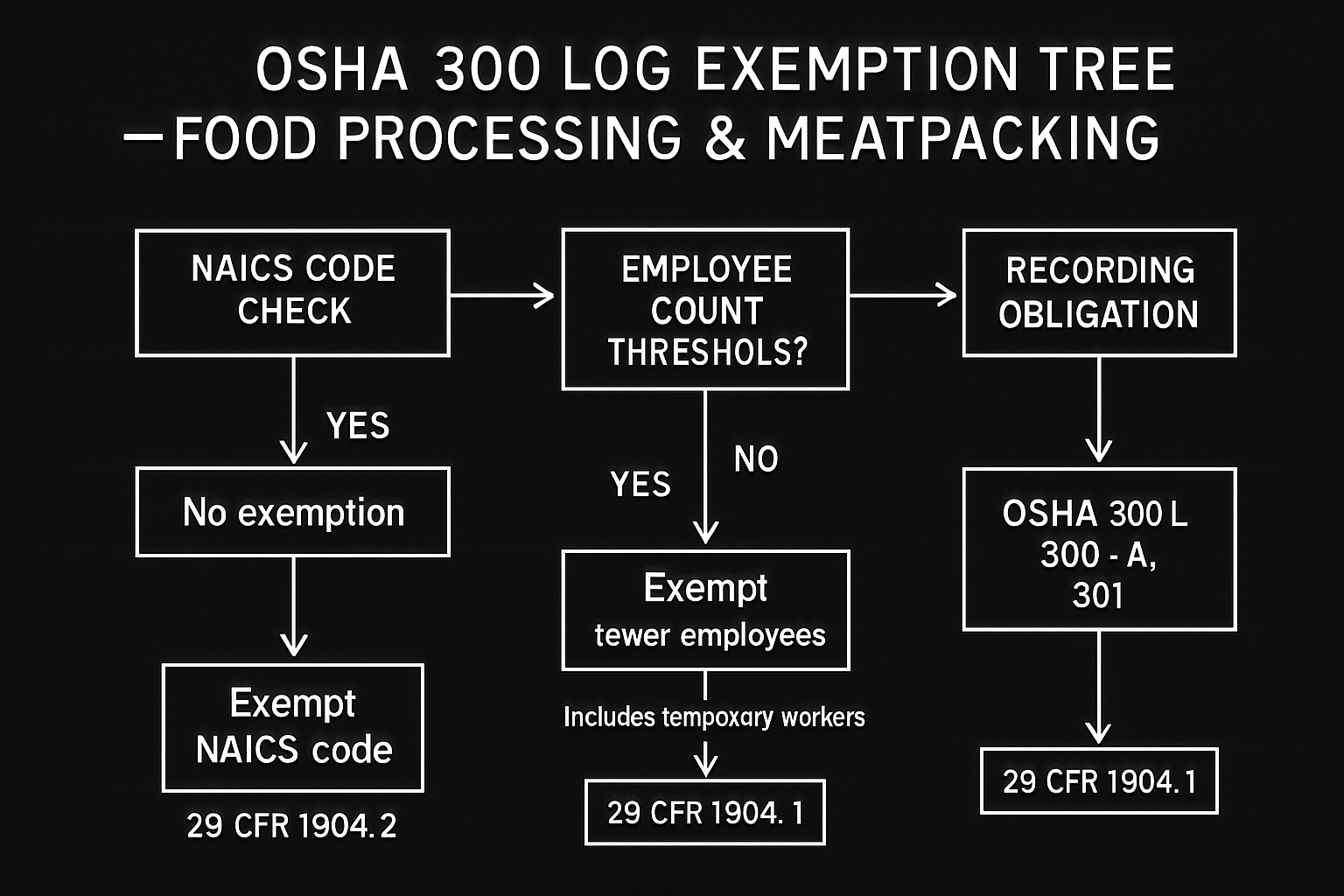
Under 29 CFR Part 1904, two thresholds trigger partial exemption from routine recordkeeping: employer size (10 or fewer employees at all times during the prior calendar year, per 29 CFR 1904.1) and low-hazard industry classification under 29 CFR 1904.2 and Appendix A to Subpart B.
Here's where food processing facilities routinely misread their own status. NAICS code 3116 (Animal Slaughtering and Processing) — which covers beef, pork, and poultry slaughter, further processing, and rendering — is not on the partially exempt low-hazard list. Neither is 3114 (Fruit and Vegetable Preserving and Specialty Food Manufacturing) or 3112 (Grain and Oilseed Milling). These are high-hazard classifications. Full recordkeeping applies under 29 CFR 1904.7 through 1904.29 regardless of size, unless the facility has 10 or fewer employees.
Where the confusion enters: some facility operators run a primary slaughter operation (NAICS 3116, non-exempt) alongside a small administrative office or a separate retail butcher counter they've classified under 4452 (Specialty Food Stores), which is on the partially exempt list. If your NAICS code is wrong — or if you're applying the retail exemption to production floor injuries — that's a recordkeeping violation before OSHA even looks at a single case.
What "Partial Exemption" Actually Means — and What It Does Not Mean
Partially exempt employers under 29 CFR 1904.1 or 1904.2 do not need to maintain the OSHA 300 Log, the 300-A Annual Summary, or the 301 Incident Report for routine recordkeeping purposes. That's the exemption. What the exemption does not cover:
- Reporting fatalities to OSHA within 8 hours — still required under 29 CFR 1904.39(a)(1)
- Reporting in-patient hospitalizations, amputations, or loss of an eye within 24 hours — still required under 29 CFR 1904.39(a)(2)
- Responding to an OSHA survey if selected — still required under 29 CFR 1904.41
- Cooperating with a CSHO who requests injury records during an inspection — still required under 29 CFR 1904.40
In a 12-person custom-exempt sausage manufacturing operation in rural Iowa, the owner who truly has fewer than 11 employees year-round legitimately skips the 300 log. But if seasonal staffing from a temp agency pushes headcount to 18 during peak production weeks, the size exemption under 29 CFR 1904.1 evaporates for that entire calendar year. Temp workers count. Leased workers whose day-to-day work is supervised by the host employer count. This is where small processors get caught — not by deliberate fraud, but because the HR manager running payroll and the EHS coordinator (often the same person) never compared notes at the start of hiring season.
The Gap Between the Written Program and the Floor — How It Develops in Meatpacking
The typical large meatpacking facility — think a beef fabrication plant running two shifts with 800 to 1,200 production employees — has a written recordkeeping procedure that reads well. It specifies that line supervisors complete a first notice of injury within 24 hours, that the safety manager reviews for recordability within 7 days, and that the 300 log is updated monthly. On paper, that's a defensible system.
Here's what happens on the floor at 2:00 AM on a Tuesday: a knife-trimmer on the chuck line takes a laceration to the left hand. The floor supervisor — who is 45 minutes into a staffing shortage and has three other positions to cover — tells the worker to go to the nurse's station, get it wrapped, and come back. The nurse applies steri-strips and a bandage. No lost time. The supervisor doesn't fill out the first notice because, in his experience, "first aid doesn't go on the log." He's not entirely wrong — but he hasn't evaluated whether the steri-strips cross into medical treatment beyond first aid under 29 CFR 1904.7(a), and he certainly hasn't considered whether the worker's work restriction starting the next day triggers recordability under 29 CFR 1904.7(b)(4).
Three months later, a CSHO arrives under the meatpacking NEP. The nurse's log shows 23 laceration visits over 90 days. The OSHA 300 shows 4 recorded lacerations. The CSHO doesn't need a calculator to know something is wrong. She asks for the workers' compensation first reports. She pulls the restricted duty assignment records from HR. She interviews the occupational health nurse directly — and the nurse, who has no stake in the safety department's numbers, describes the standard triage protocol accurately. That's how the gap gets found.
Counterintuitive Insight: The First-Aid Treatment Assumption
Most EHS managers assume OSHA's scrutiny on 300 log accuracy focuses on lost-time cases — the ones involving days away from work that are most visible. OSHA actually looks hardest at restricted work cases and medical treatment cases, because those are where under-recording is statistically most prevalent.
In food processing, "light duty" or "alternative duty" is used constantly — a line worker with a shoulder strain gets moved to label application or quality-control visual inspection. If that reassignment happens because of a work-related injury and lasts even one day, it's a Days of Job Transfer or Restriction (DJTR) case under 29 CFR 1904.7(b)(4)(i). It must be recorded on the 300 log with the transfer days counted. Facilities that run robust return-to-work programs — which is smart workers' comp management — inadvertently create 300 log exposure if their EHS team doesn't coordinate with HR on every single restricted assignment.
OSHA knows this pattern. In meatpacking inspections, CSHOs routinely cross-reference the alternative duty roster against the 300 log entries. If there are 40 people on light duty on a given day and the 300 log shows 15 active DJTR cases, the discrepancy is the opening of a recordkeeping citation under 29 CFR 1904.29(b)(1).
Penalty Exposure When Recordkeeping Breaks Down
A single unrecorded case that should appear on the 300 log is a serious violation — up to $16,131 per violation under 2024 OSHA penalty schedules. In a facility where 10 recordable cases are missing from the log, that's potential exposure of $161,310 before OSHA even begins calculating gravity-based penalties or evaluating willfulness.
Willful or repeat citations — which OSHA pursues when a prior inspection found recordkeeping violations and the employer failed to correct the systemic problem — run up to $161,323 per violation. A large meatpacking operation cited in 2021 for recordkeeping deficiencies that receives another inspection in 2024 and shows the same pattern of missing restricted-work entries is looking at repeat citation territory. Failure to abate a recordkeeping citation can add $16,131 per day from the abatement deadline forward.
These numbers matter because meatpacking facilities often argue that recordkeeping violations are "paperwork" and therefore minor. OSHA's position — supported by the courts — is that accurate injury data is a worker safety mechanism. Under-recording conceals hazard patterns, delays corrective action, and artificially suppresses an employer's Days Away, Restricted, or Transferred (DART) rate. That argument holds up in settlement negotiations and in front of the Occupational Safety and Health Review Commission.
State Plan Considerations for Food Processing Facilities
Food processing and meatpacking operations in California (Cal/OSHA), Washington (L&I), and Michigan (MIOSHA) face additional recordkeeping requirements that go beyond federal 29 CFR Part 1904.
In California, 8 CCR 14300 mirrors federal recordkeeping but Cal/OSHA's enforcement posture on recording accuracy in agricultural processing and meatpacking is more aggressive, and the state's Repetitive Motion Injury standard (8 CCR 5110) creates additional injury documentation obligations that feed into 300 log analysis. Washington's WAC 296-27 recordkeeping rules apply to all employers regardless of size for certain injury categories, closing the small-employer gap that federal rules leave open. Michigan's MIOSHA Part 11 recordkeeping rules include specific provisions on supervisor-level recording responsibilities that go further than the federal supervisor-training language.
If your facility operates across state lines — a common structure for large protein processors with plants in multiple states — your recordkeeping SOP must account for the most restrictive state requirements at each site, not a single federal standard applied uniformly.
FAQ: Recordkeeping Exemptions in Food Processing and Meatpacking
Our facility has 8 full-time employees but we use a staffing agency for production during busy season. Are we exempt from 300 log requirements?
Probably not during busy season. Under 29 CFR 1904.1, the 10-employee threshold is evaluated based on maximum employment at any point in the prior calendar year. Temporary and leased workers whose daily work is directed and supervised by your facility count toward that number. If seasonal staffing pushes you above 10 at any point, the exemption does not apply for that entire year — and you're responsible for recording injuries to those temp workers if your supervisors control their work.
We classified our facility under a retail NAICS code because we have a small on-site store. Does that exempt us from the 300 log?
The NAICS code used for recordkeeping purposes must reflect the primary business activity at the specific establishment. If the dominant activity is production — slaughter, fabrication, further processing — the production NAICS code applies, not the retail code. Misclassifying to obtain a partial exemption is a recordkeeping violation in itself and, depending on context, can be characterized as a willful violation.
An employee went to the ER and received stitches for a knife cut on the line. The doctor released them to full duty the same day. Is this recordable?
Yes. Stitches (sutures) are medical treatment beyond first aid under 29 CFR 1904.7(a), specifically excluded from the first-aid list at 29 CFR 1904.7(b)(5)(ii)(A). The fact that the employee returned to full duty without restriction does not change recordability. This case goes on the 300 log as a medical treatment case with zero days away and zero restricted days.
We have an occupational health nurse on site. Does that change the medical treatment analysis?
The provider's license does not change whether a treatment qualifies as medical treatment beyond first aid. The analysis is based on the nature of the treatment, not who administered it. If your on-site nurse applies prescription-strength topical medication, uses butterfly closures that function as sutures, or recommends work restriction — those actions trigger recordability analysis under 29 CFR 1904.7(b)(5) regardless of the nurse's scope of practice.
How far back can OSHA look at our 300 logs during an inspection?
Under 29 CFR 1904.33(a), employers must retain 300 logs, 300-A summaries, and 301 incident reports for five years following the end of the calendar year they cover. A CSHO arriving in 2024 can request logs going back to January 2019. All five years are fair game for recordkeeping citations, and OSHA will cross-reference those logs against workers' comp claims, medical records obtained through subpoena, and OSHA 300-A data submitted electronically under 29 CFR 1904.41.
We submitted our 300-A data electronically through OSHA's Injury Tracking Application. Does that trigger an inspection?
Electronic submission under 29 CFR 1904.41 feeds OSHA's data analysis system. Facilities with DART rates significantly above the industry average for their NAICS code, or with patterns suggesting under-recording (very low rates in a high-hazard classification), can be selected for programmed inspections. Submitting data is not itself an inspection trigger — but submitting data that looks anomalous for a meatpacking facility with 600 employees is a flag that analysts notice.
Final Word on the Gap
The 300 log accuracy problem in food processing is not primarily a knowledge problem. Facilities know they're supposed to record injuries. The failure is operational: the supervisor on the kill floor at 11 PM isn't thinking about DJTR case classification. The HR coordinator processing the restricted-duty assignment isn't looping in the safety manager. The occupational health nurse is documenting in a separate system that nobody reconciles against the 300 log monthly. Fix those handoffs — specifically, require a three-way review (safety, HR, and occupational health) within 72 hours of every reported injury — and the gap closes. Leave them as separate workflows, and the next CSHO who walks in will find the discrepancy before the opening conference ends.
For contractors managing ISNetworld®, Avetta®, or Veriforce prequalification, EHS Inc provides fully managed OSHA compliance support. Book a free consultation at EHS Inc.