OSHA Inspection Walkaround in Food Processing & Meatpacking Plants: What Inspectors Look at First, Who Can Accompany Them, and What You're Not Required to Provide
When a Compliance Safety and Health Officer (CSHO) walks through the employee entrance of a beef fabrication facility or a poultry evisceration line, they are not reading your written programs. They are reading your floor. The gap between what your LOTO program says on page 12 and what a sanitation crew lead actually does at 2 a.m. on a deboning line — that is exactly what a CSHO is trained to find. This guide is built around that gap.
Food processing and meatpacking have been OSHA enforcement priorities since the agency's enforcement targeting programs began. The industry sits at the intersection of high injury rates, high turnover, multilingual workforces, cold wet surfaces, rotating equipment, and chemical hazards — all under continuous production pressure. If you run an OSHA inspection program based on a binder you bought from a consultant in 2018, this article will tell you where it falls apart.
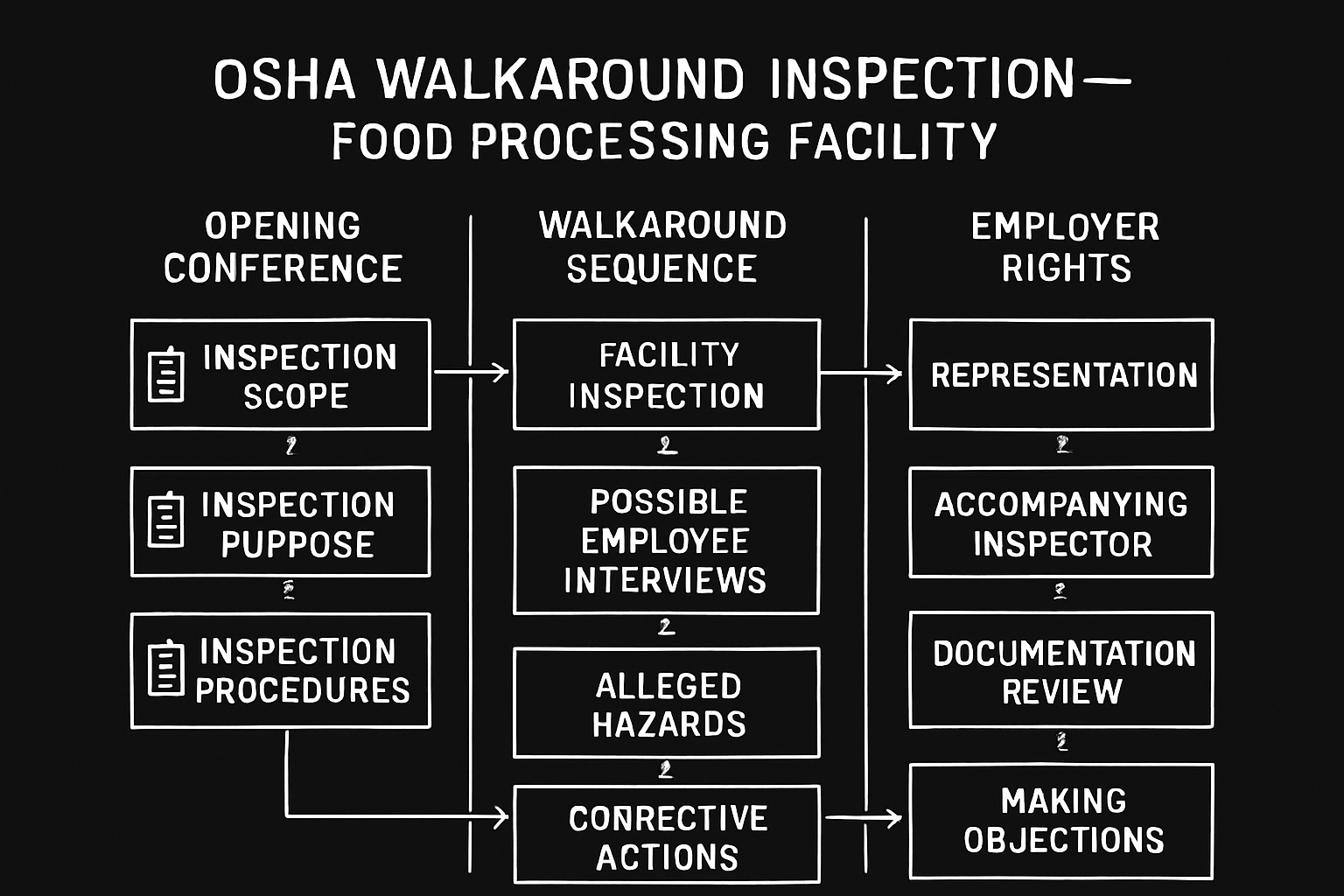
How the Walkaround Actually Begins: The Opening Conference and What Happens Before You Get to the Floor
Under 29 CFR 1903.7, the CSHO is required to present credentials and conduct an opening conference before beginning the physical inspection. During that conference, they will request your OSHA 300 logs for the current year and the preceding three years, your written programs, and your injury and illness records. You are not required to hand over anything beyond what the law specifies — more on that in a moment.
What experienced EHS managers miss: the opening conference is itself an inspection. The CSHO is watching how long it takes you to produce your OSHA 300 logs. If your EHS coordinator has to call three people and dig through a shared drive for twenty minutes, that tells the inspector your recordkeeping program is administrative theater. In a meatpacking facility with 600 production employees, your 300 log should be immediately accessible to any person responsible for compliance. If it is not, you have already started the inspection poorly.
CSHOs arriving at large processing facilities often conduct a records review before ever touching a hard hat. They are looking at your 300A summary, your 301 incident reports, and your workers' compensation first reports of injury — cross-referencing them for underrecording. OSHA's National Emphasis Program on Recordkeeping (NEP) has specifically targeted food processing facilities. A line supervisor marking a laceration from a boning knife as "first aid only" when the employee received stitches at an urgent care clinic is exactly the kind of discrepancy that turns a programmed inspection into a recordkeeping citation under 29 CFR 1904.7(a).
What Inspectors Are Required to Look at First During the Walkaround
There is no mandatory sequence written into the regulation. Under 29 CFR 1903.8, the CSHO conducts the walkaround "in a reasonable manner." In practice, inspectors in food processing and meatpacking follow patterns driven by the industry's historic hazard profile and OSHA's current emphasis programs.
In a beef processing or poultry facility, a CSHO will typically move toward the following areas within the first thirty minutes:
- Lockout/Tagout points on high-speed processing equipment. Chain-driven evisceration equipment, neck-breakers, and automated portion-control saws are exactly the equipment type identified in OSHA's Directive CPL 02-00-147 on LOTO. The inspector is not asking to see your written LOTO program. They are walking to an auger conveyor and asking the sanitation technician working near it to demonstrate the energy control procedure. If that technician cannot — or walks to the wrong disconnect — you have a serious violation under 29 CFR 1910.147(c)(6)(i) for failure to conduct the annual LOTO periodic inspection.
- Ammonium refrigeration systems. Facilities using anhydrous ammonia as a refrigerant are subject to both 29 CFR 1910.119 (Process Safety Management) if they hold 10,000 pounds or more, and EPA's RMP program. The CSHO will look at your P&IDs, ask your refrigeration engineer or ammonia operator to walk them through your pre-startup safety review records, and verify that your mechanical integrity inspections on vessels and piping are current. A missing or unsigned pre-startup safety review is a PSM citation — and PSM willful or repeat violations reach $161,323 per instance.
- Knife and blade handling on the cut floor. Cut-resistant glove programs are notoriously paper-compliant and floor-noncompliant. A CSHO will observe whether boning knife operators and trim table workers are actually wearing the gloves specified in your PPE hazard assessment. If the glove is rated ANSI A4 in your written assessment but workers are wearing A2 gloves because A4 gloves slow their cut rate, that is a 29 CFR 1910.138(a) violation and a 29 CFR 1910.132(d)(1) hazard assessment failure simultaneously.
- Wet floors, drainage, and walking surfaces near chilling tanks and ice equipment. Slip, trip, and fall hazards under 29 CFR 1910.22(a)(1) are among the most commonly cited violations in food processing. The CSHO will look at whether drains are functioning, whether anti-fatigue and anti-slip mats are present and in good repair, and whether floor markings are visible or have been worn off by forklift traffic.
Who Can Accompany the CSHO During the Walkaround
This is one of the most misunderstood sections of the inspection process, and it has real consequences in union and non-union plants alike.
Under 29 CFR 1903.8(a), an employer representative has the right to accompany the CSHO during the physical inspection. Under 29 CFR 1903.8(c), an employee representative — authorized by employees — also has the right to accompany the CSHO. In a unionized meatpacking facility, the union steward or a designated union safety representative typically fills this role. In a non-union plant, employees may designate a coworker. The CSHO has the authority under 29 CFR 1903.8(b) to consult privately with employees during the walkaround, separate from both the employer representative and any employee representative.
Here is where facilities make a costly mistake: some plant managers assign a plant manager or operations director as the employer representative — someone whose first instinct is to explain away everything the CSHO observes. The better choice is your most knowledgeable EHS professional, someone who can answer technical questions accurately without volunteering information that expands the scope of the inspection.
You may not instruct the employee representative on what to say or not say. Coaching or intimidating an employee representative before or during the walkaround is a potential 29 CFR 1903.8(c) violation and could constitute retaliation under Section 11(c) of the OSH Act — which carries separate legal exposure.
Contractors on-site at the time of an inspection occupy a gray zone. If a third-party sanitation contractor's crew is working when OSHA arrives, OSHA may inspect their work area and cite the host employer under the multi-employer citation policy if the host employer created or controlled the hazard. Do not assume that having a subcontract agreement transfers your liability.
What You Are Not Required to Provide
This section is where food processing EHS managers often give away more than they are legally obligated to provide — sometimes dramatically expanding the scope of an inspection that started narrow.
You are not required to provide:
- Documents outside the specific scope of the inspection. If the CSHO arrived on a complaint about a specific machine guarding issue on your cut floor, they are not automatically entitled to your entire chemical inventory, your confined space permit log, or your fleet safety program. Respond to what is requested. Do not produce binders of documentation to demonstrate cooperation — that documentation may reveal violations outside the original complaint scope.
- Voluntary access to areas outside the inspection scope. You may respectfully limit the walkaround to the area relevant to the triggering complaint or referral. If the CSHO attempts to expand into unrelated areas without an expanded warrant, you have the right to require an administrative subpoena or warrant under Marshall v. Barlow's, Inc., 436 U.S. 307 (1978). In practice, most employers consent to broader inspections — but the right to require a warrant exists and is sometimes strategically appropriate.
- Attorney-client privileged communications. If your legal counsel has audited your facility and produced a privileged report, you are not required to produce it. Consult your legal counsel before the inspection begins regarding which documents carry privilege protection.
- Real-time access to proprietary process formulations or trade secrets. Under 29 CFR 1903.9, trade secret information observed during an inspection must be kept confidential by the CSHO. You may assert trade secret protection during the inspection for specific proprietary formulations or processing data.
The Counterintuitive Truth About Written Programs in Food Processing Inspections
Most EHS managers assume OSHA's primary interest is whether a written program exists and whether it cites the correct CFR sections. OSHA is actually most interested in whether the program is used — and the fastest way to prove it is not used is to ask the people doing the work.
When a CSHO stops a dehairing machine operator or a can-line packaging technician and asks them to describe the hazards of their job and how they control them, they are not testing the employee — they are testing the program. If your Hazard Communication program says you conduct annual training in English and Spanish, and the CSHO finds three Somali-speaking employees on your trim table who have never seen a Safety Data Sheet and cannot identify the chemical name of the cleaning compound being applied six feet away, you have a 29 CFR 1910.1200(h)(1) training violation — regardless of what your sign-in sheets say.
That is the gap OSHA finds. The program exists. The training records exist. The floor does not match either one.
Penalty Exposure When the Gap Gets Cited
For 2024, OSHA's adjusted civil penalty maximums are:
- Serious violation: up to $16,131 per violation
- Willful or repeat violation: up to $161,323 per violation
- Failure to abate: up to $16,131 per day beyond the abatement deadline
In a large meatpacking or further-processing facility, a single OSHA inspection commonly produces 8–15 citations. If a prior inspection cited your LOTO program for the same 29 CFR 1910.147 deficiency and you have not materially corrected it, OSHA will reclassify it as a repeat violation — and $16,131 becomes $161,323. Repeat violations in food processing are not rare. They are the predictable result of facilities that update their written programs after citations without changing what actually happens during sanitation or changeover.
California's Division of Occupational Safety and Health (Cal/OSHA) operates under a stricter injury and illness prevention standard, 8 CCR 3203, which requires a documented, site-specific IIPP with specific hazard correction tracking. Washington State's WISHA (WAC 296-800) similarly requires documented hazard correction timelines that federal OSHA's written program standard does not mandate explicitly. If your facility operates in either state, a walkaround that finds undocumented hazard corrections on your IIPP is a citation under the state standard even if it would not be under federal 29 CFR 1910.132.
Frequently Asked Questions: OSHA Walkaround Inspections in Food Processing Plants
Can our plant manager tell the CSHO they cannot enter without a warrant?
Yes, under Marshall v. Barlow's, Inc. you have the constitutional right to require a warrant before consenting to an OSHA inspection. In practice, exercising this right delays the inspection by days to weeks and typically signals to the agency that the facility has something to protect — which can result in a broader warrant scope than the original complaint would have justified. Most food processing facilities consent to entry. The warrant option is most strategically relevant when the inspection is triggered by a broad referral and you have active litigation or known systemic violations you are still abating.
Our sanitation contractor runs the overnight cleaning shift. Are we responsible if OSHA cites them?
Under OSHA's multi-employer worksite policy, the host employer can be cited as the "controlling employer" if it has supervisory authority over the work area where the hazard exists — even if the workers are employed by the subcontractor. If your sanitation contractor's crew is using your confined spaces, your chemical storage areas, and your equipment lockout points, and your EHS team has not verified their compliance with your programs, you carry citation exposure. This is a known enforcement pattern in food processing, particularly on overnight sanitation shifts where EHS oversight is thinnest.
Do we have to let the CSHO photograph our production floor?
Under 29 CFR 1903.7(b), the CSHO has authority to take photographs as part of the inspection. You may assert trade secret concerns over specific process areas, in which case photographs of those areas must be treated as confidential under 29 CFR 1903.9. You cannot prohibit all photography on the floor. Your employer representative should accompany the CSHO during all photography and document what is photographed and when.
We train in English and Spanish. Is that enough for a multilingual workforce?
Only if those are the languages your employees actually comprehend. Under 29 CFR 1910.1200(h)(1), training must be conducted in a manner and language employees can understand. If your workforce includes Haitian Creole, Somali, Karen, or Burmese speakers — which is common in large poultry and pork processing facilities — and your training is only available in English and Spanish, you have a compliance gap regardless of what your training matrix shows. OSHA has cited food processing employers specifically on this basis. The standard is comprehension, not translation.
What happens if we find a hazard during the walkaround before the CSHO does?
Document it immediately and begin abatement. If you correct a hazard during the walkaround before the CSHO observes it, OSHA generally cannot cite it — though they may note the underlying program failure. Do not attempt to correct hazards in a way that is obvious or theatrical in front of the CSHO; it looks like consciousness of guilt and may prompt them to look harder at the surrounding program. If abatement cannot be completed during the walkaround, document your correction timeline and communicate it in writing during the closing conference.
Can employees refuse to speak with the CSHO during the walkaround?
Employees have the right to speak privately with the CSHO under 29 CFR 1903.8(b) and cannot be compelled by the employer to decline. You cannot instruct employees not to cooperate with OSHA interviews — doing so may constitute retaliation under OSH Act Section 11(c) and obstruction. Employees also have the right to decline to speak with the CSHO voluntarily, but that is the employee's choice to make, not yours. Your role is to not interfere.
Further Resources
Review OSHA's official guidance on inspection procedures and employer rights at the OSHA Inspections page on osha.gov.
This guide is provided for informational and compliance education purposes only and does not constitute legal advice. Consult qualified legal counsel regarding your specific inspection rights and obligations.
For contractors managing ISNetworld®, Avetta®, or Veriforce prequalification, EHS Inc provides fully managed OSHA compliance support. Book a free consultation at EHS Inc.