Trenching and Excavation Under 29 CFR 1926.652: The Paperwork Trail That Kills Industrial Maintenance and Millwright Contractors in OSHA Audits
A millwright crew gets called out to a chemical plant to replace a failed pump base. The job requires excavating around an underground piping network — nothing dramatic, maybe a 6-foot cut in disturbed soil. The crew foreman has done this a hundred times. They've got a backhoe operator, two millwrights, and a pipe fitter on the ground. They slope the walls, nobody gets hurt, and the job is done in two shifts.
Three weeks later, a CSHO (Compliance Safety and Health Officer) shows up at the site — not for this job, but for a separate incident involving a subcontractor. While walking the facility, the officer asks the safety coordinator to pull the excavation records from the pump replacement. What happens next is what this guide is about.
The violation isn't usually the slope angle. It's the documentation that proves the slope angle was intentional, defensible, and based on a classified soil type determined by a qualified competent person — in writing, before anyone went below grade.
What OSHA's Subpart P Framework Actually Requires — and Where Millwright Contractors Habitually Fall Short
The excavation standard lives in 29 CFR 1926 Subpart P. The specific requirements for protective systems are under 29 CFR 1926.652, but the competent person requirement is anchored at 29 CFR 1926.651(k)(1), and soil classification methodology is detailed in Appendix A to Subpart P. These aren't interchangeable — CSHOs distinguish between them on citations.
Here's how the framework stacks: before any worker enters an excavation deeper than 5 feet, a competent person must classify the soil using one of two accepted methods — visual and manual tests as outlined in Appendix A, or written documentation supporting an alternative protective system. For excavations of 20 feet or greater, a registered professional engineer must design the protective system under 29 CFR 1926.652(b)(1)(iv).
Industrial maintenance contractors almost never hit 20 feet. Their exposure is almost entirely in the 5-to-12-foot range — pump pits, manhole access, underground utility tie-ins, conduit runs under process slabs. That range is where enforcement activity concentrates, and it's where the documentation culture is the weakest.
Soil Classification: The Test Nobody Is Actually Performing on Paper
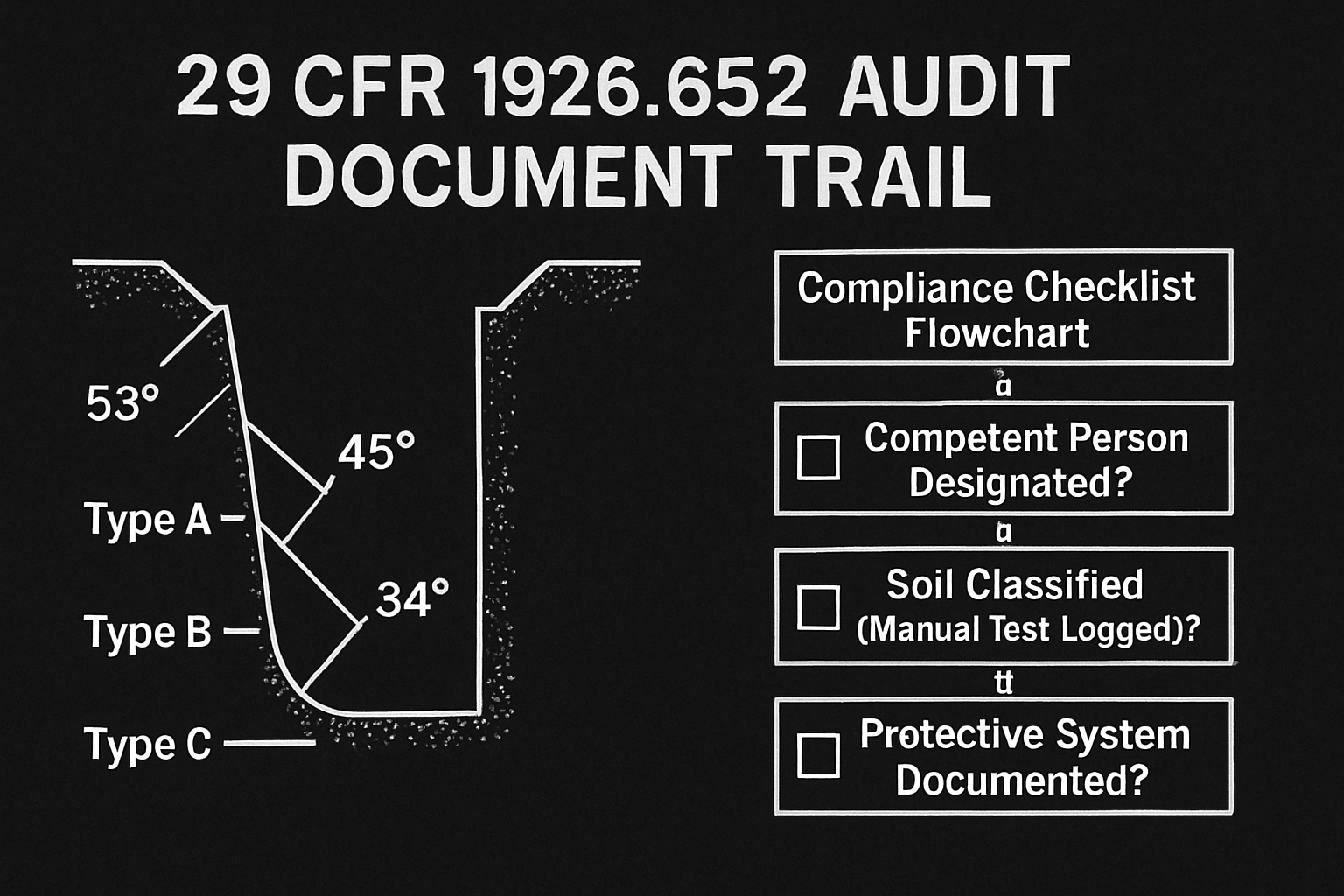
Appendix A to Subpart P defines four soil types: Stable Rock, Type A, Type B, and Type C. Most millwright foremen know intuitively that disturbed soil around a plant foundation is probably Type C — and they're usually right. But "usually right" and "documented with a manual test result" are two different things during an inspection.
The manual tests OSHA recognizes include the thumb penetration test, the pocket penetrometer, the Torvane shear device, and observational indicators like fissuring, layering, and moisture seepage. The visual test component includes checking for tension cracks, evidence of previous disturbance, and surface water conditions. None of this is complicated. All of it requires a written record tied to a named competent person and a specific date and location.
What CSHOs find in industrial maintenance contractor files — when files exist at all — is a daily safety checklist with a box checked that says "excavation inspected." That's not soil classification documentation. That's a trap. The checkbox proves the inspection happened; it proves nothing about the methodology used to select the protective system.
A proper soil classification log entry should include: date and time, exact location of the excavation (not just "pump pit #3" — grid coordinates or a sketch tied to the facility map), the specific manual tests performed and their results, the resulting soil classification (A, B, or C), and the name and signature of the competent person who made the determination. If conditions change — rain event, freeze-thaw cycle, nearby heavy equipment vibration from a crane or compaction roller — a new entry is required before workers re-enter.
The Competent Person Designation: Where the Paper Trail Dies Fastest
Under 29 CFR 1926.651(k)(1), the competent person must inspect excavations, adjacent areas, and protective systems daily and as conditions change. Under 29 CFR 1926.650(b), the definition of competent person includes the authority to take prompt corrective measures — including removing workers from the excavation — without approval from a supervisor.
In industrial maintenance and millwright contracting, the competent person is almost always the working foreman. That's legally defensible if the designation is documented. What's routinely missing:
- A written competent person designation on company letterhead, tied to the specific project or work order
- Training records showing the named individual completed formal excavation/trenching competent person training — not a toolbox talk, not a generic safety orientation
- Documentation that the designation was communicated to the host facility's safety coordinator (most owner-client ISNetworld® packages require this)
CSHOs ask for competent person designation on the first document request. If the answer is "that's our foreman, he knows what he's doing," the citation is already forming. The designation must exist before the excavation opens — not reconstructed after the fact.
Protective Systems: The Slope Calculation Nobody Writes Down
The three compliant protective system options under 29 CFR 1926.652(b) are sloping/benching, shoring, and shielding (trench boxes). Millwright contractors working inside active facilities almost always default to sloping when space permits, or trench boxes when it doesn't. Both are defensible. Neither is documented the way OSHA expects.
For sloping, Appendix B specifies maximum allowable angles: Type A soil allows a 3/4:1 (horizontal:vertical) slope; Type B requires 1:1; Type C requires 1½:1. If your competent person classified the soil as Type B and the as-built slope is 1:1, that's compliant — but only if the soil classification log exists to support the slope decision. Without the log, OSHA treats the slope as unsupported by documentation, and the citation defaults to the most conservative interpretation of conditions.
For trench boxes, the equipment must be rated for the soil load and excavation depth. The manufacturer's tabulated data or a PE stamp must be on-site under 29 CFR 1926.652(c)(1)(ii). Millwright crews often pull trench boxes from a rental yard with a delivery ticket and no data sheet. That delivery ticket is not the tabulated data OSHA requires. The rental company has the data — but someone has to request it, keep it, and bring it to the job site.
The Counterintuitive Finding That Surprises Even Experienced Safety Managers
Most safety managers assume OSHA's primary excavation exposure for millwright contractors is an unprotected trench — walls straight, no box, nobody slopes. That's the Hollywood version. In practice, the citations that generate the largest penalties and the most successful willful classifications aren't at unprotected excavations.
They're at excavations that have a trench box in place but no tabulated data on-site, and where the competent person cannot demonstrate they inspected the excavation that morning.
Here's why this matters for penalty exposure: an unprotected excavation with a verbal safety culture and no paperwork reads as a serious violation — up to $16,131 per instance. But a contractor who has been cited previously for missing tabulated data, corrected it on paper, and gets cited again? That's a repeat violation — up to $161,323 per instance. The trench box gives management the illusion of compliance while the paper gap creates willful or repeat exposure that a naked trench wouldn't generate on its own.
What a CSHO Sees in the First Ten Minutes of an Industrial Maintenance Site Visit
CSHOs who work industrial facility construction know the millwright/maintenance contractor profile. When they approach an active excavation on a refinery or chemical plant turnaround, the first documents requested are typically: the job hazard analysis (JHA) tied to the excavation task, the competent person designation, the soil classification log, the daily inspection record for that day, and the trench box or shoring tabulated data.
In turnaround environments, the millwright foreman is often managing three or four concurrent tasks — equipment alignment, piping tie-ins, and the excavation simultaneously. The excavation paperwork gets delegated to a crew leader who may not understand what "tabulated data" means. The CSHO knows this. They ask the crew leader — not the foreman — to produce the documents. What the crew leader reaches for tells the story.
If the crew leader reaches for a binder with a daily inspection form signed that morning, a soil classification log with specific test results, and a faxed data sheet from the trench box rental company — the inspection moves on. If the crew leader radios the foreman and the foreman says "we've got all that, let me go get it" — the inspection has found its target.
State Plan Jurisdictions: Stricter Requirements That Catch Traveling Millwright Contractors Off Guard
Several state plans impose requirements beyond federal Subpart P. Millwright contractors who work across multiple states on turnaround projects get caught by these routinely.
California (Cal/OSHA) — Under 8 CCR 1541.1 and associated appendices, Cal/OSHA requires additional documentation for any excavation adjacent to existing structures or underground utilities. The competent person requirement includes specific written authorization language that federal OSHA does not mandate explicitly. Cal/OSHA also requires utility location documentation ("potholing" or "daylighting" evidence) that must be in the file before excavation begins.
Washington (L&I) — Under WAC 296-155-657, Washington requires that the competent person document the basis for any deviation from Appendix B slopes in writing, with greater specificity than the federal standard's Appendix B allows. Traveling crews from non-plan states are frequently unaware of this requirement.
Michigan (MIOSHA) — Under MIOSHA Construction Safety Standard Part 9, Michigan's requirements mirror federal but are enforced with additional scrutiny around competent person training documentation — specifically, the training provider and curriculum must be documented, not just the training date.
The Audit-Ready Document Package Every Millwright Contractor Needs Before Breaking Ground
The following documents must exist before workers enter any excavation deeper than 5 feet. This is the package a CSHO expects to review within the first 30 minutes of an inspection:
- Written competent person designation — signed by management, project-specific or work order-specific, includes the individual's name, title, and the basis for their qualification
- Soil classification log — includes test methods used, results, resulting classification, date/time, location description or sketch, and competent person signature
- Daily inspection record — completed before workers enter each shift, includes conditions observed, any changes since last inspection, and corrective actions taken
- Protective system documentation — either slope calculations referenced to Appendix B (tied to soil classification), or trench box/shoring tabulated data from the manufacturer or PE
- Utility locate documentation — evidence that underground utilities were identified and marked, which feeds directly into the hazard section of the JHA
- Emergency response plan for the excavation — rescue equipment on-site, not "will call 911" — per 29 CFR 1926.651(g)(2), atmospheric testing and retrieval equipment requirements apply where applicable
Penalty Exposure Summary for Industrial Maintenance Contractors
To put the financial risk in concrete terms: a millwright contractor cited for three simultaneous serious violations — missing soil classification documentation, missing competent person designation, and missing trench box tabulated data — faces up to $48,393 in penalties on the first citation. If that same contractor was cited within the prior three years for excavation violations, all three become repeat violations, with exposure up to $483,969. These are not theoretical figures. They represent the penalty structure under the 2024 OSHA penalty table.
Failure to abate carries an additional $16,131 per day per violation from the date of the original citation if corrective action is not completed within the abatement period. For a contractor managing three open citations across a two-week abatement window, the daily accrual alone can exceed the original penalty total.
Frequently Asked Questions From Millwright and Industrial Maintenance Contractors
Our crew has been doing this for 20 years and nobody's been hurt. Does OSHA really cite for paperwork when the work is physically safe?
Yes — and this is where industrial maintenance contractors get blindsided. OSHA's excavation standard is a performance-based standard built on documentation. The physical condition of the excavation is evaluated against the documented basis for that condition. If a trench is properly sloped but there's no soil classification log proving the soil type that justified that slope, OSHA cites the missing documentation as a violation of the standard — not as evidence of an unsafe condition. The injury record is irrelevant to the citation; it's relevant only to penalty mitigation during informal conference.
The plant we're working at has its own safety team on-site. Does their inspection substitute for our competent person inspection?
No. The competent person requirement under 29 CFR 1926.651(k)(1) belongs to the employer whose workers are in the excavation. The host facility's safety team may have their own inspection obligations under their own safety management system or OSHA's multi-employer citation policy, but their inspection does not satisfy your obligation. If your millwrights are in the excavation, your competent person must have conducted and documented the inspection for that shift.
We rented a trench box. The rental yard gave us a delivery ticket. Is that sufficient documentation?
A delivery ticket is not tabulated data. Under 29 CFR 1926.652(c)(1)(ii), the manufacturer's tabulated data or a PE-stamped design must be on-site. Call the rental company, request the manufacturer's data sheet for the specific box model and size you rented, and keep it in your job site file. Most rental companies have this available immediately — the failure is almost always in requesting it, not in its existence.
How often does the competent person actually have to inspect the excavation?
Under 29 CFR 1926.651(k)(1), the competent person must inspect the excavation prior to the start of work, as needed throughout the shift, and after any event that could affect conditions — rain, freeze-thaw, nearby heavy equipment operation (a crane pick adjacent to the excavation counts), or any indication of change in soil behavior. "Once in the morning" is not compliant if a crane is picking equipment within 50 feet of the excavation all afternoon. Each condition change requires a re-inspection and a log entry.
We're working in a plant where the utility lines aren't accurately mapped. What's our obligation before we dig?
Under 29 CFR 1926.651(b)(1), the employer must contact utility companies or owners to determine the location of underground utilities before excavation begins. "The plant's maps are wrong" is not a defense — it's an explanation of why the hazard exists, not a justification for proceeding without verification. Hydrovac excavation (potholing) to visually confirm utility locations is the accepted industry practice in congested industrial environments. The fact that you potholed and found discrepancies should be documented; it shows due diligence rather than indifference.
What's the most common first citation OSHA issues on a millwright contractor's excavation job?
Based on OSHA enforcement data and inspection experience, the most common first citation in this vertical is failure to have a competent person designation in writing — specifically 29 CFR 1926.651(k)(1) combined with the Subpart P competent person definition at 29 CFR 1926.650(b). It's cited as serious, it's easy to document from the CSHO's perspective, and it immediately opens the door to questioning every other aspect of the excavation program. Fix this first. Everything else in the paperwork package flows from whether you can name, on paper, who your competent person is and why.
For the full federal excavation standard, visit the OSHA 29 CFR 1926.652 standard page on osha.gov.
This guide is provided for informational purposes only and does not constitute legal advice. Specific compliance questions should be directed to a qualified EHS professional or legal counsel familiar with your jurisdiction and operations.
For contractors managing ISNetworld®, Avetta®, or Veriforce prequalification, EHS Inc provides fully managed OSHA compliance support. Book a free consultation at EHS Inc.