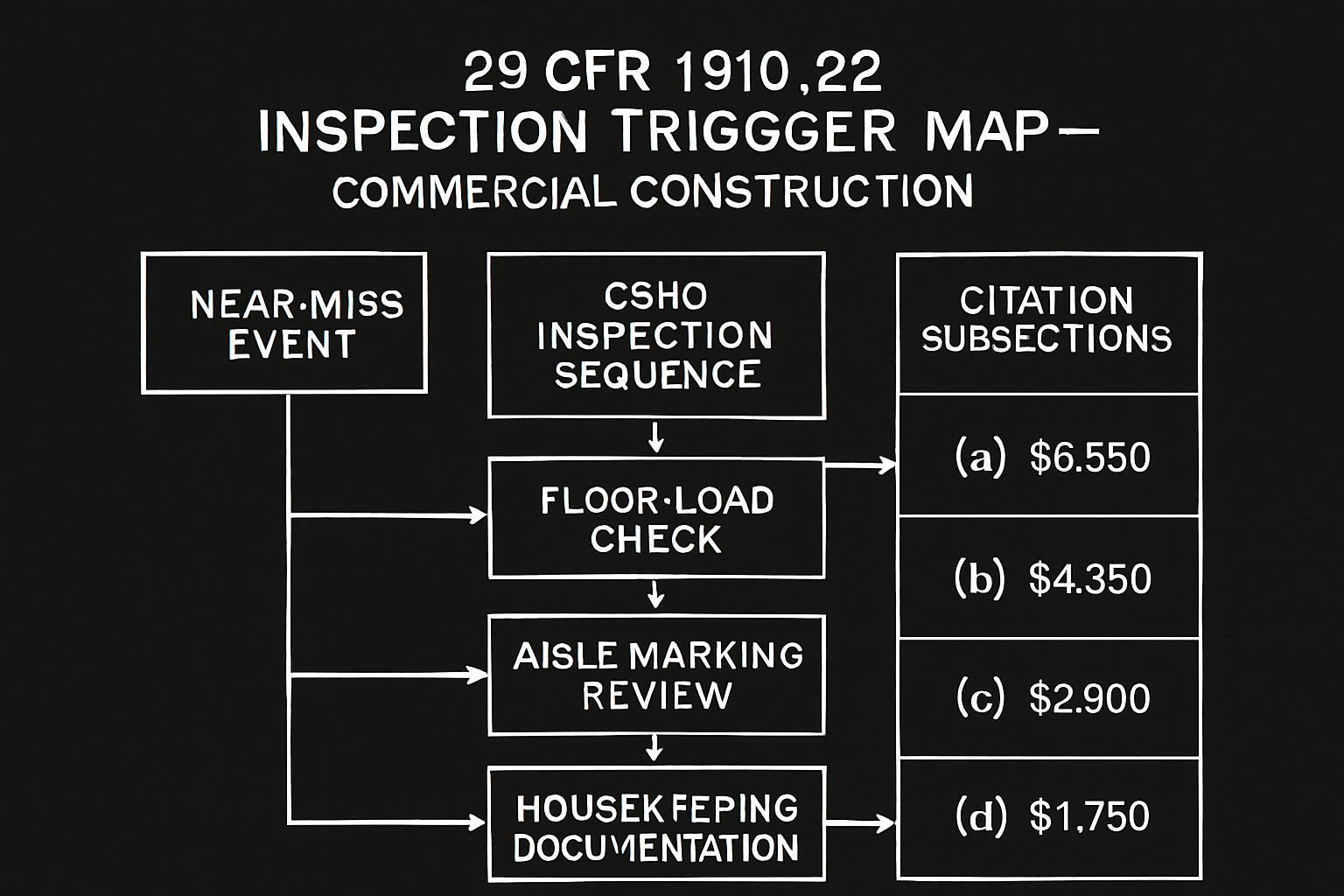
Walking and Working Surfaces 29 CFR 1910.22: Housekeeping, Floor Load Ratings, and Aisle Markings for Commercial Construction GCs and Subcontractors
Here's how it usually starts: a drywall mechanic trips over a coil of extension cord running across a temporary construction corridor on the third floor of a mid-rise office build. He catches himself on a stud wall — no fall, no recordable. The superintendent fills out a near-miss report, probably thinks that's the end of it. Then someone reports it to OSHA, or the incident shows up in a subcontractor's injury and illness log during a prequalification audit, and suddenly a Compliance Safety and Health Officer (CSHO) is standing in your site trailer asking for your walking and working surfaces program.
That CSHO isn't there to write up the extension cord. They're there to look at everything — and 29 CFR 1910.22 is one of the first standards they open on their laptop. What they find in the next two hours determines whether you walk away with a letter or a citation stack that runs five figures per item.
This guide breaks down exactly what 29 CFR 1910.22 requires, why commercial construction sites fail it repeatedly, and what the inspection playbook looks like from the moment the CSHO badges in.
Why 29 CFR 1910.22 Applies to Commercial Construction Job Sites
General contractors and subcontractors operating in commercial construction often assume 29 CFR 1910 — the General Industry standards — don't apply to them. That assumption costs money. OSHA's construction standard at 29 CFR 1926 Subpart X covers walking and working surfaces for construction activities, but 29 CFR 1910.22 is routinely cited when a commercial construction site has established a fixed or semi-permanent work area: a job site office, a materials staging warehouse, a tool crib, or a permanent-structure floor being used for laydown. If the space functions like a workplace, OSHA treats it like one.
Additionally, many commercial GCs operate in owner-controlled or contractor-controlled insurance programs (OCIPs/CCIPs) where the owner's facility has general industry obligations running concurrently. When your ironworkers and mechanical subs are working in and around an operating facility — a hospital expansion, a data center fit-out, a university building renovation — 1910.22 is squarely in play.
What 29 CFR 1910.22 Actually Requires: The Specific Subsections That Get Cited
The standard lives at 29 CFR 1910.22 on OSHA.gov and covers four operational areas. Each one has a specific subsection. Inspectors don't cite "1910.22" — they cite the subsection. Know the difference before a CSHO does.
29 CFR 1910.22(a) — Housekeeping. The standard requires that all places of employment, passageways, storerooms, service rooms, and walking and working surfaces be kept clean, orderly, and in a sanitary condition. The word "orderly" is doing a lot of work here. It's not just about swept floors — it's about whether materials are stacked and secured, whether cords and hoses create tripping hazards, and whether scrap and debris are accumulating in egress paths.
29 CFR 1910.22(b) — Floor loading protection. Every floor must be maintained in a condition to support the load imposed on it, and loads must not exceed the rated floor load capacity posted for that floor. The standard also requires that where a load limit is posted, the employer must ensure the maximum safe load is not exceeded.
29 CFR 1910.22(c) — Aisles and passageways. Aisles and passageways must be kept clear and in good repair, with no obstructions that could create a hazard. Where mechanical handling equipment — forklifts, pallet jacks, scissor lifts — is used, sufficient clearance must be maintained for the safe passage of both equipment and personnel.
29 CFR 1910.22(d) — Covers and guardrails. Floor holes and open pits must be guarded by covers or guardrails. This overlaps with 29 CFR 1910.23 (hole covers and guardrails) and is frequently cited in tandem.
The Near-Miss Investigation: What the CSHO Actually Looks At First
When a CSHO arrives following a reported near-miss or injury on a commercial construction site, their opening walk-through is not random. Experienced inspectors follow a pattern, and understanding it is the difference between a prepared safety manager and a reactive one.
First, they photograph the injury location and the immediate path to it. For a trip incident, that means every foot of the corridor between where the drywall mechanic started walking and where he went down. They're looking for the predictable failure modes: extension cords taped loosely across walkways, drywall scraps pushed to the side rather than removed, pneumatic hose coils, open buckets of joint compound, drop cloths bunched at edges.
Second, they look up — literally. Overhead storage on temporary shelving, material stacked against stud walls above head height, lumber leaning against framed partitions. All of this feeds into housekeeping citations under 29 CFR 1910.22(a) and, if the floor loading is relevant, into 29 CFR 1910.22(b).
Third, they ask for documentation. Not your safety program binder — your floor load ratings, your posted load limits, and your aisle marking records. This is where most GCs lose ground fast.
Floor Load Ratings: The Violation Nobody Sees Coming Until It's Too Late
Commercial construction staging floors are routinely loaded beyond their rated capacity, and almost nobody tracks it systematically. Here's what happens on a typical six-story office build: the concrete flatwork is poured for the third floor, the structural engineer assigns a rated load, and that information lives in the structural drawings — which are in the project engineer's trailer, not posted anywhere near the floor.
Meanwhile, the masonry sub's foreman decides to stage 40 pallets of CMU block on the third floor because it's convenient for the next day's pour. A pallet of CMU block weighs roughly 3,000 pounds. Forty pallets is 120,000 pounds of point-loaded material on a floor that may be rated for a fraction of that in concentrated loads. No one posted the load limit. No one checked the structural drawings. No one told the foreman.
Under 29 CFR 1910.22(b), the obligation is explicit: the load limit must be posted on the floor, and loads must not exceed it. A serious citation here runs up to $16,131 per violation. If OSHA determines the GC knew about the overloading and permitted it anyway — or if there's a prior citation on record — that becomes a willful or repeat violation at up to $161,323 per violation.
The structural engineer on your project can provide rated load data. Get it in writing, post it in the staging area, and make it part of your subcontractor coordination meeting agenda before any materials hit that floor.
Aisle Markings: What the Standard Requires and What Construction Sites Actually Do
Most safety managers on commercial construction projects assume aisle marking is a warehouse concern — yellow paint on a warehouse floor, forklift lanes, that sort of thing. That assumption is wrong, and experienced inspectors know it.
Under 29 CFR 1910.22(c), any area where mechanical handling equipment operates alongside foot traffic requires defined, maintained clearances. On a commercial construction site, this includes: interior scissor lift operation on slab floors, telehandler operations inside a building envelope, rough terrain forklift movement through a site laydown yard adjacent to pedestrian paths, and pallet jack operations in material staging corridors.
The standard doesn't mandate yellow paint specifically — it requires that aisles be "adequately marked." On a construction site, this can mean painted lines, temporary tape, traffic cones with rope barriers, or signage. What it cannot mean is nothing. A CSHO who sees a Skyjack 3219 rolling across a concrete slab in a building where electricians and pipe fitters are also working, with no defined pedestrian corridor and no markings separating foot traffic from equipment travel, has the basis for a citation.
Counterintuitive insight: Most safety managers assume aisle marking violations are about the marking itself — the color, the width, the material. But OSHA actually looks for whether the marking is maintained under working conditions. A painted aisle line that gets covered by drywall dust, debris accumulation, or plywood sheets within 48 hours of being applied is functionally the same as no marking at all. The CSHO photographs what exists on the day of the inspection, not what was installed two weeks ago. Maintenance of the marking — not just its initial application — is what drives compliance.
State Plan Variations GCs Operating in California, Washington, and Michigan Need to Know
California's Division of Occupational Safety and Health (Cal/OSHA) enforces Title 8 CCR Section 3273, which mirrors federal 1910.22 but adds specific requirements for the frequency of housekeeping inspections — supervisors in California must conduct documented inspections of walking surfaces at defined intervals in high-hazard construction environments. Cal/OSHA penalty structures also differ: serious violations can reach $25,000 per violation under California law, significantly exceeding the federal threshold.
Washington State (L&I / WISHA) enforces WAC 296-800-310, which incorporates the federal general housekeeping standard but applies it through Washington's General Safety and Health Standards. Washington inspectors have historically been aggressive about floor loading documentation on mixed-use construction/operations sites.
Michigan OSHA (MIOSHA) enforces General Industry Safety Standard Part 2, which tracks federal 1910.22 but includes additional guidance on aisle width minimums for specific equipment classes — relevant for Michigan contractors operating scissor lifts and telehandlers inside building envelopes during fit-out work.
What a Compliant Commercial Construction Site Actually Looks Like
Compliance under 1910.22 on a commercial construction job site has four operational components that must run simultaneously:
Daily housekeeping accountability by trade. The GC's superintendent assigns housekeeping responsibility by zone and by trade at the morning huddle. Each sub's foreman signs off on their area before the crew leaves for the day. This isn't a suggestion in the safety plan — it's a line item on the daily sign-in sheet. When a CSHO asks who is responsible for the third-floor corridor, someone has a name and a signature.
Structural load data posted before staging begins. Before any sub stages materials on a floor, the project engineer provides written rated load capacity for that slab. That document goes to the GC superintendent, who posts it at the staging entrance and communicates it to the sub's foreman in writing — email, text, or safety communication log. The foreman signs acknowledgment.
Aisle markings installed and maintained by the GC as common-area responsibility. In pedestrian-equipment shared zones, the GC — not individual subs — owns the marking. Temporary paint or tape is applied, photographed, and logged. Maintenance inspection occurs no less than weekly, or after any activity that could compromise the marking (concrete grinding, heavy debris accumulation, equipment travel over the line).
Near-miss reports drive a walking surface inspection, not just an incident report. Every near-miss that involves a slip, trip, or fall potential triggers a same-day walking surface inspection by the GC superintendent and the affected sub's safety representative. The inspection is documented on a form that references 1910.22(a), (b), and (c) by subsection. This documentation demonstrates due diligence if OSHA arrives later.
Frequently Asked Questions: 29 CFR 1910.22 for Commercial Construction Contractors
Does 29 CFR 1910.22 apply to my construction project, or is that a general industry standard?
Federal OSHA applies 1910.22 when a construction site has established areas that function as general industry workplaces — permanent or semi-permanent staging areas, tool cribs, site offices with adjacent walking surfaces, or work being performed inside an operating facility. If your project involves any of these conditions, 1910.22 is in play alongside the construction standards in 29 CFR 1926 Subpart X. OSHA CSHOs routinely cite both in the same inspection.
Who is responsible for aisle marking on a multi-employer construction site — the GC or the sub?
Under OSHA's multi-employer citation policy, the GC as the controlling employer is responsible for common-area walking surfaces, including aisle markings in shared corridors and equipment travel zones. Individual subcontractors are responsible for their own work areas. However, if a sub's operations create a hazard — a pipe fitter running a hose across a marked aisle — that sub can be cited as the creating employer even if the GC is also cited as the controlling employer. Both citations can be issued simultaneously.
What documentation do I actually need to demonstrate floor load compliance under 1910.22(b)?
You need: the structural engineer's written rated load capacity for each floor being used as a staging area, documentation that the load limit was communicated to each subcontractor supervisor staging materials on that floor, photographic evidence that the load limit is posted at or near the staging area entrance, and records showing that actual staged loads were calculated and compared to the rating before materials were placed. A load ticket or staging plan signed by the sub's foreman and the GC superintendent is strong supporting documentation.
How does OSHA calculate penalties if multiple violations of 1910.22 are found in one inspection?
OSHA calculates each violation separately. A single inspection can produce multiple 1910.22 citations — one for housekeeping under (a), one for floor loading under (b), one for aisle markings under (c) — each carrying up to $16,131 for a serious classification. If the employer has prior citations for the same standard within the past five years, those become repeat violations at up to $161,323 each. Failure to abate a cited condition after the abatement deadline adds up to $16,131 per day per violation. A mid-size GC with three 1910.22 serious violations, one repeat, and a 10-day abatement failure can be looking at a six-figure penalty from a single inspection.
Can a near-miss that wasn't reported to OSHA still trigger an inspection?
Yes. OSHA receives referrals from multiple sources: workers, worker representatives, other contractors on site, building owners, and insurance carriers. A near-miss logged in your own injury and illness records can surface during a programmed inspection or a records audit. In states with mandatory near-miss reporting requirements — California is moving in this direction — the report itself can trigger follow-up. Treating every near-miss as a potential inspection trigger is the only operationally safe assumption.
What's the single fastest thing I can do today to reduce 1910.22 exposure on an active project?
Walk every floor being used for staging or corridor travel with your phone camera and photograph the current condition. Document what you find. Then assign a named person — your superintendent, your site safety representative — to a weekly 1910.22 compliance walk with a signed checklist. The existence of that documented inspection program, even if it catches violations and corrects them, demonstrates good faith to a CSHO and typically reduces penalty severity classifications during settlement negotiations.
For contractors managing ISNetworld®, Avetta®, or Veriforce prequalification, EHS Inc provides fully managed OSHA compliance support. Book a free consultation at EHS Inc.