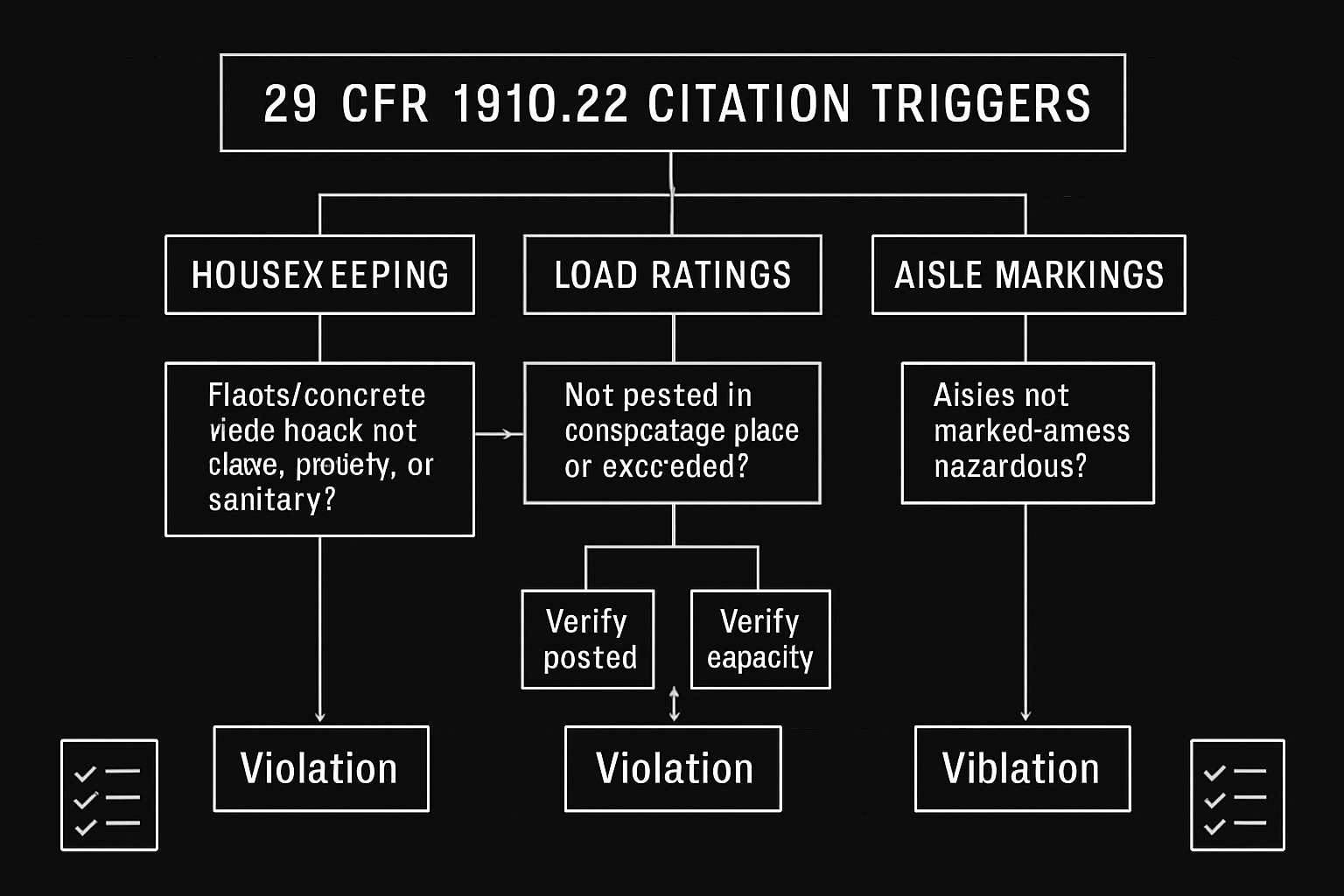
29 CFR 1910.22 Walking-Working Surfaces: Housekeeping, Load Ratings, and the Specific Conditions That Trigger Citations
Of all the general industry standards OSHA enforces, 29 CFR 1910.22 generates a disproportionate share of citations — not because it's complex, but because it governs conditions that supervisors walk past every day without acting. This guide takes a narrow, enforcement-focused look at how OSHA compliance officers use 1910.22 to issue citations in warehousing and distribution operations: a sector where foot traffic is constant, load capacities are routinely ignored, and housekeeping violations are often treated as cosmetic rather than regulatory failures.
This is not a broad overview of fall protection. This is a breakdown of the specific clause language, the specific observable conditions that constitute violations, and the documentation practices that separate compliant facilities from cited ones.
What 29 CFR 1910.22 Actually Requires — and What Most Facilities Miss
The standard at 29 CFR 1910.22(a) establishes four baseline requirements that apply to all walking-working surfaces in general industry:
- 29 CFR 1910.22(a)(1) — All walking-working surfaces must be kept in good repair.
- 29 CFR 1910.22(a)(2) — Surfaces must be kept clean and orderly and in a sanitary condition.
- 29 CFR 1910.22(a)(3) — Every floor, working place, and passageway must be kept free from protruding nails, splinters, holes, or loose boards.
- 29 CFR 1910.22(b)(1) — Where mechanical handling equipment is used, aisles and passageways must be kept sufficiently clear and marked as appropriate.
Most facility managers focus on (a)(1) — the physical condition of the floor — while underweighting (a)(2), which is where OSHA compliance officers write the most citations in distribution centers. "Clean and orderly" is not a subjective standard. OSHA interprets it to mean free from slip, trip, and fall hazards at all times during operations, not just after end-of-shift cleanup.
The Housekeeping Citation Trigger: What OSHA Officers Are Actually Documenting
During a programmed inspection at a mid-sized fulfillment center (50–300 employees), a compliance officer arriving unannounced will photograph the floor condition as it exists during active operations — not after a cleanup crew has passed through. The citation is built on what's present during the work shift, not what could be cleaned up in 20 minutes.
Specific conditions that directly support a 29 CFR 1910.22(a)(2) citation in a warehouse environment:
- Stretch wrap film, banding straps, or pallet boards accumulating in aisle lanes or near dock doors
- Spilled liquids from damaged product that have not been immediately addressed and marked
- Cardboard buildup at packing stations that extends into the walking path
- Unattended hand trucks or pallet jacks partially blocking marked egress routes
- Product overhang from racking that has fallen to floor level and not been removed
The key enforcement word in OSHA guidance is immediately. The agency does not require that spills never occur — it requires that response protocols exist and are executed. A facility without a written housekeeping inspection log for aisle conditions is far more vulnerable to a citation than one with documented, time-stamped walkthroughs showing corrective action. That log doesn't guarantee compliance, but its absence is routinely noted in OSHA inspection reports as evidence that the employer lacked a system for maintaining the standard.
Load Ratings Under 29 CFR 1910.22(d): The Most Overlooked Clause in Warehousing
29 CFR 1910.22(d)(1) requires that the maximum safe load limits of floors within a building or other structure be posted in all storage areas. This is one of the least-enforced clauses until something fails — and then it becomes central to OSHA's citation strategy and any associated fatality investigation.
The standard states: "The maximum safe load limits of floors within a building or other structure, in pounds per square foot, shall be conspicuously posted in all storage areas, except when the storage area is on a floor or slab on grade."
That final exception — "slab on grade" — is where facilities routinely make errors. Many warehouse managers assume that because their building sits on a concrete slab poured directly on the ground, they are exempt from posting load ratings entirely. This is partially correct for the floor itself, but it does not exempt elevated structures within that space. Specifically:
- Mezzanine storage platforms above slab-on-grade floors require posted load ratings under 29 CFR 1910.22(d)(1)
- Elevated dock leveler platforms with permanent storage use require load rating documentation
- Racking systems with upper-tier storage accessible by personnel (not just forklift) may be subject to this requirement depending on state plan interpretation
In California — which operates under Cal/OSHA (a state plan more stringent than federal OSHA in several provisions) — 8 CCR 3221 extends load rating posting requirements to include permanent racking structures with a rated capacity and requires engineering documentation to be available on-site, not merely posted. A California warehouse cited under federal 1910.22(d)(1) may face additional penalties under 8 CCR 3221 if engineering records cannot be produced during an inspection.
The Aisle Marking Requirement and When It Becomes a Citation
Under 29 CFR 1910.22(b)(2), where mechanical handling equipment is used, aisles and passageways must be kept appropriately marked. OSHA does not mandate a specific color or width for aisle markings in the general industry standard — but once a facility has established marked aisles, the failure to maintain those markings becomes a citable condition under both 29 CFR 1910.22(b)(2) and 29 CFR 1910.22(a)(1).
A concrete failure scenario: A 180-employee regional grocery distribution facility uses yellow floor striping to delineate pedestrian walkways from forklift travel lanes throughout its 300,000 sq ft floor. Over 18 months of forklift traffic, the markings in four high-traffic intersections have worn to near-invisibility. A compliance officer conducting a follow-up inspection — triggered by a forklift-pedestrian near-miss incident report — photographs the worn markings and issues citations under both clauses. The "willful" classification is applied because the employer's own pre-shift inspection form, produced during the inspection, had documented the worn markings six weeks prior with no corrective action recorded.
That last detail — a documented known hazard with no corrective action — is the single most reliable path from a "serious" citation to a "willful" classification, which carries penalties up to $156,259 per violation as of current OSHA penalty schedules.
Documentation Practices That Directly Reduce Citation Exposure
Compliance under 29 CFR 1910.22 is almost entirely a documentation and corrective-action problem, not a knowledge problem. Employers already know floors should be clean and load ratings should be posted. What creates vulnerability is the absence of a system that proves ongoing compliance. Effective practices include:
- Time-stamped housekeeping inspection logs — conducted at minimum once per shift, signed by a supervisor, with corrective actions noted and closed
- Load rating postings that are laminated and mounted at every storage area entrance, not taped to walls where they can be removed or obscured
- Aisle marking condition as a line item on pre-shift forklift inspection forms — not a separate program, but embedded in existing equipment checks
- Engineering documentation for mezzanines — the original stamped drawings or a current engineer's letter confirming rated capacity, kept on-site and retrievable within minutes of an OSHA officer's request
Relevant OSHA Resource
The full text of the standard, including all amendments from the 2017 Walking-Working Surfaces final rule, is available directly from OSHA: OSHA Walking-Working Surfaces Standard (29 CFR 1910 Subpart D).
Frequently Asked Questions: 29 CFR 1910.22 in Warehousing
Does the slab-on-grade exception in 29 CFR 1910.22(d)(1) apply to mezzanines inside a warehouse?
No. The exception under 29 CFR 1910.22(d)(1) applies only to floors that are literally on grade — meaning poured directly on the ground. Any elevated structure, including mezzanines, raised storage platforms, or elevated pick modules inside a warehouse, requires conspicuous posting of maximum safe load limits regardless of the building's overall floor type.
How does OSHA define "clean and orderly" under 29 CFR 1910.22(a)(2)?
OSHA does not provide a specific numerical or measurable definition in the standard's text, but enforcement guidance and citation history establish that "clean and orderly" means free from slip, trip, and fall hazards during active work operations — not only at the end of a shift. Hazards that exist at any point during a work shift and are not immediately addressed constitute a violation of 29 CFR 1910.22(a)(2).
If a forklift driver blocks a marked aisle temporarily while loading, does that violate 29 CFR 1910.22(b)(2)?
Temporary operational obstruction of a marked aisle is evaluated by OSHA in the context of frequency, duration, and whether alternate safe pedestrian access was maintained. A single brief blockage during an active loading sequence is unlikely to generate a standalone citation. However, systematic aisle obstruction as part of normal operations — particularly in facilities where pedestrians and forklifts share space — creates citation exposure under both 29 CFR 1910.22(b)(1) and 29 CFR 1910.22(b)(2).
Can a facility be cited under 29 CFR 1910.22 if no injury has occurred?
Yes. OSHA compliance officers issue citations based on the existence of a hazardous condition, not on whether that condition has caused an injury. The citation standard under the OSH Act is whether a condition creates a recognized hazard that is causing or likely to cause serious physical harm. An injury is not a prerequisite for a citation under 29 CFR 1910.22 or any other OSHA standard.
What's the difference between a "serious" and "willful" citation for a housekeeping violation under 1910.22?
A "serious" citation applies when OSHA determines the employer knew or should have known of the hazard. A "willful" citation — carrying significantly higher penalties — applies when OSHA has evidence the employer was aware of the hazard and made no effort to correct it. In practice, this distinction often comes down to what the employer's own records show. A housekeeping inspection form that documents a hazard without any recorded corrective action is one of the most common sources of evidence used to support a willful classification under 29 CFR 1910.22.
For contractors managing ISNetworld®, Avetta®, or Veriforce prequalification, EHS Inc provides fully managed OSHA compliance support. Book a free consultation at EHS Inc.