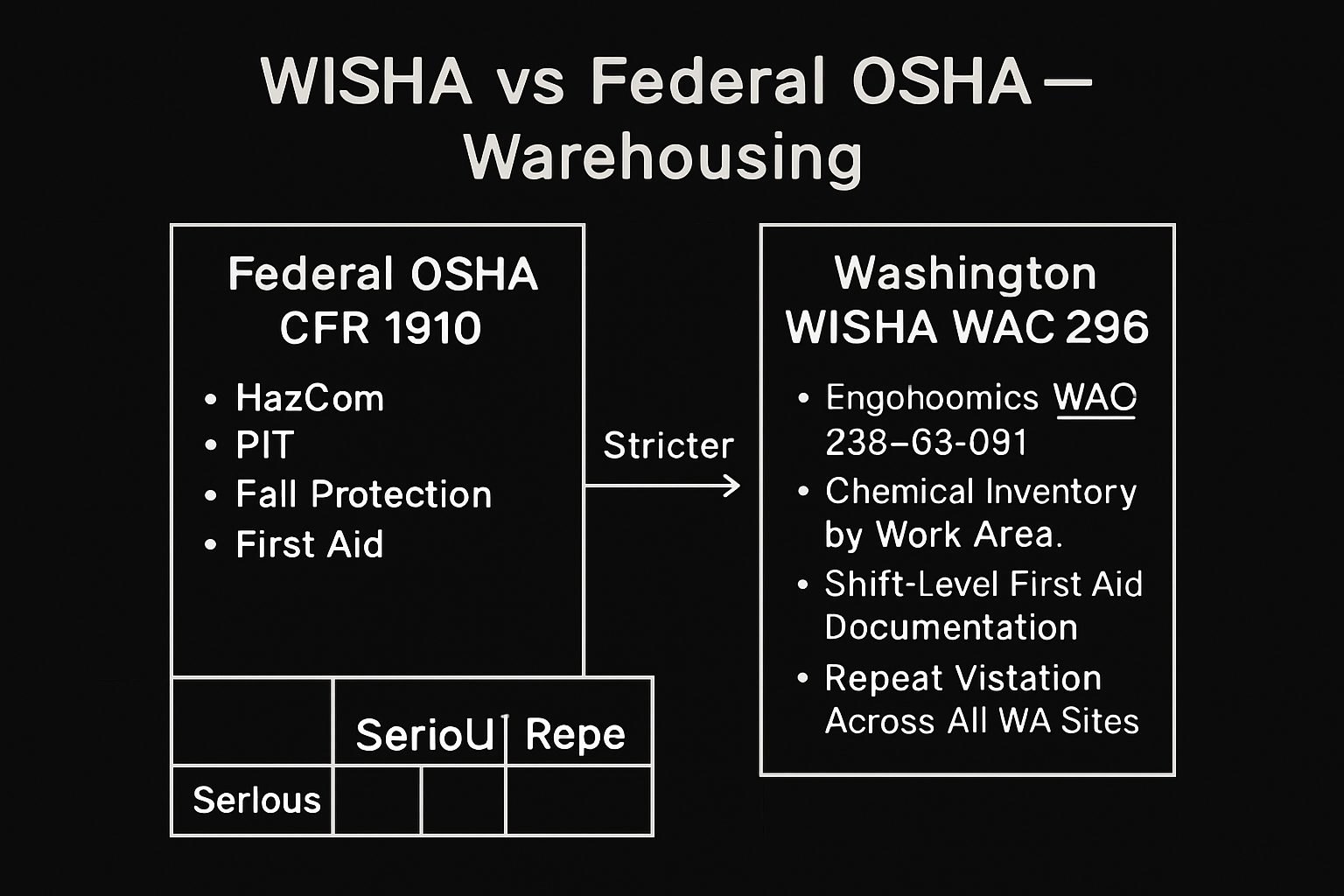
Washington WISHA vs Federal OSHA: Where State Safety Rules Are Stricter in Warehousing and Distribution
When a Washington State Department of Labor & Industries (L&I) Compliance Safety and Health Officer walks into your fulfillment center in Kent, Sumner, or Spokane Valley, they are not running the same checklist a federal OSHA CSHO would use in an Ohio distribution center. Washington operates under the Washington Industrial Safety and Health Act (WISHA), a state plan approved under Section 18 of the OSH Act. That means the state can adopt standards that are at least as effective as federal OSHA — and in several areas that hit warehousing and 3PL operations hard, Washington has gone considerably further. What follows is what those differences look like on the warehouse floor, what a CSHO scans for in the first fifteen minutes of an inspection, and where the citation exposure is highest.
How the First 15 Minutes of a WA L&I Inspection Play Out in a Fulfillment Center
A CSHO does not head for the safety office first. They walk the dock. In a high-velocity fulfillment center running two or three inbound shifts, the receiving dock is where the physical pressure of throughput meets the compressed space of trailer spotting, powered industrial truck (PIT) traffic, and pedestrian flow. The officer is watching the dock plate — specifically whether dock levelers are being used with trailers that aren't chocked and whether forklift operators are entering trailers before a vehicle restraint or wheel chock is confirmed. Under WAC 296-807-250, Washington's powered industrial trucks standard, the chocking and restraint requirements are enforced with a specificity that mirrors federal 29 CFR 1910.178(k)(1) but is supported by L&I's published enforcement guidance that treats unsecured trailer entry as an imminent danger scenario — not just a serious violation.
After the dock, the CSHO pulls the injury log (OSHA 300) and asks the safety manager — or whoever has been handed the job of "safety coordinator" this quarter — for the last 12 months of incident data. They're cross-referencing fork truck pedestrian near-misses, PIT tip-overs, and any musculoskeletal injury involving order selectors or pick-pack associates. That last category leads directly into Washington's ergonomics standard, which federal OSHA does not have.
WAC 296-62-051: Washington's Ergonomics Rule and Why It Hits Fulfillment Centers Differently Than Any Other Standard
This is the single biggest structural divergence between Washington and federal OSHA for warehouse and distribution employers. Federal OSHA has no enforceable ergonomics standard — the general duty clause (Section 5(a)(1)) is occasionally used for egregious cases, but it is not a systematic enforcement tool. Washington's ergonomics rule at WAC 296-62-051 is an enforceable standard with specific employer obligations.
Under WAC 296-62-051, if your employees perform "caution zone jobs" — defined as tasks requiring more than two hours per shift of heavy lifting (≥75 lbs), lifting more than 10 lbs with the hands below the knees or above mid-chest, or working in a bent/twisted posture — you are required to implement an ergonomics program that includes hazard identification, employee involvement, and hazard reduction. For a fulfillment center running a manual depalletizing line, a returns processing station, or a high-cube pick module where order selectors are pulling from floor-level locations for four or more hours, this is not a hypothetical risk. It is a daily operational reality.
A CSHO conducting an ergonomics-focused inspection will time-study the depal station. They will watch a receiver breaking down a mixed-SKU pallet of 50 lb. cases from a floor-level entry. They will document hand positions, trunk flexion, and shift duration before they write a single word on a citation form. Employers who have never mapped their caution zone jobs — meaning they have not done a formal WAC 296-62-051 job analysis — are citing themselves. The penalty for a serious violation under Washington state is up to $7,000 per violation for general serious and up to $70,000 for willful or repeat violations (Washington L&I penalty structure as of 2024). Federal serious violations run up to $16,131 per violation; willful or repeat up to $161,323 per violation under 2024 OSHA penalty adjustments. The ergonomics exposure under WISHA is separate from and additive to any federal general duty exposure.
Most EHS managers assume the ergonomics rule only applies if someone has already filed an MSD claim — but Washington L&I can cite a facility proactively for failing to identify caution zone jobs, even with a clean injury log. The standard is process-based, not outcome-based. A zero-recordable-rate facility with an undocumented manual depal operation is still in violation of WAC 296-62-051.
WAC 296-24-14501: Washington's First Aid and Emergency Medical Response Requirements
Federal OSHA's first aid standard at 29 CFR 1910.151(b) requires that in the absence of an infirmary, clinic, or hospital near the worksite, a person trained in first aid must be available. Washington's WAC 296-24-14501 goes further. Washington requires that a first aid kit meeting specific ANSI/ISEA Z308.1 standards be maintained and inspected, and that the adequacy of first aid provisions be assessed against the specific hazards of the operation — not just the headcount. For a 600,000 sq. ft. fulfillment center running three shifts with 400+ associates on peak days, "a person trained in first aid must be available" is the floor, not the ceiling. L&I will ask for documentation showing who is trained, what shift coverage looks like, and whether training is current. AED placement and inspection logs are also reviewed — not because Washington has a standalone AED standard, but because L&I applies the general safety and health standard at WAC 296-800-150 to require employers to address foreseeable emergency medical scenarios, and a high-exertion warehouse environment makes cardiac events a foreseeable hazard.
WAC 296-155-477: Elevated Work Platforms and Mezzanine Fall Protection in High-Bay Distribution Centers
Washington's construction standards do not apply to warehousing operations, but L&I applies WAC 296-155-477 and the general industry fall protection standard at WAC 296-24-88010 to mezzanine work platforms, pick modules, and elevated conveyor maintenance access points that are common in automated fulfillment facilities. Federal OSHA requires fall protection at 4 feet in general industry under 29 CFR 1910.28(b). Washington mirrors this threshold but enforces it with additional scrutiny on equipment that straddles the line between fixed facility infrastructure and temporary work positioning — specifically, elevated order-picker platforms used by reach truck operators and the guardrail systems on battery charging mezzanines.
The CSHO will walk the mezzanine on the battery charging deck. They are looking for self-closing gates at ladder access points (WAC 296-24-88010(4)), adequate toe boards, and whether the guardrail was built to resist a 200 lb. outward or downward force per WAC 296-24-88014. Reach truck operators on elevated platforms are also covered under WAC 296-807, and L&I has cited 3PL employers for failing to treat the operator restraint system (lap bar or restraint belt) on a stand-up reach truck as a required component of the fall protection system when operating at height.
WAC 296-62-07521: Washington's Chemical Hazard Communication and SDS Requirements Exceed HazCom 2012
Washington adopted the GHS-aligned Hazard Communication standard, but L&I's enforcement of WAC 296-62-07521 includes specific requirements around written hazard communication programs that must identify hazardous chemicals used at the facility by work area — not just a facility-wide list. In a distribution center that handles consumer goods including aerosols, lithium battery-powered products, pool chemicals, pesticides, and cleaning concentrates (all common SKUs in general merchandise 3PL operations), the chemical inventory list must be current and location-specific. A CSHO will ask for the written HazCom program and then walk to the janitorial closet and the battery room. If the chemicals there are not on the inventory and the SDS binder does not cover them, that is a citation under WAC 296-62-07521(2) regardless of whether the federal HazCom standard at 29 CFR 1910.1200(e)(1) would have been technically satisfied by a broader program document.
Washington Penalty Structure vs. Federal OSHA: What the Numbers Mean for a 3PL Operator
Washington L&I and federal OSHA use different penalty calculation methodologies. Federal OSHA uses a gravity-based penalty system with multipliers for history, size, and good faith, producing serious violation penalties up to $16,131 and willful/repeat penalties up to $161,323 per violation (2024 figures). Failure to abate a cited hazard costs up to $16,131 per day under federal authority. Washington L&I calculates penalties using a base penalty table tied to the classification (general, serious, or willful) and then applies modifiers for history and size. A large 3PL operator — defined by L&I as an employer with more than 250 employees — does not receive a size reduction credit. Multi-site 3PL operators with Washington facilities should treat every L&I inspection as a repeat-violation risk because L&I considers a violation to be a repeat if the same condition exists at any Washington facility operated by the same employer — not just the same location.
Practical Compliance Differences: What 3PL Safety Managers in Washington Need to Operationalize
The operational differences between WISHA compliance and federal OSHA compliance in warehousing come down to four program elements that federal OSHA does not require in the same form:
- Caution Zone Job Analysis under WAC 296-62-051 — document every high-repetition manual material handling task, assign MSD risk levels, and maintain a written ergonomics program. This is not optional once your operation has order selectors, depalletizers, or returns processors.
- Shift-Specific First Aid Coverage Documentation under WAC 296-24-14501 — name the trained individuals per shift in writing. "We have a certified person on days" is not sufficient if the night inbound crew does not have coverage documented.
- Work Area-Specific Chemical Inventories under WAC 296-62-07521 — your SDS binder and written HazCom program must map hazardous chemicals to locations, not just list them by facility.
- PIT Pre-Shift Inspection Records and Remediation Logs under WAC 296-807-14020 — Washington enforces the documentation requirement on forklift inspection records with the same intensity as federal 29 CFR 1910.178(q)(7), but L&I will also ask whether deficiencies noted on inspection forms were actually removed from service. Forklifts with documented brake or steering deficiencies that were still in operation the same day are willful violation candidates.
FAQ: Washington WISHA vs Federal OSHA for Warehouse and Distribution Employers
Does Washington's ergonomics rule apply to temporary or seasonal warehouse workers placed through a staffing agency?
Yes. Under WAC 296-62-051, the host employer controls the work conditions and is responsible for ensuring caution zone jobs are identified and controlled — regardless of whether the worker is on the host employer's payroll or a staffing agency's payroll. Washington L&I's "host employer" doctrine, consistent with the federal OSHA multi-employer worksite policy, places primary ergonomics compliance responsibility on the 3PL or fulfillment center operator who directs the work.
If our corporate safety program was built to federal OSHA standards, what's the fastest gap to close before an L&I inspection?
The written ergonomics program under WAC 296-62-051 is the most common gap because federal OSHA has no equivalent. If your operation includes any manual depalletizing, high-cube picking below knee height, or sustained trunk-flexed sortation work, you need a caution zone job analysis before the next L&I visit. That documentation gap is also the most difficult to explain away under questioning because the standard's language is explicit about what triggers the program requirement.
Our facility is in Sumner, WA but our corporate safety director is in Texas. Who is responsible for WISHA compliance?
Washington L&I will cite the Washington facility and its operating entity. The corporate structure does not insulate the Washington operation from citation, and it does not prevent L&I from treating violations as willful if corporate policies were known to be deficient and no corrective action was taken. The Washington facility's general manager and site safety coordinator are the individuals a CSHO will want to speak with — and their knowledge of WISHA-specific requirements will be assessed during the opening conference.
Does Washington L&I accept OSHA 10 or OSHA 30 cards as proof of safety training compliance?
OSHA 10 and OSHA 30 cards are not a safe harbor under WISHA. Washington requires that training be specific to the hazards of the job and the equipment used. A forklift operator's OSHA 30 card does not substitute for a documented PIT operator evaluation under WAC 296-807-14016, which requires evaluation of the operator on the specific type(s) of truck they will operate in the facility's specific operating conditions. L&I will ask to see the operator evaluation form, the evaluator's name, and the date — not a course completion certificate.
Can Washington L&I inspect a warehouse that has never had a complaint or reported injury?
Yes. Washington L&I conducts programmed inspections of high-hazard industries, and warehousing and storage (NAICS 493) is on their targeting list. A CSHO can walk in without a complaint, referral, or fatality. These programmed inspections are often more thorough than complaint-driven inspections because the officer is not constrained to a specific hazard and can document conditions across the entire facility. Operators in the Puget Sound and I-5 corridor industrial markets should treat the absence of a prior inspection as a liability, not a clearance.
Is Washington's penalty for a willful violation actually higher than federal OSHA's?
For large employers, federal OSHA's willful/repeat penalty ceiling of $161,323 per violation (2024) typically exceeds Washington L&I's willful maximum of $70,000 per violation. However, Washington's multi-violation grouping rules and the state's approach to repeat violations across an employer's Washington facilities can produce aggregate citation amounts that rival or exceed federal exposure — especially in multi-facility 3PL operations with systemic program deficiencies. The more meaningful risk in Washington is often the repeat classification, which Washington L&I applies more broadly than federal OSHA's same-establishment rule.
For authoritative reference, review the federal OSHA powered industrial trucks standard at 29 CFR 1910.178 alongside Washington's WAC 296-807 to understand where the two frameworks align and diverge on forklift safety in distribution environments.
For contractors managing ISNetworld®, Avetta®, or Veriforce prequalification, EHS Inc provides fully managed OSHA compliance support. Book a free consultation at EHS Inc.